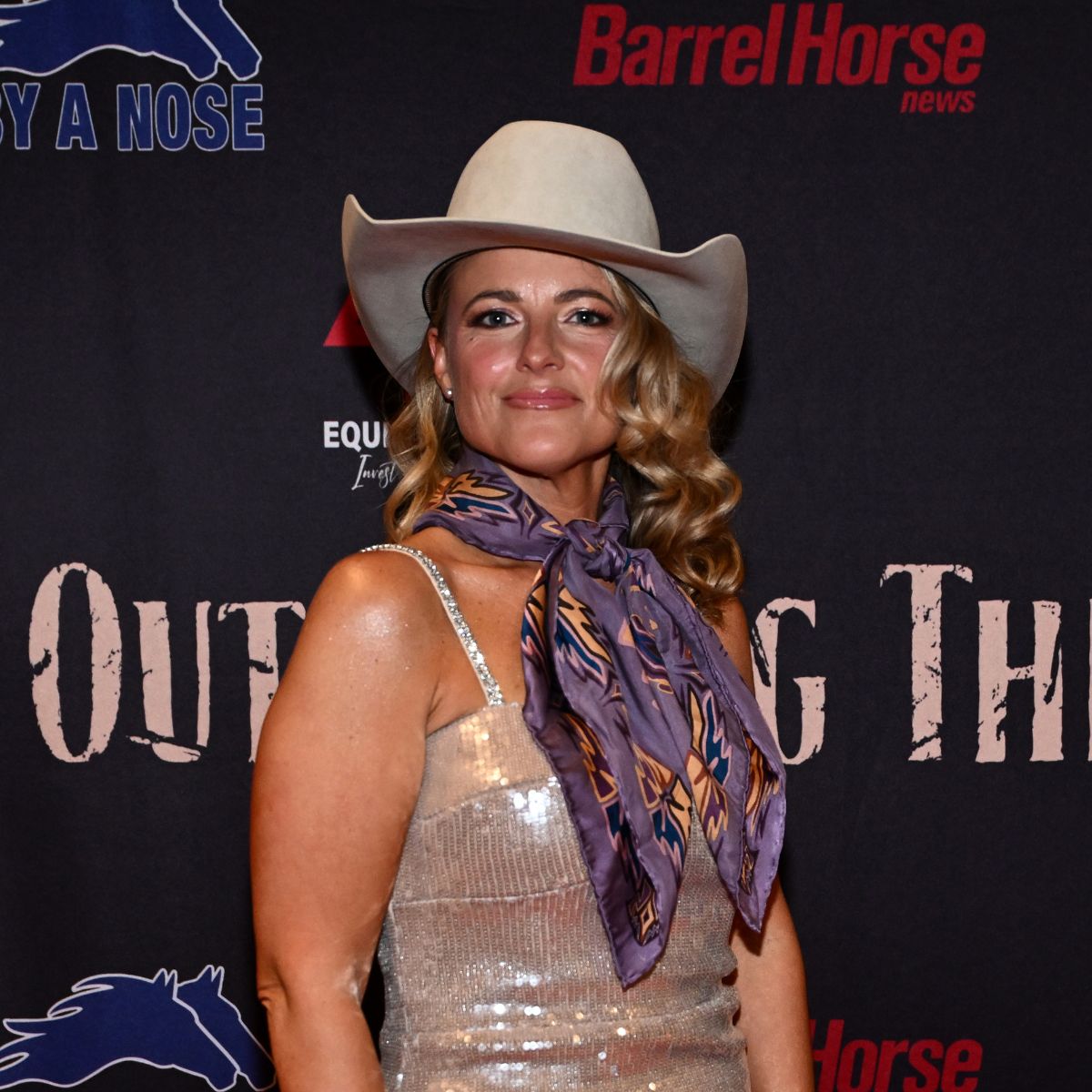
Roxann: [00:00:00] She spent two and a half years telling another woman’s breast cancer story, then received her own diagnosis. Producer Erin Mitchell joins us to talk about the film Outriding the Devil, the lump she initially put off checking, and how the woman in her film became a source of strength during treatment. Share this episode with family and friends and consider making a donation at therose.org.
Thank you, Erin, so much for joining us on our podcast, Let’s Talk About Your Breasts. We’re excited to, to have you on the show.
Erin: Thank you. I’m excited to be here.
Roxann: So tell us a little bit about your film. We’re gonna get into a c- a couple of different things, but I would like to start by discussing the film, um, Outriding the Devil. So tell us a little bit about that.
Erin: Yes. So Outriding the Devil is a film about rodeo in America, and the director had always wanted to tell a story about that, [00:01:00] and we wanted to tell it through a story that everybody could relate to, not just people from the West, but people from everywhere. And that story is Angela Ganter’s journey with breast cancer, her 10-year fight from stage IV to come back, and as a barrel racer, a competitive barrel racer, and, um, win at one of the best rodeos in the world, the Calgary Stampede, after her 10-year battle.
Roxann: Wow. Wow, so impressive. Definitely impressive. So tell us about your role with the making of the film.
Erin: Yeah, so I am the producer, the senior producer. What that means in independent filaking is that you do pretty much everything and anything it takes to, um, help the film make it to production and then post-production, and then get it to audiences. It’s quite a role that takes very many hats, you know? [00:02:00] So yeah.
Roxann: I’m sure that kept you very busy. Um, and your cast and crew, was it a large crew that you had or was it, you know, smaller?
Erin: So it depends. So for the, for the primary documentary part of the film, ’cause the movie is a docudrama, and what that means, um, to audience members that don’t know exactly is, you know, it’s just like the History Channel where they have reenactments of different- time periods, and they’ll put actors in, um, that are historical representatives of real people. And so we, we chose to do that, and, uh, so we have the, you know, primary footage of the documentary of the interviews of Angela, her family, the, her life story, and then, you know, the backdrop of rodeo athletes and kind of people talking about rodeo in general in America.
And then from that, there were so many pieces of Angela’s story that related to the history of rodeo in Texas, because [00:03:00] her grandparents, her great-grandparents were the original pioneer ranchers of West Texas, Coma- what was then Comancheria. And they settled there in 1850.
Roxann: Wow.
Erin: And so we wanted to really bring that home, because Angela’s, Angela’s lineage. Almost she, she, it makes her a contemporary pioneer in a way. You know? Because her, and the way that she fought cancer and the way her attitude was, we felt, was so relevant and, and the way that we hear about pioneers, just that courage, the bravery to, to come west and into the complete unknown and face unbelievable challenges. And so that runs in her blood, and we knew that her story was gonna really bring out the spirit of the West- and the culture of the West, not only through rodeo, [00:04:00] but through, through our American history.
Roxann: Why was the film important for you to be a part of? Why was her story something that was important for you to tell?
Erin: So for me, uh, I’m not familiar with the rodeo world. I grew up in Pennsylvania. I did not have any exposure to rodeo until I came out west.
And I lived, I’ve lived in Tucson, Arizona for eight years. I went to the Tucson Rodeo as almost like a cultural thing to do ’cause I was living in the West and, and I saw the little girls barrel racing-
Roxann: Oh …
Erin: competition And when I saw that seven-year-old little girl in a pink hat with rhinestones come out with this horse that just took care of her like she was its own, you know? His own. Like, the horse was so gentle as she was coming around the barrels, you, you could tell it just, like, [00:05:00] did not want the little one to fall off.
Roxann: Aw.
Erin: And that bond that I witnessed in that arena that day really made me love… That was, that was… Barrel racing was the competition that I fell in love with that day. And then combine that with the directors wanting to tell a story, and then I- told him, “I love barrel racers and I wanna know everything there is to know about barrel racers.” And then when he met, he met Angela, because he went into the Texas Rodeo Hall of Fame Museum in Pecos, Texas, and he did the little tour on his drive to Fort Worth one day, saw Angela’s story, literally called her up that afternoon and said, “Hi. Has anybody approached you to tell your story?”
Roxann: Wow.
Erin: And she said, “Let’s talk.” She was not a full-on yes at that moment.
Roxann: Wow. [00:06:00] Wow. Well, I’m glad you had a chance to experience the, the local rodeo, and that kinda led things into the world that you are now, I’m sure, very familiar with. Um-
Erin: Yes …
Roxann: especially, I know that, you know, when the film, uh, premiered here in Houston, obviously we’re Texas, it’s kinda cowboy country, um, Houston Rodeo.
Erin: Totally.
Roxann: Is a big deal.
Erin: Totally. Yes, yes, yes.
Roxann: So with, with your team that was helping with the film, um, obviously breast cancer w- is, you know, is the theme throughout that. Were there others on the, on your team that had any type of connection to breast cancer or just cancer in general? Or were they not really, it wasn’t really something that they were familiar with?
Erin: You know, nobody overtly came up to me and told me about that I know as we’ve, we’ve talked about, you know, everybody knows somebody now. And that knows somebody is getting closer and closer to home.
Roxann: Yes.
Erin: And so nobody shared that with me, but what, what we did see is the [00:07:00] enthusiasm from cast and crew to want to be a part of this story, and I, I believe that that is, you know, from all walks, from, from, you know, people that are not all from the West, but they wanted to tell it because, because of Angela’s breast cancer journey.
And, uh, and I think, I think it’s important for every individual to be reminded of their own will and courage and reasons when they’re in that place. Because it’s a, it’s a s- it’s a shocking and surprising place to be in, as familiar as we are with breast cancer as a s- as a culture The minute those words come your way, like it doesn’t register yet- uh, in the way that, uh, it, it does whenever [00:08:00] you hear it for a loved one or for yourself.
Roxann: Right. And, and you’re right, so many people do know somebody, um, whether it’s a friend, it’s a, you know, a family member, it’s, um, somebody from work. Um, and I know one of the statistics that typically gets touted is that it’s one in eight women in the US will develop breast cancer. So that unfortunately means a lot of people either have experienced it themselves, or they know somebody that does. And so with the film, um, I know things hit a little closer to home to you afterwards. So tell us, tell us about that.
Erin: Yes. So in the process of making the film, it was about two and a half years, and we were on tour, uh, in the West premiering, it was a premiere of film tour, and we went to different rodeo towns all over the US. Um, we did four premieres in Texas, by the way. And, and so we were in Wyoming, and we were gonna be at the Sheridan Rodeo. [00:09:00] And in May, that was in July, in May I had felt a lump, and I did not go right away to get it looked at. Uh, I was talking to a very, very close friend of mine. We hadn’t spoken in many years, just circumstance- and distance, and she inadvertently shared with me she had a, a benign lump removed. And something just clicked-… and it was okay. That was your tap, tap on the shoulder, ’cause I, I, I had felt the lump, but I, I said, “Okay, my hormones are changing. I’m 50 years old, and maybe it’s just that.” And even when you Google, it actually tells you that.
It actually says, “It could be this-” “it could be that. But go and sh- get it checked out.” Well, I didn’t. [00:10:00] And then in July when I talked to her and I was literally touring the film and the story, and every time we do it you get conversations about women will come up to you about their, their journeys. And so that was my, my kinda like one, two, three, I needed to get this checked out. And so I did, and then it went really fast. It was you need to come in tomorrow for the mamogram. You need to come in tomorrow for the biopsy. You need to come in next week for, you know, and so on and so forth. It… And it was, it is a rapid growing type, but it’s the most coon type, and I I am glad that all those pieces fell together- because I wouldn’t have gotten the diagnosis, and now I have a plan.
Roxann: Now, now let’s just back up. You said you noticed a lump. Now, is, was this through a breast self-exam that you noticed this? Were you doing those [00:11:00] regularly? You know, were you, were you doing the screening mamograms on and off, or, or was that not something you had been doing?
Erin: No, I hadn’t done it. I had not ever had a mamogram.
Roxann: Okay.
Erin: I have no family history. It was not high in my consciousness- of something that that it w- that would happen to me.
Roxann: That’s definitely something that we coonly hear for some of those reasons. One reason being, um, a lot of people aren’t aware that breast cancer doesn’t always run in families, and so, um, they think, “Oh, you know, I don’t have it in my family, so I don’t need to worry about it,” and, “I know the guidelines say 40, but I feel okay.”
They don’t, they don’t feel sick. Um, they, you know-
Erin: Yeah …
Roxann: there’s nothing that’s telling them. They don’t feel any kind of symptoms or, or things like that. But of course, if it’s in its earliest stages, you, you might not know what is developing inside your body, and that’s why that screening mamogram is so important because of its ability to detect things in [00:12:00] its most minute stages.
And of course, the earlier you catch it, the more treatment options you have, the better outcomes. Um, so I was just curious about that, if you had, you know, how you noticed the lump and things. So what type and stage do you have? Do you remember the name of it exactly? I know sometimes it’s a long diagnosis name, and so I didn’t know if you knew that off the top of your head.
Erin: You know, with my, with my chemo brain- … I was like, “What? Wait, which one do I have?” But it’s invasive ductal carcinoma.
Roxann: Okay.
Erin: It is the most coon. But then from that, there’s the types of tumors. So it’s a fast-growing type.
Roxann: Okay.
Erin: It has spread to my lymph nodes-
Roxann: Okay …
Erin: but it has not spread anywhere else.
Roxann: Okay.
Erin: And the sta- so the staging is called 2A. 2A.
Roxann: Okay. Okay. And this was just this year, 2026.
Erin: This was just six weeks ago.
Roxann: Right, 2026. This was just recently.
Erin: Yes.
Roxann: Right. I want, I want listeners to understand this wasn’t last year, you know, and things [00:13:00] have kind of progressed for you.
Erin: No.
Roxann: So-
Erin: No …
Roxann: we’re speaking to you at the very beginning, really, of your journey-
Erin: Yes
Roxann: is when we’re, we’re, you know, we’re having this conversation. So, um-
Erin: Yes …
Roxann: a lot of times we speak with women, you know, a, a year or two after they’ve gone through their treatment plan. Things are, you know, they, they’re feeling a little bit better, not experiencing maybe all the side effects that they had been before. So why were, why were you, um, interested in sharing your story now at the beginning?
Erin: Well, it’s… We were planning on launching the film’s streaming release and the final celebratory premiere in Calgary, which is where Angela, you know, she won in Canada for her comeback, and we were planning on releasing it in October because it’s Breast Cancer Awareness Month.
Roxann: Right.
Erin: And so um, the irony and the mystery of that, that I could have been working on a film about this topic for two and a half years, and then six weeks before we [00:14:00] release it to the world- you know- I get this diagnosis. I mean, it, it’s very uncanny. And I do believe that is no coincidence, and I do believe that somehow getting so connected to Angela’s story, I was given a map for, for this.
And so I know her strength and courage. She exemplifies it, and you would just love to hear the unique ways that she has approached this, this disease. And she would never judge anyone for having fear, but I can tell you that she exemplifies a, a kind of fearless approach to this, and it’s not [00:15:00] just, she’s not just giving you lip service. You can feel it. You can feel that power- that strength, that cowgirl grit- and determination, and I’ve, I’ve felt that in her. And so when I got this diagnosis, I don’t know if being with her, I just had this resonance from that- where it was like, “I’m, I’m not afraid.”
Roxann: Really? And that was gonna be my next question. What, what, if you remember, you know, what it felt like to hear those words, um, because it’s, it can be very scary. It can be overwhelming. It can be dramatic. It can be shocking. Um, so obviously everybody responds to, to that differently. It can be paralyzing for some, and for some, it spurs them right into action, and they wanna talk to every, you know, doctor they possibly can and get online. So what was your first reaction, and, and who did you share it with first?
Erin: [00:16:00] Yes. So I, my first reaction, I will say, was the shocking- that, that feeling. You know, just like, “Wow, that’s interesting. That was unexpected.” “That is the last thing I would ex- you know, think was gonna be.” And so that, that was definitely first, and I had to la- allow myself a minute to digest that for myself. You know, I got really quiet for a couple of days. I thought about it. I called a friend, um, told her, the one that shared that she had a, a benign- lump removed. And after that, um, again, this, this kind of Angela story, my own belief in trusting the process of what’s been given to us, and because it, I feel like we all have something to learn from our challenges. And, uh, my [00:17:00] s- my greatest challenges in life have always been the thing that makes my life richer ultimately. It just takes a lo- it s- sometimes takes a long time to get there.
Roxann: Yeah.
Erin: So I guess that all kind of combined made it so that- I was ready and I was gonna be okay. And then the first, the first, after my friend, um, the first people I told, I had to tell because my brother’s 70th birthday party was happening, and it was a surprise, and everybody was gonna be there. And I was flying home for after two years of not seeing my family, um, back east.
Roxann: Wow.
Erin: And, uh, and I had to share it with them because at that point I hadn’t had the diagnosis because I just had the biopsy. But the radiologist told me to prepare, and so I, I knew it wasn’t gonna be- … good news. [00:18:00] And so that’s just what I shared with them. I didn’t… I said, “Look, I don’t know exactly what this means. Here’s what’s been happening.” Our parents always taught us, you know, to have courage in the midst of fear and, and so I, I wanted to share that with them, with them exactly transparently as it was happening so that they Here’s what it is. I think people alwa- I think more people hold their personal challenges to themselves more than sharing. I think that’s for a lot of reasons. I think we love people, we don’t wanna hurt them, we don’t want them to worry. I also think it’s because sometimes we’re, we don’t want them to judge us. We don’t want to have anybody thinking that we’re weak- or didn’t do something right to get this.
And so th- I think there’s [00:19:00] a lot of great reasons, but for me, I’ve seen too many people suffer in silence with their struggles, and I just, I wanted to walk the talk- ’cause I want people to share with me so that they don’t have to be alone- in that journey. And, uh, so it was like I w- I was like, “Oh, I guess that’s one of my values. I have to live by it right now” You know? So, yeah.
Roxann: So your family, is that who you have primarily been leaning on, uh, through the, you know, for these past six weeks and, um, that’s who you’ve been… Okay. All right. I didn’t know if there were any other… I, I know it’s early for you, but are there, you know, any other kind of coping strategies? I know for some people, um, you know, they start delving a little more into music, or it’s more, uh, d- different things, um, to help them through, whether that’s faith, whether that’s just really focusing on work, um, whatever it might be, or family. You know, that, that network or circle of support that they have.
Erin: Yes. My [00:20:00] family and my close friends- uh, have been incredible, and they’ve all showed up in ways that I couldn’t have planned for or wouldn’t know that I would even need. And yet somehow the soup comes over- … when I’m famished and don’t feel like have the, the energy to cook anything. Or the beautiful roses showed up yesterday from, from a girlfriend that I had wanted to go get roses for the podcast. And, and there, there they were. You know? And, uh, so just magical ways that people come out of the woodwork. I think specifically, again, this has to do with breast cancer, you know. Because especially as women, I mean, the, the breasts are metaphorically and literally the place where we nourish- and get nourished. And, and so there, I think [00:21:00] there’s something just really in our memory about, about our mothers and grandmothers and, and I think that’s- I think it really means something to people.
Roxann: Oh, I agree. And I’m glad you ha- you mentioned, you know, the magical ways that people are, are showing up for you, um, because I think, you know, oftentimes we hear pe- caretakers or people who are very well-intentioned, they don’t know what to do. They wanna help. They, um, but they’re not e- exactly sure and if it’s the right time, um, or what you really need. And then you have others who they’ll just go and do. They don’t ask. They’ll go and do. Um, and so that, I think, um, is something that we have heard often on this podcast is, that has been very helpful, um, because things just show up, as you said, whether it’s, it’s a meal, it’s, you know, flowers just to brighten your day, or if maybe somebody needs a ride somewhere.
Um, you know, it’s, it’s things like that that I think those, those things make a [00:22:00] big difference. Um, and you might not even realize how much you needed that until it showed up. Um, so I’m glad to hear that you have a really strong support group, um, that are doing the big and little things for you, um, that are, that are making all that difference for you. Um, you did mention chemo, so I wanted to ask, what is your treatment regimen like? What, you know, what does that look like?
Erin: So I didn’t know I was going to be… So first of all, it’s, it’s essentially four cycles of one cocktail-
Roxann: Okay …
Erin: over an eight-week period, and then 12 cycles of another cocktail. Ca- And when I say cocktail, it’s chemo cocktail. And so that is, I’ve just had my very first cycle, so it’s one day the infusion. And the second day is a, a shot that produces, helps produce white blood cells from your bone marrow. [00:23:00] And what was fascinating was a lot of the chemo drugs, a lot of the drugs out there have multiple names, have, you know, different branding and, and generics, and it depends on your insurance, all kinds of s- things. So of course, the director always names his movies kinda with a little play on words, and so his play on the, on Angela’s Red Devil chemo that she had to take- was Outriding the Devil. Where… So that was really the play on that chemo that she was given for her treatment plan. I did not know that that was in my regimen- when they had given it to me a month ago. And the nurse, when I sat down, brought out this red liquid, and shes asked, she was asking me what I did for a living. And I said, “Well, actually, ironically enough, I [00:24:00] just finished this movie about a woman who, who had breast cancer, and she survived to come back and rodeo.”
And sh- and I, I said, “It- we named it after the Red Devil chemo.” And she, she’s like, “Erin.” She, like, holds out this bag of red liquid, and I was like, “What?” I could not believe it. It was such a full circle. And I know that might sound silly that I didn’t know, but again, it was, it was labeled a different name- and I just didn’t make… I didn’t equate it- to that. And Angela had Stage 4. I had Stage 2A. I thought that that type of chemo was not… I wouldn’t- Need that, I don’t know. I just didn’t think… Yeah, I wouldn’t need that strength, and people call it, in the counity, the carpet bomber.
Roxann: Oh, gosh.
Erin: You know, it’s, like, just really bad.
Roxann: Yeah.
Erin: And, uh, so [00:25:00] yeah. That was a moment. That was another one of those-
Roxann: Yeah …
Erin: wow moments. And I texted Angela right away And, uh, she’s been incredibly supportive, by the way.
Roxann: That’s good.
Erin: Just incredible. I told her I have my map because of her. And yes, and so I do take that cocktail for eight weeks.
Roxann: Okay.
Erin: And then 12 weeks a different one. My first round was brutal.
Roxann: Okay.
Erin: They told me it wasn’t gonna be, and, um, it was- everybody’s different.
Roxann: Right. That’s what exactly what I was about to say. It impacts everybody differently. Um, you know, different guests that we’ve had tell us they, they were fine. You know, they were playing tennis right afterwards. They were doing this, they were doing that, and we have others that say, “I was down for the count. You know, it took me a while to bounce back from that.” So it does. Everybody’s body [00:26:00] reacts differently to it. Um, and I, and I wanted to just mention, you know, how you said that you didn’t kind of put two and two together with what, you know, what you were receiving.
And I think, um, you know, when our patients have talked to us about getting that diagnosis, all of a sudden they are now introduced to this brand-new world of terminology of, uh, just a whole lot of different things that they weren’t aware of unless they had a very direct connection with somebody, you know, iediate family member, super deep close friend.
You don’t know some of these things. You don’t know what the medications are called. You don’t know about the staging. You don’t know about the different types of doctors you might need to see or the different types of treatment options that are even available to you. So I think a lot of times women need to give themselves grace, uh, for, for maybe not…
You don’t know what you don’t know. Um, and, and I think sometimes people try to go online and read and, and that can obviously be detrimental because you’re, you’re possibly gonna read the worst case scenarios of everything. So I think it’s important for, for people, for patients to… It was helpful for you to have a map, as you [00:27:00] have mentioned that Angela was for you, and hearing some of this for the past two years, her experience, um, but also having somebody that they can lean on to ask some of those questions and not feel judged because they didn’t know something or, or feel a little silly like, “Oh, is that how this works?” Because it is. It’s a whole brand-new world. The insurance process becomes a brand-new world. Yeah, just everything changes.
Erin: Absolutely. And I have the perfect… I mean, I literally didn’t know the difference between what I was taking as a prescription IV or over the counter. I, I didn’t know. They weren’t labeled on my sheet-
Roxann: uh-huh
Erin: that they gave me, and so I was, I was really confused. And, um, I was busy, I was busy enjoying life after the diagnosis.
Roxann: Yeah.
Erin: And I just was kind of like, “All right. That’s a lot of words. That’s a lot of information.” And there’s that dance between, you know, [00:28:00] the, the, the placebo effect, like, “This is gonna cause this,” right? So it’s, like, being informed without reading that stuff and letting it determine what, what this is gonna be for you. You know? Like, not believing everyth- everything that’s there.
Roxann: Right.
Erin: Everybody’s different. Everybody reacts differently. And some of those side effect lists are … They’re really hard to look at.
Roxann: Ab- absolutely.
Erin: And so I, I was loosely looking- if that makes sense. You know? And, and, and so when, when my first treatment round came up, I missed taking the prescription drugs because there was a mix-up with the pharmacy and, and then I woke up after the bone shot is when I really felt awful.
Roxann: Okay.
Erin: Um, the bone shot was really… Made me feel like my bones were broken all over my body. Um, the, the chemo caused [00:29:00] severe headaches, like not… I wouldn’t even call it a headache. It felt like I was in a boxing ring and I got boxed-
Roxann: Wow …
Erin: in the head. So, um, yeah, and I had, you know, my stomach got really wrecked. But I was that kid, you know, that got nausea in the car, in the backseat of the car, and- on rides, so I don’t know if that plays into it, like my dis- my constitution- or if it really was just major side effects- from the drugs.
Roxann: Right. And it could, it could’ve been, um, y- it could be either one of those things, but I think, you know, coming onto this podcast and describing what you have felt and what you have been through, I think that’s helpful for our listeners to just understand, um, that you may feel this way, you may not.
You may experience this, you may not. Because I think a lot of times, um, you think that maybe it’s gonna be A, B, C, and D. You think this is the plan and this is exactly the way it’s gonna go, and doesn’t always happen that way, um, whether it is the side effects or what the [00:30:00] treatment is. Um, so I’m glad that you are sharing what you experienced and being so open about it, and it’s not, of course, in any way to scare anybody, but it’s just the reality of some of the things that somebody might have to go through if they’re going through-
Erin: Yes
Roxann: chemo or treatment. So I’m, I’m really-
Erin: Yes …
Roxann: I’m really glad that you are being as open as you are about the things that you didn’t know. Um, so how have you been trying to advocate for yourself with your medical team when, when you don’t know something, or there’s a mix-up at the pharmacy or, or life happens?
Um, so has that been easy for you? Um, I know a lot of times we’ve heard from, from guests who say, well, they didn’t exactly want to challenge the doctor, or they didn’t want to challenge the, the conventional thinking. And then we have other women who say, “No, I push for it. I ask the question. I raise my hand.”
So how are you handling that when it’s something that you aren’t aware of or something that you potentially disagree with? I know it’s earlier in your, in your journey, so you might not have had those instances happen yet. [00:31:00] Um- but, um, if they have, how did you handle those?
Erin: Yeah. So for me, I, I really resonated with my oncologist iediately, and my surgeon- and the care that I was receiving. So I was, I was feeling a high level of trust at that point.
Roxann: Good.
Erin: And there were times and things that I wanted to ask more about. I wanted to see about further genetic testing, um, not, not general, but on the actual tumor itself- you know, to see how the tumor’s gonna respond to certain drugs, if I’m able to do those tests, if are they able to do that. They did not initially on the treatment plan take into consideration my family history on heart, uh, and car- you know, cardiovascular health- And so I made it very clear a little bit later, [00:32:00] “Listen, two of my sisters have cardiomyopathy. This drug impacts the, the heart tissue.”
Roxann: Oh.
Erin: “You need to know that. I need to understand what is your thinking on this.” So now- just that question, she’s now ordered a interim echocardiogram in the middle of this treatment cycle that w- she wouldn’t normally do.
Roxann: Just to monitor?
Erin: Just she said to be abundantly cautious.
Roxann: Good. Okay.
Erin: And so, you know, for me, it’s been there’s a patient portal, and I think a lot of now hospitals have that. So my coitment to myself is to tell them when I feel symptoms When I have questions, when I don’t understand something, or when somebody I love and trust from the medical counity, from the alternative medicine counity, like an acupuncturist or an herbalist or, you know- [00:33:00] those types of supports, and they ask me something that I don’t know the answer to, I just, I ask them.
And I just- I just make it a point to go on that portal, and it, I- if I send them messages three times a week, I’m j- I’ve just thrown it out the window that I’m gonna bother, I’m gonna make them think that I don’t trust their process. I mean, none of that. I don’t care. I want- I want them to know that this is happening. My, I have a question, or I have a concern. Here’s what it is, and Dr. Monahan has… She really, either her or her nurse will get back to me with a response. And then later I see how that response has shifted my care. And so I would say to women out there, let go of all the old stories. Advocate for yourself. If you have a question, you are not stupid. [00:34:00] It is, it is your body. You know your body best. You know your family history best.
Roxann: Yeah.
Erin: These doctors are doing their best to take into consideration everything that they can think of, but I, I have found that the little nuanced information has shifted the type of care that I’m getting- for the better.
Roxann: Well, I think that’s a really, really good message, um, to just advocate for yourself, and throw the, you know, don’t worry about it. This is your body. You’ve gotta ask the questions. You know, dig as deep as you need to till you feel comfortable with the responses that you’re getting. And I’m glad that you brought up the example of your sisters, because I think, um, and I think we’re all guilty of it, i- you know, you get asked these, you know, you get these questionnaires, “Do you have this?
Do you have that?” And, and you might not realize that maybe a family member’s condition actually does matter for, for what you are potentially going through. So I’m, I’m glad that you say that, because I [00:35:00] think that is, that is important for people to remember. Just because you might not real- might not believe there’s a tie to it, in the medical world, there possibly is a tie to it.
So just put it all out there because it might change things for you. So, um, thank you so much for joining us and talking about your journey and talking to us about the film. So a couple of, couple, two last quick questions for you. I’ve taken up a lot of your time. Um, what is your parting advice for a woman who is on the fence about getting a mamogram? They might be 40, they might be 50. They’re just, you know, they’re busy. What would you say to a woman who doesn’t have time?
Erin: I would say that- For me, it was about knowing my body, and knowing my body meant having a connection with my breast tissue that they are not just perfunctory, that they’re there, they’re a part of your body. They speak to us [00:36:00] with i- with, with lumps. And just stay connected to that, and then when you feel one, go get it checked out. It really could be benign. And there are false positives, so there, there is that issue. However, I, I just believe that that was my way that my body was speaking to me, and when I felt that, that was, that was the next, that was the next step. It’s like doing what you know you can do for you. And so yeah, that’s what I would say to-
Roxann: Okay …
Erin: women out there.
Roxann: So Outriding the Devil, tell us how our listeners can watch the film. Where can they watch it? When can they watch it? Tell us.
Erin: So yeah, so we’re launching at the end of October during Breast Cancer Awareness Month for streaming, and we’ll have a promotional period for starting in October where you [00:37:00] can stream direct. We are right now in conversations with a distributor, which will mean that the film will be available to watch on larger platforms in the future. Okay. But until that happens, we want our audiences to see this movie. They’ve been asking about it. We’re gonna do a direct stream. There will be a dir- there will be a link, and I can provide that for you when that gets released.
Roxann: Yes.
Erin: And, uh, yes, you can come onto our website, um, otdmovie.com, and we will announce there. We’re on Instagram, we’re on Facebook, Outriding the Devil, and you will know when, uh, in October and how to access that direct link to watch it.
Roxann: Great, great. Yes, please do share that with us. We’ll make sure that we include that so everybody can, can take a, take a look at the film and, and, you know, get that rodeo history, but also that great story of Angela and everything that she’s overcome. I would love to chat with you again in the [00:38:00] future, um, to hear more about how your journey is going, um, and just kind of, just kind of keep us updated, um, keep our listeners updated. I’m sure, I’m sure folks are interested to hear. So thank you so much, Erin, for joining us, um, and I look forward to speaking with you again, and we will make sure that our listeners have everything they need to watch the film Outriding the Devil. So thank you.
Erin: Thank you, Roxann. Thank you so much.
Post-Credits: Thank you for joining us today on Let’s Talk About Your Breasts. This podcast is produced by Speke Podcasting and brought to you by The Rose. Visit therose.org to learn more about our organization. Subscribe to our podcast, share episodes with friends, and join the conversation on social media using #letstalkaboutyourbreasts. We welcome your feedback and suggestions. Consider supporting The Rose. Your gift can make the difference to a person in need. And remember, self-care is not selfish, it’s [00:39:00] essential