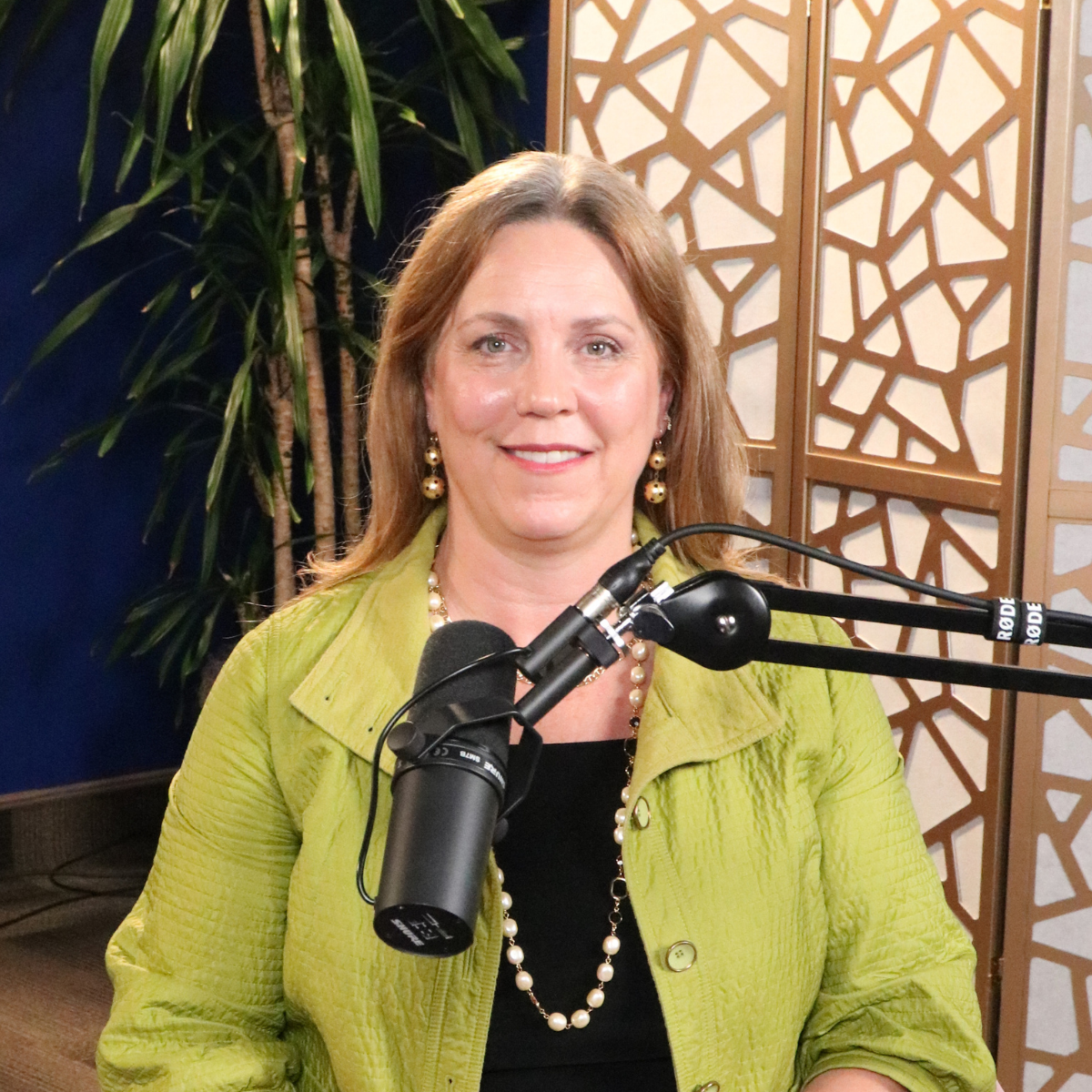
Introduction: [00:00:00] Rest isn’t lazy, it’s learned. In part two of our conversation, Emily Whitehurst gets honest about what happens after you finally stop. The anxiety, the silence, and the first time you actually feel a feeling in your body. She shares how Tai Chi, breath, and tiny moments of stillness helped her find a new baseline, and why managing your attention is a superpower every woman needs. This episode is a guide for anyone who can’t remember the last time she truly rested but knows something has to change. Share this episode with a friend who keeps saying she’ll slow down someday, and consider making a donation at therose.org.
Dorothy: Emily, we’ve talked so much about what you did, sort of- … and, and how it made you feel. But, you know, I’m still going, well, how? [00:01:00] How did you do this? And, and I do appreciate so much that you, you have a couple of practices- that probably didn’t have time for when you were in that working environment.
Emilee: Yeah. Not, not as consistently as I would like.
Dorothy: Yeah, for sure. Okay.
Emilee: Yeah.
Dorothy: But w- so- How did you take that first step to even do that?
Emilee: So what we’re, what we’re trying to figure out how to share right now- as I understand it, is if somebody wants to take a pause- for however long, for just because they, they know they need a break-
Dorothy: Wow.
Emilee: Yeah … and they, they’re able to find the sort of, uh, at least of enough of a financial cushion to step away, many professions have this built-in notion of a sabbatical, and a clergy, you know-
certainly does. So this idea of a sabbatical for, uh, one’s own self to re-ground, re-root, reconnect, so that you can come back and do your purpose, is a really valuable one, and one- not one I’ve made up, for sure. So I think what we wanna figure out together- is, and, and I’m just [00:02:00] reflecting on this myself, so hopefully it’ll be beneficial to people, is how do you actually go about doing that? What does that actually look like? And I c- I can tell you, the biggest anxiety I had about it is that if I do this, I just, I will just descend into … I, I will be a lazy, no good, worthless kinda human. You know, I just- didn’t know how to allow myself the luxury or the privilege or the right to take a break.
And so I think one of the first things people need to reckon with is that inner voice that’s telling them that, uh, they, they can’t afford to rest, they can’t afford to stop, they can’t afford to, um, reconnect with their body and get feeling good because, if they do, they will never be able to function the way th- the society expects them to function. And that may be true, so that … Y- you may not be able to come back and play the game the way you used to. And, you [00:03:00] know-
Dorothy: So you’re gonna have to decide somewhere in there-
Emilee: Yeah …
Dorothy: that game’s not worth playing.
Emilee: You’re gonna have to some- de- decide somewhere that game’s not worth, worth playing in the same way. On the other hand, I can’t prove this yet ’cause I’m still in this process- but I am certain that whatever I end up doing next, the person that I will be bringing to the table, the kind of contribution that I will be able to make because I’ve taken this time to rest and reconnect, will be much more aligned and attuned to the, the, my highest and best use- Uh, I will be bringing to the table what I and only I can bring because I will be a whole, whole healthy person.
Versus feeling like I have to function in a way that is counter to my best interest. But there is, uh, I mean, there is a set of mores and expectations, and there’s a culture around work in the United States, I think maybe more so- well, I can’t say, but, uh, you know, we don’t, we don’t [00:04:00] think that we have this right to rest- and to be, um To be whole humans. And, and really what I have found is that to do that, it is, it is tough to do it if you’re at work and 50, 60, 70 hours a week. Uh, uh, it’s tough to do it if you, as, uh, any parent does, have to put your children first always so that you can s- so that they have a safe, secure, stable environment.
Uh, and also work, uh, and then you’re a parent. You know, it’s, it’s not easy- it’s not an easy balance to strike. But in any given week, if 70 or 80 hours, 60, 50, 40, I mean, depending on what your needs are, is dedicated to, uh, uh, to, uh, a set of activities that don’t nurture your wellbeing, and I mean very practically, like sitting at a computer hunched over, uh, in an, you know, not moving enough, not having time to eat. Th- those kinds of things- actually take a toll. Like, if you wanted to design a torture [00:05:00] for somebody, put them in a cold room hunched over in front of a screen for 40 hours a week, that would be torture. You could torture-
Dorothy: You’re right.
Emilee: You, you, you could say, “This is a torture.” Um, this is not… And you know, I think COVID was, that was true. You know, you became so focused on these screens and- Oh, yeah … sitting there, and it’s like a soul-sucking kind of experience. It’s not healthy.
Dorothy: But- So how much time do you spend outside?
Emilee: I do. That’s such a good question. You know, we are in Houston, and Houston- is hot a lot of the times- of the year. And, um, but I think being connected at some point of every day with the out- with nature, I mean, really, it’s, it’s… And it can be as simple as just, like, walking to your car and taking note. I mean, I’ll start, and I now notice, like today, I was driving up Shepherd. I mean, how many times I drive up Shepherd? And I noticed a hawk sitting on a wire, a beautiful hawk, and that, you know, that’s like, ah, but I wouldn’t notice that if I’m like this, you know? I wouldn’t- Right … I wouldn’t have [00:06:00] the wherewithal to listen to, um, my own body or to nature’s cues. Uh, but, um, I think time outside, I think connecting with the natural world is so, so essential for holistic wellbeing.
Dorothy: Right. So you don’t feel like your mind has slowed down?
Emilee: Oh, I think it probably has. Now, it’s not clear if that’s menopause brain, like brain fog- … but I, I certainly would not wanna take an IQ test now, uh, compared to where I was in my 20s.
Dorothy: Like, my- See, you’re talking in a whole different way. Don’t you feel like you’re more creative now? Think about what you just said. You noticed the hawk.
Emilee: Yeah.
Dorothy: You’re able to see things.
Emilee: Yes. Oh, yeah. I mean, I, I, I think that’s right. I think there are… You know, a lot of it is about managing your attention, and this is, th- there’s a lot of conversation about this now. But, um, the ability to manage where your attention goes, where your [00:07:00] mind goes, it’s the superpower. It’s the superpower. Um, and recognizing that so much of the reality that we live in is one we are creating based on the, uh, assumptions and habits that we’ve cultivated, maybe for good reason over time, but they’re not necessarily serving us, or we think it’s reality, and it’s not. It’s our imposition on reality that we can change.
We can change that. We don’t have to think and be the same way that we’ve always been. And so really figuring out how to disconnect, slow down enough to get a handle on where is my attention going- what are the stories that I’m living in, and do I want, do I want those to be my stories? How do I- I get… I, I should get to author my story.
Dorothy: True.
Emilee: Right? And, and I want… But to do that takes, uh, intention and time because otherwise you’re in habit mind. You’re just, [00:08:00] you’re just-
Dorothy: Yeah …
Emilee: in habit mind. And, you know, we really are taught, unfortunately I think, that the external reality determines our internal experience. Like, if I get in a car wreck, of course I’m supposed to be upset and outraged because that person pulled in front of me, or if, you know, if I don’t get this job, of course I’m supposed to be upset. But what if we get to decide how we want to respond to anything that happens to us?
Dorothy: That’s so true.
Emilee: What if we get to decide- that we want to put our attention, manage our mind in such a way that we’re creating the outcomes that we want? What if that’s our birthright? But you can’t do it without a body breath practice, ’cause if the mind, the mind can’t fix the mind. The mind is not- it’s a body, mind, breath practice that, um, allows us to interrupt those habitual modes of thinking and redirect our intention to what we really want [00:09:00] versus what, uh, we f- don’t want.
Dorothy: So do you think you do- you taking this time off has formed or been an example for your daughters? How are, how are you trying to instill this in your daughters?
Emilee: Yeah, that’s such a good question because, you know, they are, at 15 and 13, they’re in this just marvelous period where they are really becoming themselves. And they’re, and they’re becoming… You know, they, their appearance, wh- who they, who they are in the world is, it’s important that they really express that right now through their appearance, and that’s a really valuable undertaking.
Dorothy: Right.
Emilee: I love watching them develop their sense of style and their sense of aesthetics and their, uh, th- bring their sort of energy into the world in a way that feels Like they’re organizing themselves into a self. It’s, it’s a, it’s a beautiful process to watch. And in some [00:10:00] ways that’s gotta get formed because you can’t function in the world if you don’t have something like that.
Dorothy: Right.
Emilee: And you hope it’s, you know, grounded in love and healthy. Then over time, there is, I think, an opportunity always to kind of recreate yourself depending on who you wanna be and what patterns aren’t working for you anymore-
Dorothy: Right
Emilee: or what lines of thinking aren’t serving you anymore. Uh, and that’s, that’s a practice. That’s not something, that’s not a one and done. That’s a constant sort of practice of, um, re-imagining your life in ways that are consonant with what you want, not with what you don’t want or what you feel like has to, uh, has to be.
Dorothy: So it’s the interruption of those thoughts that we don’t think we can interrupt, but you have to interrupt them. It’s stillness. It’s learning your breath- and your body wisdom.
Emilee: Yeah. Um, you know, at the end of the day, Dorothy, to me, [00:11:00] it’s always comes back to love.
Dorothy: Yeah.
Emilee: It just, it just comes back to love. It really does. It’s a, it’s like, do you really know what love feels like? Do you have that for yourself- and do you have that for the people? I mean, one of the mantras that I, I say… So when, when you’re in this process of interrupting the mind with the body- and the breath, it is helpful to have something to replace. And I’ve learned this from my teacher, so I, I don’t wanna be like… I wanna give, uh, uh, credence to the, my teacher-
Dorothy: Right. Right …
Emilee: uh, Henderson, who’s helped me learn this too. But if you can replace the habit mind with a, with a different type of thought and put your minds on that, uh, mind’s attention on that phrase. So I, one of the mantras that I say is, “I love and am loved by those around me.”
Dorothy: Ah.
Emilee: I love and am loved by those around me. Just consistently saying that, and that, for me, helps my body relax. I’m just, you know, when I re- I, I [00:12:00] love and am loved by all those around me, and that’s really true. It’s really true for me. Yeah. Uh, I love my children. My children love me. I love my parents. I lo- I’m lucky in that way. But saying that also helps make it true. That-
Dorothy: Yeah … I believe that.
Emilee: Yeah. And when people, and I, I do wanna say this because, uh, uh, of my work in, at the Houston Area Women’s Center, knowing what love feels like and knowing what it’s not, and being able to, um, be in an environment where you love and are loved by the people around you, is probably the most important thing. And so- anything I ever wanna be about, and I hope, I, I, I believe this is what the Houston Area Women’s Center is up to fundamentally, is to ad- advance love and healing- and liberation from, uh, dynamics that aren’t, aren’t, aren’t kind and, uh, safe.
Dorothy: Right.
Emilee: So I would tell myself that. I would tell myself that i- in, like, a practice of [00:13:00] redirecting my mind so I’m not… well, actually, literally, like, my mind’s not thinking, “Oh, I’ve gotta do this, I’ve gotta do this, I’ve gotta do this.” That’s my life. I’ve gotta do this, I’ve gotta do this, I’ve gotta do this. And then if I can just for, I don’t even know, 60 seconds, I love and am loved by those around me, and that’s the energy through which, from which I move. Um, it’s a, it’s a game changer.
Dorothy: Some great, great suggestions on- … how we might get to some of this. So again, thank you so much for being with us. This was just really, really thought-provoking. I mean-
Emilee: Oh, thank you so much …
Dorothy: yeah.
Emilee: Well, it’s wonderful to know that taking my retirement out and spending s- 10 months on the couch- is beneficial to other people. I wasn’t sure that would be the case.
Dorothy: Oh, no. I think it very much so is.
Emilee: Good.
Post-Credits: Thank you for joining us today on Let’s Talk About Your Breasts. This podcast is produced by Speke Podcasting and brought to you by The Rose. Visit therose.org to learn more [00:14:00] about our organization. Subscribe to our podcast, share episodes with friends, and join the conversation on social media using #Let’sTalkAboutYourBreasts. We welcome your feedback and suggestions. Consider supporting The Rose. Your gift can make the difference to a person in need. And remember, self-care is not selfish, it’s essential.