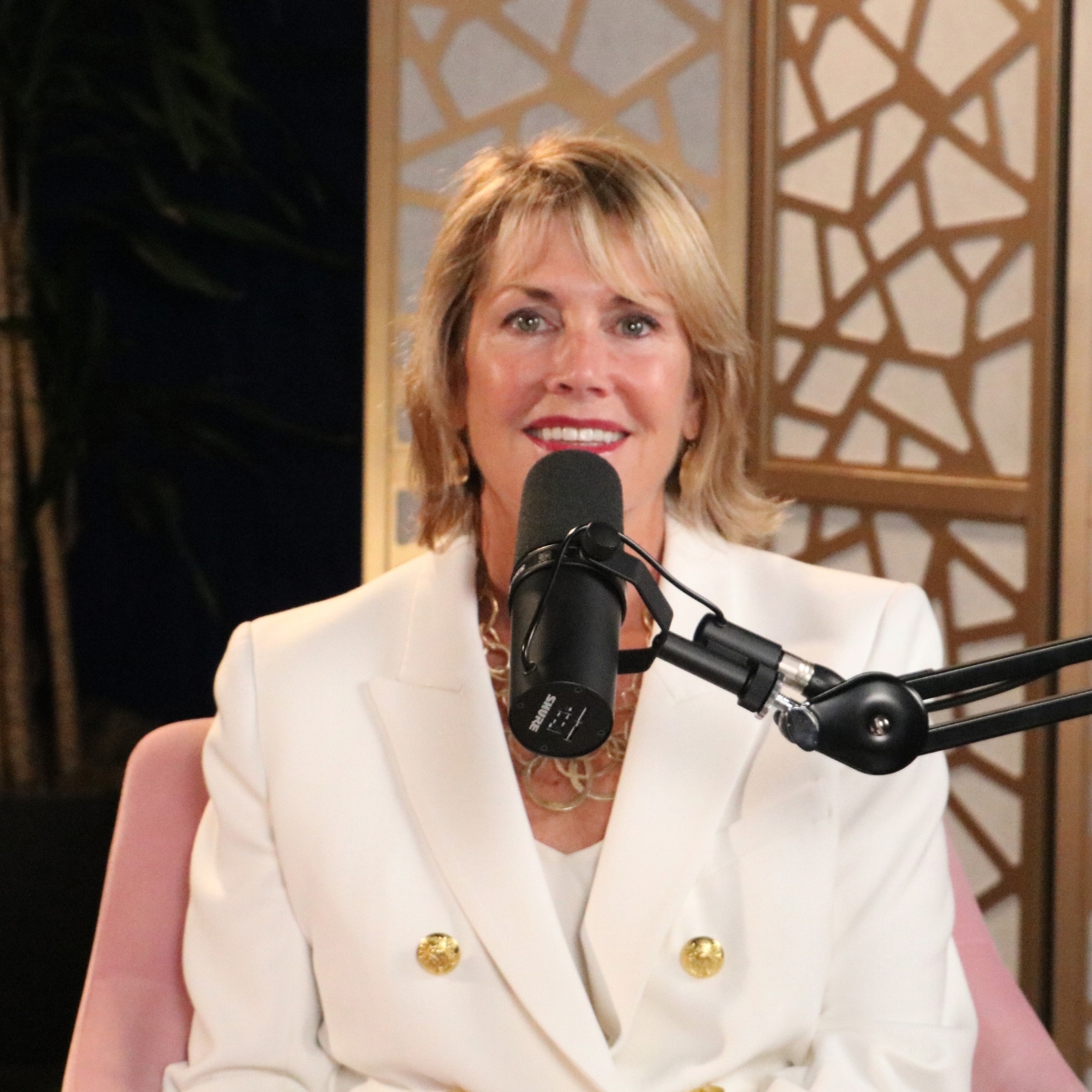
Angie: [00:00:00] Nancy Meyer brings more than 30 years of media leadership to Houston and more than 20 years of breast cancer survivorship. The president and publisher of the Houston Chronicle joins me to talk about advocacy, early detection, leading through uncertainty, and the life lessons that matter most.
Nancy, welcome to Let’s Talk About Your Breasts. Houstonians know you as the president and publisher of the Houston Chronicle, but you also bring a very personal connection to breast cancer and awareness. And so it’s only fitting that you join us today during Breast Cancer Awareness Month. Thank you for being here.
Nancy: And Angie, thank you very much. Um, it’s been a while, but it is also a subject that I think no matter what is worthy talking to, especially at this time of year.
Angie: Well, first, can you tell us a little bit about yourself sort of outside of your role?
Nancy: Fantastic. I have been in Houston for about four and a half years. So I, I’ve lived in many places across the US, typically coastal, um, New York, [00:01:00] Florida, San Francisco. I grew up in New Jersey, um, from a… Two brothers, and so not a large family, but a very close family. And, um, media was a passion from an early age. Um, we got three newspapers into our home, and it’s not like I read the news, ’cause that probably as a kid, that wasn’t very interesting.
But whether it was the comics or, you know, your own personal photo in a newspaper, so it’s a real passion. People ask me, “Do you love what you do?” And from a TED Talk I think many years ago, it’s not what you do but why you do it. And, you know, every day you get up and you’re the publisher of the Houston Chronicle, not always an easy job, but I look at this as free- saving free speech and democracy in America.
Angie: Yeah.
Nancy: And so there’s a great passion there, and it’s been there for a long time.
Angie: Did I understand that you started in classified ads?
Nancy: I did. I-
Angie: Do those even exist anymore?
Nancy: You know, they still do, but very small. It used to be that connection of people wanted almost like a Facebook Marketplace.
Angie: Yeah.
Nancy: That’s what most people would know [00:02:00] classified as today. And it was one of those, people wanted to sell their car or placing an employment ad. And so yeah, I started in classified, and then I moved quickly onto management and, um, more I would say the digital space, um, which I found exciting. You know, it changed the world for media. I think very interesting change, but it also made us reshape what we do. And I think even today we meet people more where they are. Yeah. The platforms, how we deliver content are so important, and people wanna see it in different ways, in different fashions.
Angie: Yeah. What led you to Houston and to come to us to the Houston Chronicle?
Nancy: You know, I was in Miami, and I love Florida. I had worked for Hearst before for about 10 years in San Francisco and New York, and it was a company I always said would be great to return to. When I left them, it was mainly lack of opportunity on the East Coast, and my family and friends were there. Um, so when I got the call and I thought, “Oh, this will be something for the East Coast. It’ll be [00:03:00] Northeast,” and when they said Houston, I thought, “Wow, Houston.” And so I– But you know what? I jumped at the chance. Hearst is, I think, a great steward of their businesses. They’re growing outside of media, and, you know, yet media is something that they really started the company. William Randolph Hearst even raised money during the Galveston hurricane in, I think it was 1905-
Angie: That’s right. Yeah …
Nancy: um, at the Waldorf Astoria in New York, so we have great presence and great history here. And again, being great stewards of that business. I will tell you now living in Houston, and some have heard this, um, if I go back to the Northeast or even Florida, people say, “How is it living in Texas-“
Angie: Yeah …
Nancy: nancy?” And I say, “I don’t know. I live in Houston.” Um, because you know what? First of all, the philanthropy here, the people here, we just have a wonderful community.
Angie: Yeah.
Nancy: It’s like a big small town.
Angie: Yeah.
Nancy: And even our diversity, which I think is such a strength for us, I [00:04:00] talk to people, and I’m not a historian, but that feel of almost Ellis Island, so was the, you know, Galveston.
Angie: Yeah.
Nancy: And it was such a great place of entry and communities to come together.
Angie: Yeah.
Nancy: And I think we’re still that, which is wonderful.
Angie: And great food, to boot.
Nancy: And number one. We talk about it all the time, but great food is number one in Houston.
Angie: Yeah. Well, I would like you to sort of take us back to when s- when you first heard those words, “I have breast cancer,” and, and what that was like for you.
Nancy: You know, initially, um, I had found a small lump in my breast. Um, went to the doctor in, I think it was maybe August of 2020. Excuse me, t- um, 2000. And we didn’t think it was anything.
Angie: Yeah.
Nancy: You know, we had it checked, mammogram, et cetera. And about eight months later, I just said to myself, “You know what? It’s just bothersome. Nothing really changed.”
Angie: Yeah.
Nancy: “But I think I’d just like to have it removed.” And I went back to the doctor, and when he started his procedures, I could tell his eyes were a little bit like, [00:05:00] “Ooh, this might be a little different.”
Angie: Yeah.
Nancy: So, um, you know, they looked at it. We did a biopsy, and like many women, when I got the call to return to the doctor’s office to hear the news, um, I didn’t… they couldn’t give me anything over the phone, and they said, “Well, the doctor would like to see you. When can you come in?” I said, “Well, I’m really busy tomorrow, and I think Monday’s busy, so how about, like, next Wednesday?” And they said, “Well, could you meet the doctor tomorrow morning at 7:30?” And I thought to myself, “Okay, this is serious.”
Angie: Yeah.
Nancy: And met the doctor. He was turning on the lights in his office as I was coming in. And I was by myself just because I thought, “Okay, I can take whatever this is.” And I remember the doctor sitting in front of me, and he was writing his notes down so that when I left, I would have them. And thinking through that now-
Angie: That’s right.
Nancy: Because I probably wouldn’t remember.
Angie: Yeah.
Nancy: Um, and the details and some things that, the next steps. And so I almost feel like you’re living [00:06:00] outside of your body.
Angie: Yeah.
Nancy: Um, and some of that messaging.
Angie: Yeah.
Nancy: Um, and then you work to be well. Yeah. And so I, I think those lessons are you’re never too busy, or you should never be too busy, um-
Angie: Yeah.
Nancy: To make sure your health is number one. Having someone there certainly, I think is an advantage, but I, my physicians and the people I worked with were second to none. And I always remember to tell that story, the doctor sitting in front of me, writing those notes down, and I still get goosebumps because he knew.
Angie: He knew, yeah.
Nancy: He knew, and that said to me immediately I was in good hands.
Angie: Yeah.
Nancy: And then you speed up to, “Okay, how do I solve this?”
Angie: Yeah. What was treatment like for you?
Nancy: You know, I was stage one, and so luckily, um, and I say that to so many people, so I think every treatment’s different, but this was close to 25 years ago.
Angie: Yeah.
Nancy: So, um- It was a little different … you know, I had radiation and chemotherapy.
Angie: Yeah.
Nancy: And so it was about a six-month process, um, I think four [00:07:00] chemotherapies and then radiation. And, you know, I had a great group around me, friends, family, medical professionals, and, you know, they did talk about support groups. And typically, you know, at that time, the life expectancy, et cetera, and the support with a support group had so many benefits. Now, I didn’t go through a s- I didn’t work in a support group, but I will tell you, there were two people I was working with who were going through cancer at the same time in treatment, as well as having that network around me, I think really helped both my psyche getting through it, having people who could support me through it. So I also recommend that, or a very good group to have around you-
Angie: Yeah …
Nancy: that can assist you through the procedures.
Angie: Yeah. Yeah. Uh, that support is so important, and we’ve had people come on to tell us about caregiving and how that in itself is, it can, has its own challenges, but so important to be able to, to be able to support and have that support on the road to recovery. So it’s been [00:08:00] 20 years now. How, as you reflect on it, what does breast cancer mean to you now? Is it something that you continue to get screened, or what’s your relationship with breast cancer now?
Nancy: Without a doubt, yes, screening. Yeah. Um, after my diagnosis, after my treatment, I did, um, do gene counseling, and so, you know, that was negative. Yet, cancer runs in my family.
Angie: Oh.
Nancy: And so it was interesting to see, you know, hey, what do you know today versus what will they know five, 10 years, um, from now on gene counseling. And so, but I also grew up in the Northeast, so environmental concerns and things like that. So from that point forward, first of all, I took my exercise more seriously.
Angie: Yeah.
Nancy: Even through breast cancer and treatment, I exercised. And I think, again, from just my mental health, that was such a positive. Eating well, and in Houston we do have great food, so that may not always be what I’m doing, but, you know, it’s always good to, everything in moderation. But also being an advocate, and I started work, [00:09:00] um, Making Strides, American Cancer Society, Making Strides. When I moved to Connecticut, I became a board member and worked very closely with Susan G. Komen Connecticut and ultimately Susan G. Komen New England. And so it’s been something that both personally people have reached out and wanna be an ear or even a shoulder. While I can talk about my treatment-
Angie: Yeah
Nancy: you know, I’ve also, it’s not something … While I can say mine seemed very basic. This is what you went through. Everyone’s is going to be different.
Angie: Yeah.
Nancy: And most importantly is hearing them, I think being there to support them, understanding what they’re going through, and I think also just being more open, that still some people, even the title of this podcast, you know, makes people probably sit up. It’s a little bit more provocative-
Angie: Yeah …
Nancy: let’s Talk About Your Breasts, right? Um, there are subjects that’s p- still people don’t wanna talk about today, and yet this should be open because the more people who get checked regularly, we [00:10:00] know, checked early, life expectancy is such a bigger opportunity for people. We also know in lower socioeconomic, um, communities and our more diverse communities, sometimes that doesn’t happen as often as it should.
Angie: That’s right. That’s right. I wonder, and you m- touched on it briefly, but, you know, being a 20-year survivor, breast cancer has also, the tr- the amount of treatment, the amount of awareness has grown so much, uh, in the last two decades. But I wonder what you would tell someone who’s hearing that for the first time now that, that they have breast cancer.
Nancy: You know, I think I would say ask more questions, and it wa- yes, the internet existed 25 years ago, and certainly I looked on things on the internet. But I would say, again, being your biggest advocate for your own healthcare, because even today, I think my treatment was very good. I look back and stellar surgeon, stellar help, but at the same point, [00:11:00] I’d say to myself, “Would I have done things differently?” Um, you know, we know people have come out and said today, “Oh, maybe I would have had a mastectomy,” right?
Angie: Right.
Nancy: And different choices I might have made. I still feel good about my choices, but I think I was, you know, caught a fog. You feel a little outside of your body. Um, your first reaction is, “How do I remove it? How do I get my treatment? How do I be well?”
Angie: Yeah.
Nancy: And I think all of those things are important, yet you still should be concerned about 5 years or 10 years down the road.
Angie: What comes to mind when you think of a woman who, that something is wrong, but they might not have insurance, or they might not have a doctor that they regularly attend to? What comes to mind?
Nancy: I think first of all, reaching out to places that can help you. So whether it’s, um, cancer organizations that can assist, because there is some financial assistance. It’s also, I think, understanding the laws-
Angie: Yeah …
Nancy: and what that means. And in breast cancer, I’d say legislation has come very far-
Angie: Yeah
Nancy: even in the last [00:12:00] 25 years. You know, even reconstructive surgery and what that means, and how insurance needs to cover that. But I think if you d- first and foremost, in any healthcare situation, go to the doctor. Typically, it can be solved easier, less expensively, but if you don’t, there are organizations that you can reach out to that can assist you. And, you know, people aren’t always vulnerable. They’re not always open to asking for help, and I think as women, we tend to tr- wanna solve things.
Angie: Yeah.
Nancy: And I’ll take care of this first, because this person needs me.
Angie: Right.
Nancy: I’ll come second.
Angie: Yeah.
Nancy: So, you know, and I, that would be, I had insurance. I was blessed and privileged to have that. But for those that don’t, number one, if you have a family or even just yourself, the fact is reaching out is easier than not, because the consequences can be so much worse-
Angie: Yeah …
Nancy: if you don’t get checked early, and if it’s not diagnosed early.
Angie: Yeah. That’s a big passion for The Rose, is that we [00:13:00] believe that no woman should die of breast cancer, that the treatments are available, the tools are there for early diagnosis. We just wanna make sure that every woman has access to be able to have a journey that has the best outcomes possible.
Nancy: Exactly.
Angie: As you think about sort of your breast cancer journey, how has that influenced your leadership style at the Chronicle or, or just in your media career in general?
Nancy: You- I think I’ll say compassion. Luckily, and, and, uh, gosh, I’m al- almost getting teary-eyed, I was work- I was actually working for Hearst at the time.
Angie: Oh.
Nancy: Um, I was in Albany, New York, and first of all, the company, all of my leadership w- were excellent, and I worked with, um, a member of the Hearst family, George Hearst.
Angie: Oh.
Nancy: And George came to my office, and he said, “Nancy,” and my tie to Houston, he said, “Nancy, we have some of the best healthcare available in Houston, Texas, and we own the Houston Chronicle. If you need anything, please let me know.” And truly, I, again, I felt great support. I felt my physicians were great in New York, but at the same point, I knew that was open to [00:14:00] me. And so, you know, again, I look at that journey, and I say compassion. Where I worked, people took, you know, I’ll say took care of me.
During treatment at times, you know, you’re susceptible to other things because of your white blood count, I think it is, and it was during the winter, and my boss would be like, “Nobody can go in Nancy’s office right now- … because you know what?” So I think there was this security blanket around me by coworkers and pe- and, and the folks- That’s important that were closest to me. And, you know, again, even today I can get goosebumps because I was lucky to have that.
Angie: Yeah.
Nancy: So I think from a leadership perspective, that compassion matters, and whether it’s mental health, whether it’s physical health, we never know the journey some- what someone’s going through. And, you know, you see someone acting a little different. They seem more removed. Ask the question, even if you say, “Hey, if it’s personal, it’s okay, but I wanna-
Angie: Yeah …
Nancy: make sure you’re okay.”
Angie: Yeah.
Nancy: And sometimes it’s just asking, and people will [00:15:00] let down that guard a little bit more.
Angie: What have you learned from this city, and what do you hope the Houston Chronicle continue to mean to Houstonians?
Nancy: I think this city, you said it best, and when you said food. This city is fantastic and has wonderful food. That all being said, I, it is also one of the most philanthropic and giving cities I have ever lived in. This is a big small town, and people still know their neighbors. And even with, you know, we have great populations moving in and being part of the Houston family, if you will, even in our suburbs, but the philanthropy that happens here-
Angie: Yeah.
Nancy: And the stewardship and that history that goes with it, we actually, you know, we had a nonprofit in today to talk to some of our organization, is just fantastic.
Angie: Yeah.
Nancy: And I think we should be so proud of that in Houston.
Angie: That’s absolutely right. What brings you joy now? What, sort of what do you look forward to?
Nancy: You know what? My friends, my family, my work, travel, and, you know, just, um, you know, I’m gonna say [00:16:00] curiosity. Because there is still so many things to see and learn, and when you get to go live in a new city, every weekend is like exploration to me. And so being curious, and I also think it just keeps you a little young. You know, walk a different path to work, right? Take a different drive. Because there’s always something you’re gonna see that’s new or different, and, you know, I s- I try to live that way, you know? Experience those things. I’m probably a little risk-taker. People will be like, you know, at the Grand Canyon, “Nancy, don’t go close to that edge.” I’ll go close to that edge, right? But I just think, hey, life, life is meant to be lived. Let’s live it.
Angie: Thank you so much for being here today and sharing your journey with us.
Nancy: Well, thank you very much, Angie, and it’s wonderful to be here. And thank you for sharing my story and allowing me to share the story, because 25 years later, you even heard me talk about goosebumps. It’s funny that it comes back to you when you’re sharing. Um, and hopefully if that can be assistance to somebody else, I, I hope that can be.
Angie: Thank you.
Nancy: You’re welcome. [00:17:00] Thank you.
Post-Credits: Thank you for joining us today on Let’s Talk About Your Breasts. This podcast is produced by Speke Podcasting and brought to you by The Rose. Visit therose.org to learn more about our organization. Subscribe to our podcast, share episodes with friends, and join the conversation on social media using #LetsTalkAboutYourBreasts. We welcome your feedback and suggestions. Consider supporting The Rose. Your gift can make the difference to a person in need. And remember, self-care is not selfish, it’s essential.