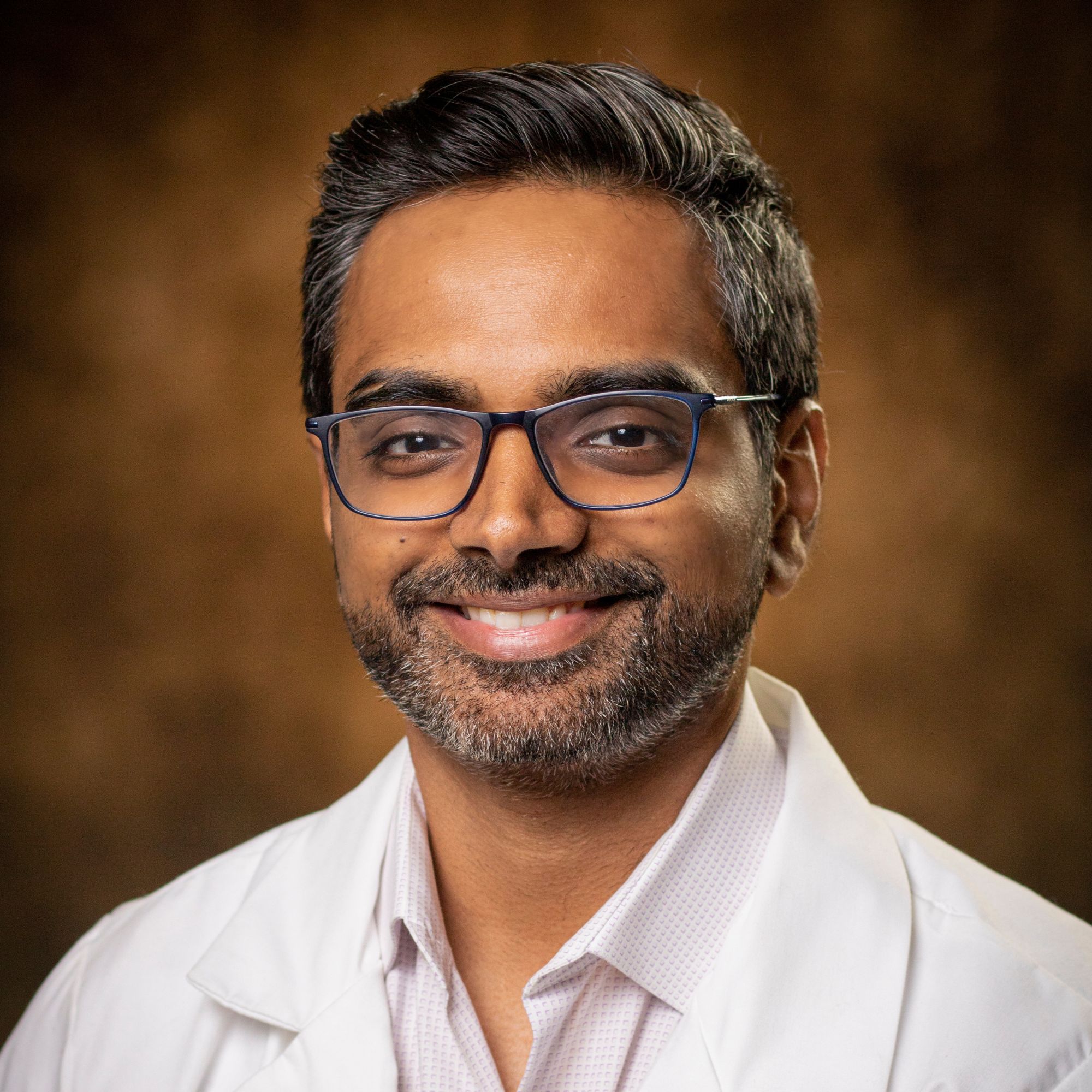
Angie: [00:00:00] Dr. S., thank you for joining us during Breast Cancer Awareness Month to help share the basics about Breast Health and perhaps to dispel some common myths. First, I wondered if you could tell us a little bit about yourself and how you came to The Rose.
Dr. Raz: Sure. A pleasure to be here. So we started, I was an assistant professor at UTMB, and this is about 2021 COVID time, actually. Uh, and Rose was short-staffed, so there was a collaboration between UTMB and Rose that, hey, some of the physicians will come in here and, um, you know, run the service. So help Rose out, and we’re like: Yeah, let’s, let’s do that. It’ll be a great collaboration. It’s a community health center. Uh, so I used to come in, and one of my other colleagues, Quan Nguyen, who’s at Baylor now, she used to be more frequent here.
And I, in particular, really liked this place from the get-go because, you know, the techs were there, the patient population that we serve. And, you know, when the collaboration ended, I just decided that, hey, you know, Rose was a better fit. You know, all the techs loved me, and I had a lot of fun here, too. [00:01:00] Uh, the leadership was awesome. I worked with Jessica back then, too-
Angie: Yeah …
Dr. Raz: and Dorothy and then Dr. Melillo. We hit it off. So everything just worked out. Back in the day, Dr. Cotes was here. She was the, she was the chief there, uh, at Galleria location, and she was actually an ex-UTMB fellow as well, right before me, two years before me. So there was already, like, some chemistry and, you know, talk, you know, work, uh, history then. So, yeah, th- then I came over to The Rose, and the rest, as they say, is history.
Angie: And how long have you been at The Rose?
Dr. Raz: So it’s been now s- five, six years. Six years, yes.
Angie: Well, we’re so, we’re so lucky to have you. Thank you for being here.
Dr. Raz: Oh, I love it here.
Angie: Uh, well, I guess I would start with if you were sitting down with a woman who s- uh, with a woman who simply act- asked, “What should I be doing to take care of my breast health?” What would you tell her?
Dr. Raz: Right. So, you know, breast, a- anything related in the nucleus around breast cancer has evolved over the years, so I’ll go through some points. So [00:02:00] back in the day, it was just like, okay, you find a lump, you go to your primary care, then they may send you to mammogram or not. And then I’m talking about as far back as 1980s.
So we’ve come a lot far now. It’s 2027, so what has changed? Well, essentially, National Screening Program has started, right, since the ’80s, and something to realize is that has reduced mortality, so how many women die from breast cancer, by 40%.
Angie: Oh, my goodness.
Dr. Raz: So obviously, do things which reduce your risk of dying. So that being, if you are 40, make sure you get mammograms. So if you’re hearing this during October, if you haven’t done so, please book your mammogram. You know, you can do it at The Rose. You can call us, et cetera. So be proactive, is what I would say.
Angie: Yeah.
Dr. Raz: If you are younger, let’s say under 40, 25, 30, now there is a huge wave, if you wanna call it, or just understanding is a better word, of at least understanding your risk.
Angie: Yeah.
Dr. Raz: And what do, [00:03:00] what do I mean by that? Not every woman is high risk, that hey, you’re gonna get it. Cancer happens, and some women or in humans in general, some are more prone, some are not. It’s a v- combination of genetics, phenotypes. These are big words I’m using, but bottom line, every person’s different, and we are moving towards individual healthcare anyways, proteomics, all these things that we’re doing.
Point being, be proactive. Go to your primary care if you’re 25, 30, and say, “Hey, um, am I… Do I have dense breasts?” And we’re gonna talk about it.
Angie: Yeah.
Dr. Raz: “But what is my risk?” Yeah. And it’s important because i- we already have models where primary care can easily put in, or even you can Google this, put in simple information like, hey, you know, I’m of this age. Who had breast cancer in my family? uh, you know, uh, what your first time your period was, et cetera, if you breastfed, when your kid was, et cetera. All these things are important, and it [00:04:00] goes into this model that people have figured out. What does that mean? The model then spits out a percentage risk that you have of developing breast cancer.
So something to understand is one in eight women will get breast cancer in America. That’s the average risk. Unfortunately, it’s pretty high. But then not every woman is at that percentage. Some have higher risk, some have lower risk, and some are mid-risk. So at least understand that. Understanding that is important. So that’s how I would start. And then obviously, what you hear about it, you know, try to check yourself every month. Good time to check is 10 days after the period. It’s the quiet phase-
Angie: Yeah …
Dr. Raz: um, of the cycle. Uh, unfortunately, breast… like physical breast exams, notor- it’s very difficult. Breast tissue is very dynamic. It can change. It can masquerade as a mass, and it changes every day really. Uh, but try to do that, and then if you feel something, let your primary care know, and then come see, you know, your breast center, and we can do mammogram and ultrasound and see what’s going on.
Angie: You mentioned looking [00:05:00] at the different risk factors and, and starting screening at 40. If a woman is under 40 and she feels like she has high risk and, and maybe just feels uncomfortable with her breasts, what would you say to her?
Dr. Raz: Yeah, excellent. So depending if the risk model, and you have different risk models, if it shows that it is high risk, we can start early screening. So for example, let’s say your, your mom, first degree relative, or your sister had breast cancer, let’s say premenopausal, 45. So guidelines say that you should really start screening at 35, so 10 years before. Um, also depends if you yourself had, let’s say, some other kind of high risk biopsy in breast, then you also can start screening early. Or if you had radiation to your chest or some other cancer, leukemia, et cetera, then you sh- can also start early.
So there are nuances. Not every woman starts at 40. So again, risk stratification, where you stand on the risk is important, and obviously, you know, if you feel a lump, then you come in so we can evaluate it, because, you know, [00:06:00] it’s, it’s not just that a woman over 40 get breast cancer.
Angie: Right.
Dr. Raz: There are plenty of women that’ll get it in 30s. It’s not as prevalent, but it can happen. So any sort of, you know, lump or skin changes, nipple discharge that’s bloody, um, these are reasons enough that you should come in.
Angie: And will The Rose see women under 40?
Dr. Raz: Yes, absolutely. We see, uh, we see teenagers all the way to, you know, women that are 80. So lifetime risks, again, if you Google around and if you ask ChatGPT, et cetera, lifetime risk really evaluates women that go up all the way till 85. Luckily, uh, breast cancer isn’t very prevalent when you’re a teenager, but fibroadenoma, which is the most common mass, that is prevalent in younger, younger women, teenagers. And while it’s not breast cancer, it could be a nuisance ’cause they can grow fast.
Angie: Right.
Dr. Raz: So we also evaluate that, and then, you know, if it is a fast-growing mass, you can excise it for symptomatic relief. So yes, it’s all [00:07:00] part and parcel of, of breast care.
Angie: So can you describe sort of what a mammogram is, a screening mammogram is, for a woman who might be coming in for the first time?
Dr. Raz: Yes, absolutely. So a mammogram, uh, essentially it’s a specialized form of x-ray, and x-rays are these electromagnetic waves, so just getting the science, but they basically penetrate the tissue and go out on the other side, and there is an imaging film that i- it bombards, and then we can see, well, what’s inside the breast.
So that’s all. It’s a special form of x-ray. A mammogram is more specific because it gives us more details. So when you come in, we do four views, top, bottom, and side to side of your breast. And yes, there’s some compression involved, but basically, you come in every year once you’re 40. And if you’re average risk, you come in every year at 40, and then you get, get your mammogram, and then m- that’s it.
You come in, you’re out, and then a physician like myself then reads the mammogram and sees if there is any abnormality, like a mass or anything else in the breast that may need [00:08:00] further evaluation. So that’s what a screening mammogram is, just four views. Think of it like, you know, when you get your yearly flu shot.
Angie: Yeah.
Dr. Raz: So it’s screening. We’re just checking, hey, is there anything abnormal or not?
Angie: And what’s the importance of 3D mammogram?
Dr. Raz: The scientific term or a fancy word is tomosynthesis, but it’s 3D mammogram. And yes, so 3D mammogram, essentially, we can look at even more detail. So think of it like if you smash something, and then you’re just looking at it top to bottom, you can have superimposition, like it, it can masquerade as, like, a mass or anything.
But if you’re able to slice through, kind of like a CT, you get better vision of what’s inside. So now 3D mammography is that. We can slice through the breast and layer by layer and see if there’s an abnormal. So this has increased our sensitivity of catching, um, uh, cancer earlier, um, things that could be missed by just 2D mammograms, and it has reduced our false positive, meaning that, you know, sometimes you can see [00:09:00] stuff and ignore it, that, hey, there isn’t anything, instead of then spending more money and seeing what’s going on.
Angie: So you talked about the screening mammogram. Can you talk a little bit about diagnostic mammogram and biopsy?
Dr. Raz: Yes. So let’s say I find an abnormality on screening mammogram. Hey, there is a mass. So then what triggers is something called a callback. You may have heard that word. Callback just means that, hey, I’m calling a patient back. Um, and this could be for anything I may see on mammogram. Um, and then the patient comes back, and we do special images. So these are not your standard mammographic images. These are zoomed-up images or special images I may request of that abnormality Which is what we call as diagnostic mammogram. Uh, these are, um, you know, there’s different compression, there are different views that we obtain just to get clarification of whatever the abnormality I saw on screening mammogram, and then we may or may not get ultrasound to further elucidate what’s going on.[00:10:00]
Um, once we know there is an abnormality, then I get to decide that hey, it is biopsy worthy. Biopsy means, usually involves us numbing of the breast and going with a needle and taking small s- t- tissue samples. We take these tissue samples because we want to know what exactly that mass or abnormality is. Another physician who’s a pathologist then looks under the microscope, runs a whole bunch of tests, and gives us an answer. Really, the answer that we’re interested in is, hey, is that abnormality cancer or not cancer?
Angie: What would you say to a woman who might be, uh, fearful of giving a mammogram because of exposure to radiation?
Dr. Raz: That’s a great question. I get that a lot. So something to understand, let’s say, w- just living on Earth as humans, we get what we call cosmic radiation or background radiation. We’re not gonna see it. It just passes through us. We all get a free mammogram in a year, e- even males. We all get a free mammogram, so the amount of cosmic radiation throughout a year, there’s a unit called [00:11:00] millisieverts.
Nobody has to remember that, but that’s how we measure radiation, how we measure length in miles, you know, k- uh, uh, pounds, et cetera, for weight. Well, we measure radiation in, uh, in radiology as millisieverts, so that’s how much you get a year just living. So that’s how much a mammogram is. It’s not much. Or if I fly to San Francisco or come back, I get that. I get a free mammogram. So the radiation really isn’t much, and it does not cause cancer. Um, so the risk-reward is heavily skewed towards doing screening so we can find cancer early.
Angie: And so if, um, if a biopsy does find cancer, we often hear, hear terms like Stage 0, Stage 1, Stage 2, and so on. Can you tell us a little bit more about those stages?
Dr. Raz: Yes. So without making it too complicated, staging just means how far the cancer has spread, or more importantly, it’s used as prognosis, meaning it gives [00:12:00] physicians an idea of what the cancer may do in the future and how they can attack it. Um, Stage 0 means the cancer is still confined within the walls of the duct.
Usually, the most common kind of cancer we find is called ductal carcinoma. Think of it like a pipe, and a Houston freeze hit, sometimes the pipe bursts, and water comes out like an ice. Uh, so think of it like that has not happened. The water’s still inside the pipe, meaning cancer is still inside that duct.
So that’s very early. Stage 0 cancer is excellent, 100% cure rate. Uh, Stage 1, Stage 2 then just depends on, hey, now there’s finally a mass, and it can go places. So then it depends on, hey, how big the mass is. We consider small masses under two centimeters, two to five medium size, and over five is large masses.
And then it depends if the cancer has spread to the lymph nodes, which are in, in, in your armpit. That’s where it likes to go first. And how many of them are positive or how many carry cancer [00:13:00] changes your Stage 1, 2, 3. I see. And then obviously, Stage 4 is metastasis, the fancy word just means cancer spread to other organs This, again, this helps physician tailor the treatment and how aggressive, not aggressive with chemotherapy they may be.
Um, and again, al- obviously, it also maps where the cancer is.
Angie: One of the things I noticed, I’m still relatively new here at The Rose, is I noticed that particularly with our mobile screenings- we tend to find cancer in stage zero and stage one.
Dr. Raz: Yes.
Angie: And I wondered if you could t- I mean, you mentioned a little bit, but more specifically about how that really benefits a woman to be able to find in those early stages.
Dr. Raz: Absolutely. So, you know, earlier in our talk, I mentioned that since the national screening program went in effect in the United States and the Western countries, in Europe, the mortality has really dipped. So 40% reduction in mortality. Why is that? Well, really, the whole point of screening is if we do catch… we cannot predict, we’re not… Well, I shouldn’t say that now. Now [00:14:00] that with the advent of AI and all these proteomics, there is some predictability that’s coming now.
Angie: Oh, interesting.
Dr. Raz: So it will happen in our lifetimes. But let’s set that aside. Mammogram isn’t gonna say that, “Hey, you’re gonna get cancer now or not.” We, we can’t do that, but it detects cancer. Then why is it important to get these four views? Much to the chagrin of many women, ’cause you get some compression. Yeah. Well, the point is that if we do catch cancer early, A, it’s not as morbid. So you have to understand morbidity. Imagine if you f- feel a cancer, or many times the whole breast is one giant cancer, inflammatory breast cancer. The treatment’s very involved, like it’s a long mastectomy, pipes are sticking out. You know, you’re in the hospital a few days, then long chemo cycle, et cetera. Now, imagine the same woman actually diligently did screening. The mass is very small. Your morbidity is low.
Angie: Yeah.
Dr. Raz: And, you know, it’s a day surgery. You’re out, and c- [00:15:00] sometimes they don’t even do chemotherapy. They just do hormonal therapy, which is just a pill. So you’re back to work and you live your normal life. The mammogram allowed that because we caught it early.
Angie: So the treatment is much less invasive-
Dr. Raz: Correct …
Angie: tends to be less, much, much less invasive.
Dr. Raz: Right.
Angie: The survivability is much higher.
Dr. Raz: Higher.
Angie: You get back to your life much sooner.
Dr. Raz: Correct.
Angie: Um, and being able-
Dr. Raz: And your recurrence risk low.
Angie: Oh, I didn’t know that. I didn’t realize that.
Dr. Raz: Right. So because you stage… Staging also implies, and again, I’m getting in the weeds, but- Yeah … if you’re earlier stage, your recurrence risk, risk is that much lower-
Angie: Oh, interesting.
Dr. Raz: At five years, 10 years, and that’s what doctors study. We study long-term, so-
Angie: Right …
Dr. Raz: at five years, are you gonna get cancer back? Well, if you have lower stage and a light, you know, l- lower grade cancer, no. So that’s also why mammogram is so much more important, screening.
Angie: You mentioned dense breasts earlier, and I’d like to circle back to that. Does having dense breasts, is that a risk factor potentially to increase your risk of cancer?
Dr. Raz: That is, yes. You’re right. It is an independent risk [00:16:00] factor of developing breast cancer. What do I mean by that? So let’s just go through risk factors of developing breast cancer. First, being a woman. So men also get breast cancer, unbeknownst to many wen- men, but we can. It’s just not as common. Um, so being a woman. Second is age. As a woman ages, unfortunately risk ramps and then it plateaus out at 80, um, so that. And then, you know, first-degree relative, genetic factors, et cetera. Having dense breasts is also one of those risk factors. In simple terms, if you have dense breasts, you have slightly higher risk of developing breast cancer than, let’s say, a woman that does not have dense breasts. What do I even mean by that? Well, if you look under a mammogram, you know, next time that you come in, you can ask me, um, dense just means that you have more breast tissue-
Angie: Yeah …
Dr. Raz: in your breast. And if that’s the case, then yes, you have slightly increased risk. As a matter of fact, now FDA, MQIC requires everybody in the United States to let a woman know that if you have dense breast or not, [00:17:00] implication being that you s- you can screen slightly differently. You can add what we call supplementary breast ultrasound. And then in some women, if your risk is much higher, close to 20%, you can do screening MRI. So that’s why it matters, so we can catch it much earlier, cancer that is.
Angie: Is that, uh, is that a reason why a woman might get a callback that might not be cancer, but there needs to be different views to be able to see-
Dr. Raz: That is correct
Angie: the tissue? Is that, uh, a common reason for callbacks?
Dr. Raz: Yeah, so a lot of times the letter may say that, “Hey, dense breast tissue, we can’t see it clearly,” which is true. Even with 3D mammography, some women have such dense breasts that we can miss stuff. The, it’s just the study’s limitation, not that because we’re terrible. Every study in medicine has something called sensitivity, meaning, hey, if, what are the odds of women having breast cancer and this study catching it?
Angie: Right.
Dr. Raz: So if you have dense breasts, unfortunately, that percentage drops, so we have to supplement that with some other studies. So when we add ultrasound as, as a more affordable [00:18:00] supplementary study to boost our sensitivity, and it does, it boosts it 10, 15% in dense breasted women.
Not every woman needs s- a supplementary ultrasound. Okay. And I’m very clear with patients that, hey, if you have dense breasts, don’t have dense breasts, no need to waste money. But with dense breasted women, it absolutely does help. There have been countless times I have caught cancer that we did not even see on a mammogram on ultrasound, and yes, the woman had dense breasts.
So it does help.
Angie: And can breast density change over time?
Dr. Raz: Excellent question. Yes, it can. Much, a lot of breast density is dependent on age and then genetic makeover, um, factors. So- Um, you know, as a woman ages, it tends to be that the density of breast decreases, but it’s not necessary. Some 70, 80-year-old, uh, r- you know, mammogram, they look like they’re 30, like super-
Angie: Interesting
Dr. Raz: dense breasts. So it’s also genetics.
Angie: Well, you mentioned about artificial intelligence earlier, and I… there’s so much talk about AI.
Dr. Raz: Yeah.
Angie: And I’m just wondering your thoughts about, about how [00:19:00] AI is affecting screening and what you sort of see ahead.
Dr. Raz: Right. So, you know, obviously, AI can help us in detection on a radiologist level. Um, so but this isn’t something that’s new to breast imaging in general. We- we’ve had something called CAD, which is image, you know, AI-assisted imaging, catching, like, tiny little oval masses or cancer. So computer helps me see that. So there’s obviously, you know, more research that’s being done and new tools that come in.
But AI tools can now tell you accurately what the breast density is as a percentage. Oh, interesting. So instead of us kind of relying on our eyeball and for dense, you know, we usually tend to separate dense breast as, um, extremely dense, heterogeneously dense, scattered, meaning not very dense and fatty, but now you can actually give a percentage to that by using AI tools.
But where AI really is coming in handy now is, you know, I alluded, alluded to this earlier in our talk, is combining all the imaging stuff with what we call [00:20:00] liquid biopsy, and what does that mean? So I’m gonna go off on a little bit of a tangent here, but there are new technologies that are coming in which check blood and check for tiny little fragments of DNA or RNA.
So just to, you know, anybody that’s hearing this podcast, you know, all of our cells have DNA, and has- Okay … uh, the cousin of DNA is called a I- RNA, um, and cells shed this. It’s in our bloodstream. So think of it like a river. How would I know what’s at the riverbank upstream? Well, you kinda sample that river.
So we’re sampling that blood, and within that blood, sometimes you can have cancer cell RNA that’s just floating around, and that way we can detect it much earlier. So now this sort of blood test would be adjunct to screening mammography. Why would that help? So just so you know, let’s say if I see an abnormality and I biopsy it, my yield, meaning, hey, if I biopsy 10 women, how much [00:21:00] cancer do I catch?
It’s actually only about, like, two or three. So about 75% to 70% of the biopsies, they’re all benign. But it does cause anxiety in a woman, right? Yeah. 30% is, like, cancer. This blood test then helps us with the gray area. A lot of times I look at an abnormality, I don’t even biopsy, I just say, “Come back in six months.”
Angie: Yeah.
Dr. Raz: But maybe that’s not the right, like, uh, decision. The bi- these, these sort of liquid biopsies will then help us that, hey, you know, this is actually a high-risk woman, so risk stratification is another thing.
Angie: Right.
Dr. Raz: Because there’s so much data now, this is where AI ties in, it will actually look at the image and also liquid biopsy and come up with a comprehensive individual risk stratification. That’s where AI’s really coming in now.
Angie: Oh, interesting.
Dr. Raz: So all these studies that we have done that, hey, you know, a woman has 12 and a half percent risk lifetime, that’s American population. Within, within even American population we have sub, you know, sub …
Angie: Yeah,
Dr. Raz: so-
Angie: Yeah …
Dr. Raz: so they’re white women and they’re Black women and there are other ethnicities.
Angie: Their risk [00:22:00] varies depending on the-
Dr. Raz: Exactly
Angie: … variety of factors.
Dr. Raz: So, so, exactly.
Angie: Yeah.
Dr. Raz: So all the ethniti- ethnicities, and even socioeconomic factors, it actually changes what your risk is.
Angie: Right.
Dr. Raz: Because all these studies were done in a certain cohort. So all of this is complicated, but bottom line, to answer your original question, AI helps with this. Because there’s so much data, it needs a nice compact form.
Angie: Right.
Dr. Raz: So with all these emerging technologies, AI can then summarize. You know, everybody goes to ChatGPT to summarize; that’s where it’ll help us on our back end.
Angie: Yeah. And so what’s the impact of that practically? It sounds like women will have a better idea of their risk.
Dr. Raz: Correct.
Angie: And-
Dr. Raz: And, and then, hey, how do we screen? Is, is the screening only r- MRI screening only reserved for 20% high-risk women, or maybe we can actually identify women that are in this mid- midsection where a 15% risk that MRI may benefit. How about supplementary ultrasound? Yeah. So that’s where these women that have, let’s say, a positive liquid [00:23:00] biopsy, but nothing’s showing up on mammogram, are they candidate for MRI? They may be-
Angie: Oh, that’s interesting …
Dr. Raz: because they’re floating these cancer-like cells. What’s going on?
Angie: Right.
Dr. Raz: Or ultrasound even, so, or then there’s another thing we call contrast-enhanced mammography, which is a, uh, a more compliant version of, let’s say, MRI. Um, so all these things, you know, we, there are a lot of gray area in breast imaging. That’s where the resolution will come. That’s where the subsets will form.
Angie: Well, that’s really interesting, and it sounds like that those advances will help with early detection, perhaps help women with, with the ca- w- really just help also with the comfort level, that when you get a call back, you know exactly what you’re getting called back for-
Dr. Raz: Correct
Angie: just to provide more information along the pr- on the woman’s journey as well.
Dr. Raz: Right, right, and you can be more confident in your result, too.
Angie: Yeah.
Dr. Raz: Yeah.
Angie: Well, thank you so much for being here today. I think that, uh, this is such a great topic for Breast Cancer Awareness Month. I think that people will, uh, our listeners [00:24:00] will have a really great understanding of sort of what to expect the next time they come in for their m- their mammogram and, and what that process looks like. So thank you very much.
Dr. Raz: Oh, you’re welcome. Always a pleasure to be here. Thank you.
Post-Credits: Thank you for joining us today on Let’s Talk About Your Breasts. This podcast is produced by Speke Podcasting and brought to you by The Rose. Visit therose.org to learn more about our organization. Subscribe to our podcast, share episodes with friends, and join the conversation on social media using hashtag #Let’sTalkAboutYourBreasts. We welcome your feedback and suggestions. Consider supporting The Rose. Your gift can make the difference to a person in need. And remember, self-care is not selfish. It’s essential.