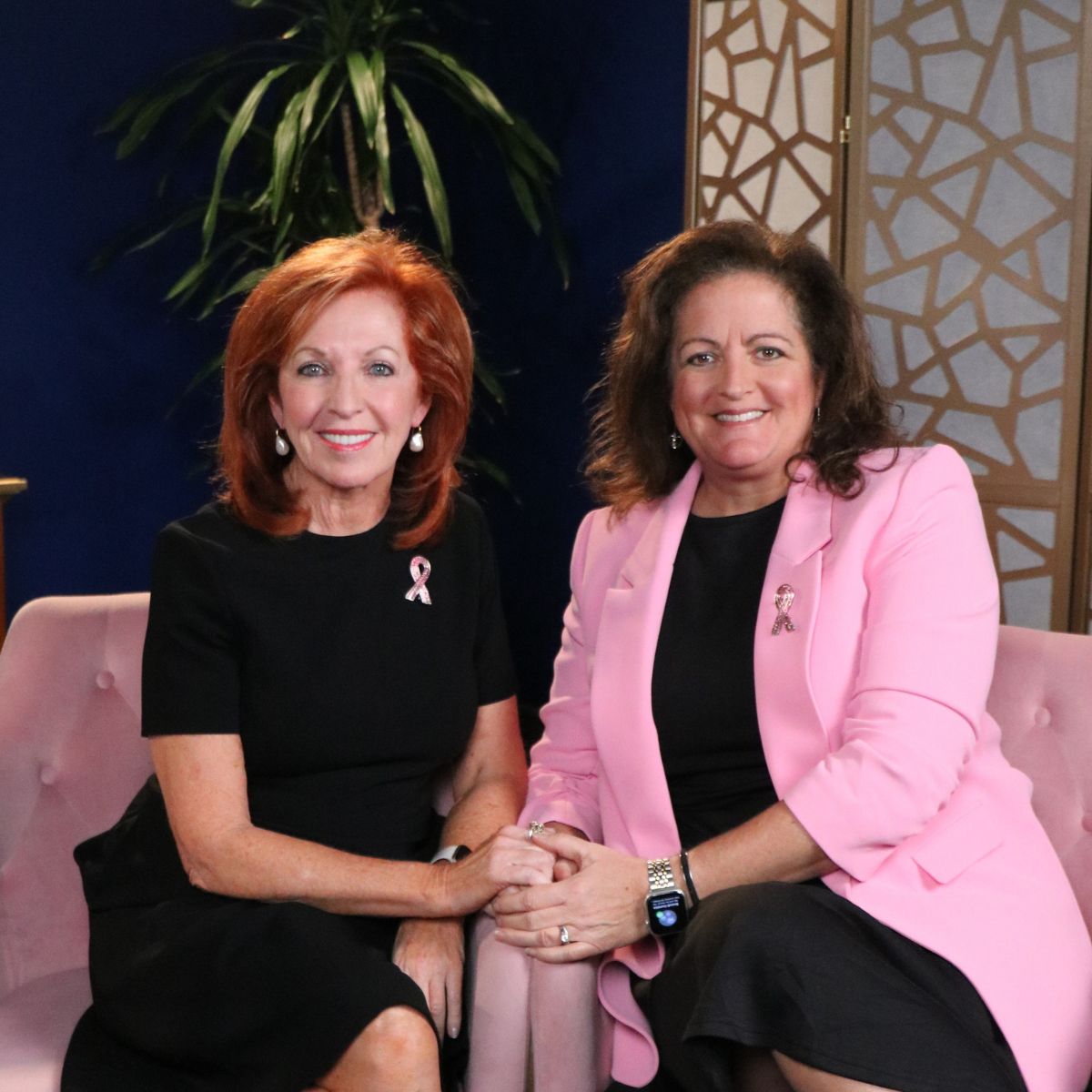
Dorothy: [00:00:00] Mothers and daughters share many things in life. And when it comes to breast cancer, we all know the importance of family history, but seldom is the daughter the first one to be diagnosed in the family. Today we’re talking to Shelley Cooper and her mother, Nancy Strohmer, who were both diagnosed with breast cancer only their diagnosis were eight years apart. First Shelley had it and then Nancy. But you’re gonna hear how each of them handled their breast cancer together and separately as they went through treatment, both of them had the same surgeon and both of them are totally recovered. Nancy and Shelley are our honorees at this year’s Everything’s Coming Up Roses luncheon and you can learn more about them and it at therose.org.
Let’s Talk About Your Breast, a different kind of podcast presented to you by The Rose, a breast center of excellence, [00:01:00] and a Texas treasure. You’re gonna hear frank discussions about tough topics, and you’re gonna learn why knowing about your breast could save your life.
Nancy and Shelley, thank you so much for coming on Let’s Talk About Your Breast and thank you even more for being the honorees of our Everything’s Coming Up Roses luncheon. We’re so happy to have you here.
Nancy: It’s wonderful to be here. Thank you Dorothy
Dorothy: and Nancy, you are no pro at this. You’ve been with us before telling us your story, and now Shelley, you have too. I have never. I don’t remember such an unusual mother daughter team as you two. You have just been such a delight to get to know and I, I think the most interesting thing is here you are both very successful women in male dominated industries, each with [00:02:00] your own special knack and what you do, but you’re also always finding time for volunteer work. How does that happen?
Shelley: Well, for me, I think it’s just in my blood. So I’ve had a great mentor in my mom and that she’s always given back always, whether, you know, it’s just at the schools or or whatever. I’ve always experienced her as a volunteer and you know, I think I’ve always had that in me as well, where I, I feel the need to give back. The need to participate and to help really, I like to help as much as I can and, and most of that translates into volunteering.
Dorothy: Nancy.
Nancy: Well, for me, it goes back to my parents originally, uh, they were very giving people, they taught me to, that it was important to give back. I have a real intense need and still do to, to give back. When I still had my business to feel like I was well-rounded, I had to be doing [00:03:00] something outside of the business as well. Volunteer work. So I’ve been involved now in Houston over 40 years with the Houston Symphony being the first group that, uh, I became involved in, became president, and was probably on every committee practically they have arts, medicine, uh, those have been my and, and Civic as well, my primary interests. And currently I have to, uh, talk about that because I’m just, I love what I’m doing with the Greater Houston Women’s Chamber of Commerce. So we just don’t.
Dorothy: Such a fabulous organization.
Nancy: It, it’s, it’s wonderful the way they promote the advancement of all women, all ages. Uh, they do a great job and we just opened a chapter in Paris, France this past year, and.
Dorothy: Oh!
Nancy: I’m so lucky to be the liaison for the, the France chapter, so I’m really excited.
Dorothy: Oh, I, I cannot [00:04:00] imagine how you could handle that job.
Nancy: it’s gonna be hard.
Dorothy: Gonna be so hard. Yes.
Nancy: So that’s really, um, been my current interest and it goes without saying, The Rose is very important to both of us. Um. We’re just so, we’re honored to be honored at the coming, the upcoming election.
Dorothy: Well, I tell you what, besides being so much fun, you two just bring a, a whole new dynamic to, to this event. And it’s, uh, I, I think it’s just so important that we do emphasize, you know, you owned a business as a woman in a world that that just didn’t happen. And, uh, for how long?
Nancy: 20 years. Didn’t start up. Uh, I wasn’t the original owner, but I was later on, so for 20 years, and still in that industry, there’s, there’s not a female owner, so.
Dorothy: Wow. You [00:05:00] were one.
Nancy: There will be one eventually, i’m sure, I hope.
Dorothy: Yeah. And you’re in the same field, Shelley, but, and your job is very again, having to sell something, market something that most of us would not even know what you’re talking about. I mean, this is plastics, this is so needed, and shipping and things like that, but we, I’ve never even heard of this.
Shelley: Yeah. It’s, it’s difficult to explain in my friend circle sometimes, because, you know, and, and really I kind of dumb it down, typically like BASF, we don’t make the things you use, we make ’em better. So it’s kind of that philosophy across the board. And for me now, it’s, it’s similar. It’s, it’s basically plastic sheets that go into things that we all use on a daily basis and, and inter interact or encounter on a daily basis. So there’s familiarity, but it’s, it’s very foreign to most people.
Dorothy: So inventor also?
Shelley: Yeah.
Dorothy: [00:06:00] Yes. Explain just, just for the audience, explain what you which you patented.
Shelley: Sure. I was co-inventor of a, basically a giant bag that is, tilt . So it self empties essentially. So in these large ocean containers that you see driving down the road or on um, barges, they will put a big plastic bag inside of that. And generally when it gets to a site, it needs to be tilted to emp, empty. So pellets or plastic, little before it’s into a sheet, these little plastic balls fall out of it or powder and it needs some sort of tilting mechanism. So this was a invention to eliminate that need because there are areas of the world that they don’t have that tilting capability. So it basically tilts it up and the bag kind of pushes itself and it’s a giant bubble that pushes all the material out. And it’s called a tilt list liner. I know, right?
Nancy: And just like that.
Dorothy: Just like that. And you’re both rural [00:07:00] travelers, am I right on that?
Shelley: Correct.
Nancy: Well, I’ve been on all seven continents.
Dorothy: Yes.
Nancy: So I’ve traveled worldwide. I don’t know how many, I think it was 38 countries. Is that what I put there?
Dorothy: Yep.
Nancy: 38 countries and maybe have creeped up since I last did the, the math on it, but, yep. 38.
Dorothy: Primarily with work?
Shelley: No, no, no. We’ve been, uh, it’s been a mixture. My, our family loves to travel. My parents have taken us to many, many places that never would’ve been able to do without them. You know, as an example, my 21st birthday, my mom took me to Africa, and yeah, so it was, it was really when we started to connect more as friends as opposed to the, the mother daughter. And so, and it was before I was gonna start to, you know, find a spouse and those kind of things. So we wanted that time together. So she gifted that to me and we went and had an amazing experience in Africa and, um, Singapore and Malaysia, and it was just a whirlwind tour. So that’s just one [00:08:00] of the samples of what, what they’ve, what, excuse me, where I’ve been and what I’ve done.
Dorothy: But I bet you neither of you ever thought you’d be sharing a breast cancer experience.
Nancy: No. No.
Shelley: And we don’t have a family history of it. I mean, my grandma had it, but she was in their eighties and they, you know, that’s kind of a, they, they say you’ll get it eventually. So that really wasn’t a family history event. So yeah, it was, it was a shock for us.
Nancy: Shocking.
Dorothy: Yeah. I’ve had several mother daughters sit in these chairs. Almost always it is the mother has it first and then the daughter. But it was not that way with you two.
Shelley: No. We decided to mix things up.
Dorothy: Well, you certainly did. So Shelley, you went first.
Shelley: I did. I did. So I was diagnosed at, uh, 41 years old.
Dorothy: First mammogram.
Shelley: First mammogram ever.
Dorothy: That you had to ask for?
Shelley: I did, yes. I had to. I had asked the year before and um, was told, oh no, you don’t need to [00:09:00] do it until next year. And they said, really? We’re moving them to 50 really now. So. We’ll just, you know, we’ll, we’ll wait. So not, not being as comfortable with doctors as I am now, probably. I just accepted that and then I have a history of friends. Uh, one of my really good friends in high school passed away at 30, or in her thirties, I should say, was diagnosed at 30. Um, and that’s always been on my radar of how could that happen? How do I, you know, how do I take that experience to help, you know, me and others. So I’ve always been an advocate, but I was, again, taking the doctor’s advice at the time. And then, but I, I swore to myself after I was disappointed not doing it, that the next year I would do it. And I did. And again, surprise, I was diagnosed in my first mammogram.
Dorothy: Early stage.
Shelley: Very early stage. It was, um, stage zero DCIS. So I was very thankful for that. And, you know, I, I’ve said this before, but embarrassed that, you know, to even say that I [00:10:00] had cancer because I didn’t feel like it was, but. You know, it can’t be diagnosed with that, you know, and, and, and it has to start somewhere.
Dorothy: Right.
Shelley: You know, but I’ve just always seen everybody struggle and, you know, I, I’ve had personal experiences with people that had it much worse, so I didn’t know how to take the information and how to accept it and say, okay, it really is what it is, and you need to take it and, and own up that it’s cancer. So.
Dorothy: Right. Right. And you’re and that’s so true. It, it doesn’t matter. It’s cancer.
Shelley: Yeah.
Dorothy: Nancy, now we’re gonna fast forward. Eight years?
Nancy: Eight years.
Dorothy: And how was your cancer found?
Nancy: So, uh, in September, 2023, uh, I went in for my annual mammogram. Never missed a mam Mammogram, of course, and jumped forward. I found I was diagnosed with breast cancer, no lumps. Didn’t feel anything. Um. And even when I went in, uh, to [00:11:00] see the oncologist, he didn’t feel anything. So he, before my biopsy was done, he said, well, I don’t think it’s going to be, you know, it’s not going to be too far along because I don’t feel anything. So I was, uh, diagnosed with stage two HER2+ cancer. And fortunately who I had chosen, which I had done the research when Shelley was diagnosed eight years prior, I chose Dr. Ken Osborne for my oncologist and fortunately he was available and he is world renowned noun for his, her two plus research.
Dorothy: Yes.
Nancy: So I was very fortunate to, uh, to have him as my oncologist. So, um. I, I, I was, but I was shocked. I, I, I was really in denial for a while, but I reflected back when Shelley was diagnosed. [00:12:00] I mean, I was more shocked that she was, uh, I mean, it was just, uh, I, I, I really had a hard time dealing with that. It was, her mother didn’t tell her that, but you know, I did. I mean, I knew what that meant and I knew that, um, you know, that what, what was ahead probably. But both of us are, are really pragmatic. We use this word a lot because we are, we do the facts, we do the research, and then we do whatever we need to do to make sure we have the best outcome. And I knew Shelley. You know, I have, she’s the go Google Pro now, the chat GPT Pro. But, so I knew that, uh, you know, she was doing what she needed to do, uh, to get through through it, but I learned something then watching her, which helped me when I was diagnosed. Her strength, her resolve, her quiet strength. [00:13:00] It just, it really inspired me and I just, I, I just, you know, every day she does, so she’s almost become the mother and I’m the, the daughter now, you know? But no, I’m, I’m gonna say no. We’re best friends. That that’s most importantly now, as she says. Yep.
Dorothy: So, so did you know she felt that way about you?
Shelley: I don’t think so. Not in so many, but, you know, I do. I mean, she’s, she’s very transparent about, you know, our, our relationship and how it But I, I don’t think, at the time I knew, I, I knew she would, she had to be worried because I would be as a mother. But she didn’t show it? No. And, you know, there were minor indications, but I had no idea. No.
Dorothy: Do you remember what you felt when you first heard, how did you, did you tell her in person or over the phone or?
Shelley: I called her, if I remember correctly. And because she was really, I think, my second call after my husband, and because I know she’s so resourceful and her friend’s base, [00:14:00] you know, is so in touch with, you know, the medical field and I wanted their expertise on where to go. ’cause you know, obviously there’s MD Anderson, that’s always the first thought, but I didn’t know if there was a better fit, you know? And after, you know, she asked her friends and, and we talked about Dr. Osborne and all this. I mean, it, it was clear to me that Baylor was the right choice.
Um, and, and it has been for, for the whole process. It’s really been a, a great experience. But yeah, that was the first thing was, okay, great, I gotta tell her this. How do I make it sound, you know, as, as gentle as possible? Um, you know, ’cause I knew she’d be scared and so again, I’m sure I was very pragmatic and just, here’s what it is. And, and really it was about a month before I really knew it was official. Ah, but because, you know, they, they just saw calcifications.
Nancy: Right.
Shelley: And then they had to, you know, they, I, I think I had a, well, I know I had a second mammogram, still couldn’t really identify ’cause it was, it was pretty deep, um, close [00:15:00] to my muscle. And a little bit tough spot to see and tough. Um, I had advocated for the, um, the 3D mammogram. ‘Cause it was not popular at the time.
Dorothy: Right.
Shelley: And so I, I, you know, I, my mom had said she has Brent’s death dense breast at some point. And so I said, okay, well let’s do that. So it was, you know, really even with that two mammograms, still didn’t know until we did the, um, did the, um, biopsy. And so I don’t even remember the process between, you know, then and ma being official, but I, I do remember the discussion saying, I knew she was the one to ask for help.
Dorothy: Yeah. Yeah. The, uh, so anytime with calcifications, they can be very tricky. And they can look different ways.
Shelley: Sure.
Dorothy: So I can certainly understand how two mammograms it, it does take the biopsy. But now Nancy, yours was a very different kind of cancer and still [00:16:00] listening to you two. Both of you went through diagnosis treatment very quickly.
Nancy: Yes. Surprisingly.
Dorothy: I thought, how did this happen?
Nancy: And I think, um, well, it’s. Uh, we did go through it, both of us did very quickly. And it’s probably because of the strong contacts I have at Baylor. And really from volunteering as well. You know, I was ear early on part of the partnership, which is a, the volunteer arm At the time of Baylor. So, you know, I knew, um, a, a lot of the, the people there and the volunteers. And that helps you navigate.
Dorothy: Right.
Nancy: You know, that process a lot better.
Dorothy: Right.
Nancy: So we both had the benefit of that. So that mine and I did, you know, Dr. Osborne was actually a personal friend, so, so I [00:17:00] was definitely on the fast track and I was very fortunate because of that. Um, but you know, part of, I think that this whole diagnosis. Yeah. The, the stress is the waiting. You know, the waiting on a diagnosis, the waiting on the treatment.
Dorothy: Waiting on the pathology, waiting on that. Yes.
Nancy: Everything. Yes. And waiting on what is the outcome going to be. But that’s where God comes in, in faith.
Shelley: Yeah. And I’ll piggyback on that. I’m glad you ended on that. ’cause I was gonna say, you know, kind of stress the, the God side of it and the, I call ’em God winks and, you know, part of it obviously was. The how do you know who to contact, which is What’s, you know, integral in how we all got started in this process. But it’s also, you know, being a little lucky, also being persistent like we are. So I think us, you know, being very deliberate and saying, okay, what’s next? What’s next? What’s next? What’s next?
Instead of waiting for the information, I think that [00:18:00] helps us, and then. God had to be for us along the process the entire way. And again, I say God winks because, you know, even just little things like, um, we ended up with the same surgeon. So Dr. Bonefas. we’re talking, you know, eight years later, completely non-planned, but she, I said, so who’s your surgeon?
Dorothy: Different cancers.
Nancy: Yes. Absolutely. Yes.
Dorothy: Tough.
Shelley: Yes. And, and she said, Dr. Bonefas. And I said, you gotta be kidding. I said, same one for me. And I, so, you know, I see that as. As a blessing and a, and a little wink from God saying everything’s gonna be okay.
Nancy: Yeah.
Shelley: You know, another instances, um, my radiologist, I decided to do it closer to my side of town because I was bouncing back and forth from work. And, um, so I went, went to my, my, uh, radiologist did that, and then my husband was diagnosed this past year with, um, colon cancer. Another God wink is he had the exact same radiologist. So yeah, we went to the first appointment. I was like, I know you.
Nancy: Yeah.
Dorothy: [00:19:00] Oh my gosh.
Shelley: Wow. So, and we’re talking 10 years later at this point, and I said, I know you. And so I had a, you know, because I, my, everybody will laugh. I’m very heavy into Facebook because I post everything and I print an album at the end of the year. So I flipped through my Facebook thing and I pulled up a picture of him and I showed him of my ringing the bell. And my mom was in the picture as well. And you know, so the, we had a lot of these little God winks and I think that’s really how the process worked best for us and how there was reassurance along the way. Just even now popping up in a completely different cancer, completely different person. And, and we have these littles, same surgeons.
Nancy: Yeah.
Shelley: Yep.
Dorothy: You know, when I have listened to both of you, I, I kept trying to find that word for you. I know pragmatics good and organized is good, but you know, there’s a, a deep sense of acceptance and that I pick up and both of you [00:20:00] because of this faith.
Nancy: Yes. Yes.
Dorothy: It’s just, yeah, you can’t even quite put your finger on it. But that also leads to that what, what I see as confidence.
Nancy: And peace.
Dorothy: And Yes. Yeah.
Nancy: I mean.
Dorothy: Yeah.
Nancy: Faith.
Dorothy: Is, it’s almost like each of you took, here’s this diagnosis and here’s God.
Nancy: Right. And put it in his hands and he’ll, he’ll take care of you. And I’ve said this before, but he is in our corner. He always is.
Dorothy: Yes.
Nancy: And you just need to let him do his work.
Shelley: And I think it’s, you know, it’s interesting you say that because, you know, we both are very planned and organized and driven. And, but the reality is we don’t have control of anything that goes on in our lives. And, you know, that is, these are subtle, subtle and dramatic and big reminders that we don’t. And it’s, it’s a reminder from God to say, Hey, guess what? It’s, it’s as [00:21:00] organized as you may be. And as, as you know, put together as you think you are, I’m still in control.
Nancy: Right, right.
Shelley: And we, you still need me. And I think, and I love that and it’s, you know, ’cause I think as we. Uh, take our faith journey. You know, sometimes we’re closer, sometimes we’re more distant to, distant to God, and I think sometimes he, he likes to send me a reminder and say, you know what? Don’t forget about me. Don’t, don’t get lost. And sometimes it’s a painful one and.
Dorothy: Oh.
Shelley: Yeah. So I, I feel that.
Dorothy: Don’t get lost.
Shelley: Yeah.
Dorothy: Wow. That’s a, that’s a strong, strong message.
Nancy: Well, faith is a, is a big part of who we are and what makes us who we are as well. And trusting in him.
Dorothy: So, and this may be a little different, a little strange, but it just dawned on me that so many women that I’ve spoken to have said they felt like they did something wrong [00:22:00] in order to, that this diagnosis was some kind of punishment. Neither one of you felt that way.
Nancy: Never.
Shelley: No, I don’t think so. And I, I don’t know. I think it’s.
Dorothy: Not that anything is wrong. I mean, might how you feel is how you feel.
Nancy: Right.
Shelley: No, and you’re right because some what did I do deserve this.
Dorothy: Right.
Shelley: I think it sometimes can be a typical reaction, but I, I think, you know, the way my parents raised me was, uh, a tribute to how I reacted. I think. I mean, it’s, you know, you can’t be the victim. You have to take control of your life as much as you can. And with God’s reminders that you’re not in total control, but.
Dorothy: Right.
Shelley: I think that part of that, it helped me think, okay, keep, it didn’t even put the thought in, what did I do deserve this? It’s, how do I get out of this and how do I overcome it? It’s really more the, the thought that I took.
Dorothy: And how do you not use this faith, but rely on this faith or.
Shelley: Sure.
Dorothy: Make sure that it is there.
Nancy: And I never had it [00:23:00] either. Not, not even. I’m just grateful to have the life I have, the health I have, the daughter I have, but it’s true. I listen to her and think, oh my gosh, I am so impressed by her.
Shelley: Well, I feel the same.
Nancy: I wanna be, I wanna be just like her, but, the best mother. She’s just the best daughter, but any, and it’s really nice to hear uh, her verbalize, you know, who she is and how she’s dealt with this, because it is, we’re very, very similar in that respect. Many others too, of course. But, um, but, but faith is, is number one.
Dorothy: So did this experience of both of you going through it change your relationship any at all?
Shelley: Um, you know, I think it just further took us in a further step. I mean, I don’t think it dynamically changed it, [00:24:00] but I think it does tie us together to think, okay, well we both have been through that and we both experienced it. And, you know, I, I think even this is sort of related, but when, when I rang my bell, I, I kind of took this as, you know, it’s just another day and, you know, it wasn’t, and I didn’t realize it until my mom surprised me and showed up that day. So that was something that that stood out in my mind. So when she went through her journey. Guess what I did?
Nancy: Surprise.
Shelley: I surprised her.
Dorothy: Oh gosh.
Shelley: And I, my gosh, I absolutely scared her in the parking lot.
Nancy: And she did it intentionally and videoed it, and she videoed it and she, I mean, you know, I thought it was being, that’s gonna be killed, you know, someone was there in the parking lot, but I really didn’t dream. I had no idea. And, you know, that it just, it meant the world to me.
Dorothy: Yeah.
Nancy: I was, it was, it was. Really important for me to be there for [00:25:00] Shelley. And I wanted to surprise her because I knew it was a big deal. I had never gone through it. Uh, through breast cancer or any cancer, but I knew it was a big deal when, when she rang the bell.
Dorothy: Yeah.
Shelley: And I didn’t, and that’s why I cherish, you know, our relationship is. We know when we need each other.
Nancy: Yeah.
Shelley: And don’t have to ask and.
Nancy: Right.
Shelley: You know, I, I worked in cahoots with one of her best friends and, you know, we all met there and we were texting back and forth and I was like, she’s not here yet. She’s da da. You know? And so it was a fun little process that I could return the favor and she did. Of how much it meant to me.
Nancy: Tenfold.
Shelley: And I didn’t realize how much it meant to me for to have somebody there. Yeah.
Nancy: And she did the same but tenfold for me. You know? She, yeah. It was, it was. I mean, but I do go back to when she scared me to death because I really didn’t expect any, anyone to be there.
Shelley: And I really do, have to scare people. So ask my best friends growing up.
Dorothy: Oh my goodness.
Nancy: So [00:26:00] it was a extra special day for me, for her to be there and, and she had my a best friend there as well. So.
Dorothy: That is. That is such a, a special. It’s, it’s a bonding memory. Special memory for both of you.
Nancy: Yes.
Dorothy: So how do you celebrate now? Now you have, you’ve only been out…
Nancy: Two and it’ll be three years this October.
Dorothy: Okay.
Nancy: So two and a half, little, about two and a half years. Not long at all.
Dorothy: Were y’all diagnosed near the same time?
Nancy: Yes.
Shelley: Yeah.
Dorothy: Yes.
Shelley: Same because we both, yeah. Finished in October and.
Nancy: Yes.
Shelley: She, I think she was diagnosed a little quick in.
Nancy: September.
Shelley: Yeah. Yeah. I was June. And finished in October, so, but well, sorry, I had my mammogram in June. I was diagnosed. No, I was diagnosed in September actually. That is right. Well, yeah.
Dorothy: Wow.
Shelley: Yeah.
Dorothy: Another.
Shelley: It’s very similar, which.
Dorothy: Is another.
Nancy: Yeah. Yeah. Very. Yeah. Interesting.
Shelley: They’re scary to say it’s gonna be okay. Yeah. You know, and you can look at it. You said scary. You can look at it [00:27:00] where it was a little bit, it is a little scary coincidence.
Nancy: Scary, right?
Shelley: Yeah. Yeah. It’s a scary coincidence. But I also see it as a little bit of a, a tap, you know?
Nancy: It, it is a kind.
Dorothy: Yeah. Right.
Shelley: Yeah. And it’s funny that we just now made the connection, but I, I, I see it as that.
Dorothy: Yes. And so when you. Now, I’m sure this never happens, but you don’t ever introduce yourself as, hi, I am Nancy. Hi, I am Shelley. We had breast cancer together, right? Or we both had breast cancer or nothing like that. That that doesn’t define.
Shelley: No.
Dorothy: It doesn’t.
Shelley: No it doesn’t. But I will say I do use it and again, with advocating and, and making people. Uh, focus on self-care is anytime I hear anybody talking about any health related thing or, oh, I haven’t gotten my mammogram, I definitely piggyback on our experiences and share it and say, you know what? You have got to go. I mean, there’s no excuse. You know, you, all of us are busy and you know, I [00:28:00] think, I can’t tell you how many times people say, oh, you guys are so busy. You’re never busy enough to make sure that you stay ahead of something like this. So, you know, for me, it took forcing myself to put it on the calendar. Now I don’t leave the office without putting it the, you know, the next year out. And I make it work. Um, and so you’re never busy, too busy to schedule it. And so I do piggyback our experience and I say, you know, you’ve gotta do it and you’ve gotta get, get your test done.
Nancy: And it’s why this, what we’re doing today is so important to both of us. Because that’s what you do so well. The Rose. Uh, getting that access to early, early, uh, detection.
Dorothy: Detection, yes.
Nancy: And that truly does save lives.
Dorothy: Right.
Nancy: And this organization has such an important mission in the community so that you really do. And that’s why it’s even more important to us now. [00:29:00] We’ve, we’ve had it. I had the experience firsthand.
Dorothy: Right?
Nancy: So it even makes it more important. But there are those that are, do have cancer and haven’t been diagnosed and that’s where you all come in and it’s, you offer a very, very special, um, offering to every woman. Whether she can afford it or not.
Dorothy: Right.
Nancy: And you do it with compassion. And with dignity. So it, that, that really is and very impressive, very important to, to us.
Shelley: And to piggyback on that, something that hit me like a Mack truck that I learned about The Rose is how people coming here that are insured and get tested. Is an easy way and a such an important way to give back as well.
Dorothy: Right.
Shelley: Because.
Dorothy: That’s right. Our insured population. Yes, absolutely. It, it provides us that foundation, that base that we so need, because, you know, providing care for [00:30:00] the uninsured is very, very costly. If it was only screening. Our insured women could help us do almost every one of the 8,000 women that we do every year.
Nancy: Wow.
Dorothy: But it’s never only screening, you know, that uninsured woman is walking in more than likely with a problem that uninsured woman’s gonna need diagnostic workups, biopsies. It’s always different for her. Yes.
Shelley: Yeah. And I think that’s such a powerful and unique thing that The Rose offers. So, um, you know, that’s something that I try to share and I post it on my Facebook, you know, recently and, and try to put those little things out there to educate people about The Rose more.
Dorothy: Is anyone surprised that you’ve chosen The Rose? Have you had to educate people about what it is and.
Nancy: Yes.
Dorothy: Yes.
Nancy: They’re not surprised.
Dorothy: Right.
Nancy: But I know I have to educate them, um, because there’s similar organizations and similar, uh, organizations that have. [00:31:00] Uh, rose in their name or whatever, right? So, so that’s been something that, and I’ve become more educated on The Rose as well, make sure that I can communicate the right message.
Dorothy: Right.
Nancy: But I have, and yeah, I think that’s really important and that’s our role to do that. To really get the, the name out there, what, what you do and how important it is.
Dorothy: Right.
Shelley: Yeah. And I don’t think, like she said, I don’t think people are surprised when I tell them about it. Of course. ’cause I’ve been pushing, you know, breast cancer awareness. But I will say one thing I was surprised about is my son’s high school, Bridgeland High School, he’s a freshman there in October. They do a push and a donation to The Rose. And I was surprised. I had no idea. And so one of my friends, I said, you know, we were signing up for things and I said, I’m, I’m gonna sign up for that one because you know, I have a personal tie in now. And so it was fun to be able to kind of put my two worlds [00:32:00] together.
Dorothy: Right. And you know, that just goes to show everyone can help.
Shelley: Yes, yes, yes.
Dorothy: You know, it doesn’t matter. Size of the gift. It’s, it’s also about that awareness. The Rose is here. I’ve always said the, my worst nightmare is that someone’s walking around out there and doesn’t know about us. That needs us. And that’s why this is so important, both of you sharing and making sure that people know there is a place they can go.
Nancy: Yes.
Dorothy: And we can’t do it without the help.
Nancy: Yep.
Dorothy: Nope. For sure. Yeah. So, wow. We’re gonna have a great luncheon and it’s gonna be so successful.
Nancy: Excited.
Dorothy: We’re gonna have fun.
Nancy: Yes.
Dorothy: And again, thank you both for being our mother daughter.
Shelley: Ah.
Dorothy: Backwards, but, but still our mother daughter, honorees and, uh, for this wonderful volunteer work that you’re doing for us.
Shelley: Thank you.
Nancy: Thank you. Well, thank you for having us and I just love doing it with my, it was [00:33:00] fun because it’s wonderful. It was a pleasure. Was fun.
Shelley: Thank you for having us.
Dorothy: Y’all just play off each other. It’s great. Thanks again.
Nancy: Thank you, Dorothy. We really appreciate it.
Post-Credits: Thank you for joining us today on Let’s Talk About Your Breasts. This podcast is produced by Speke Podcasting and brought to you by The Rose. Visit therose.org to learn more about our organization. Subscribe to our podcast, share episodes with friends, and join the conversation on social media using #LetsTalkAboutYourBreasts. We welcome your feedback and suggestions. Consider supporting The Rose. Your gift can make the difference to a person in need. And remember, self care is not selfish. It’s essential.