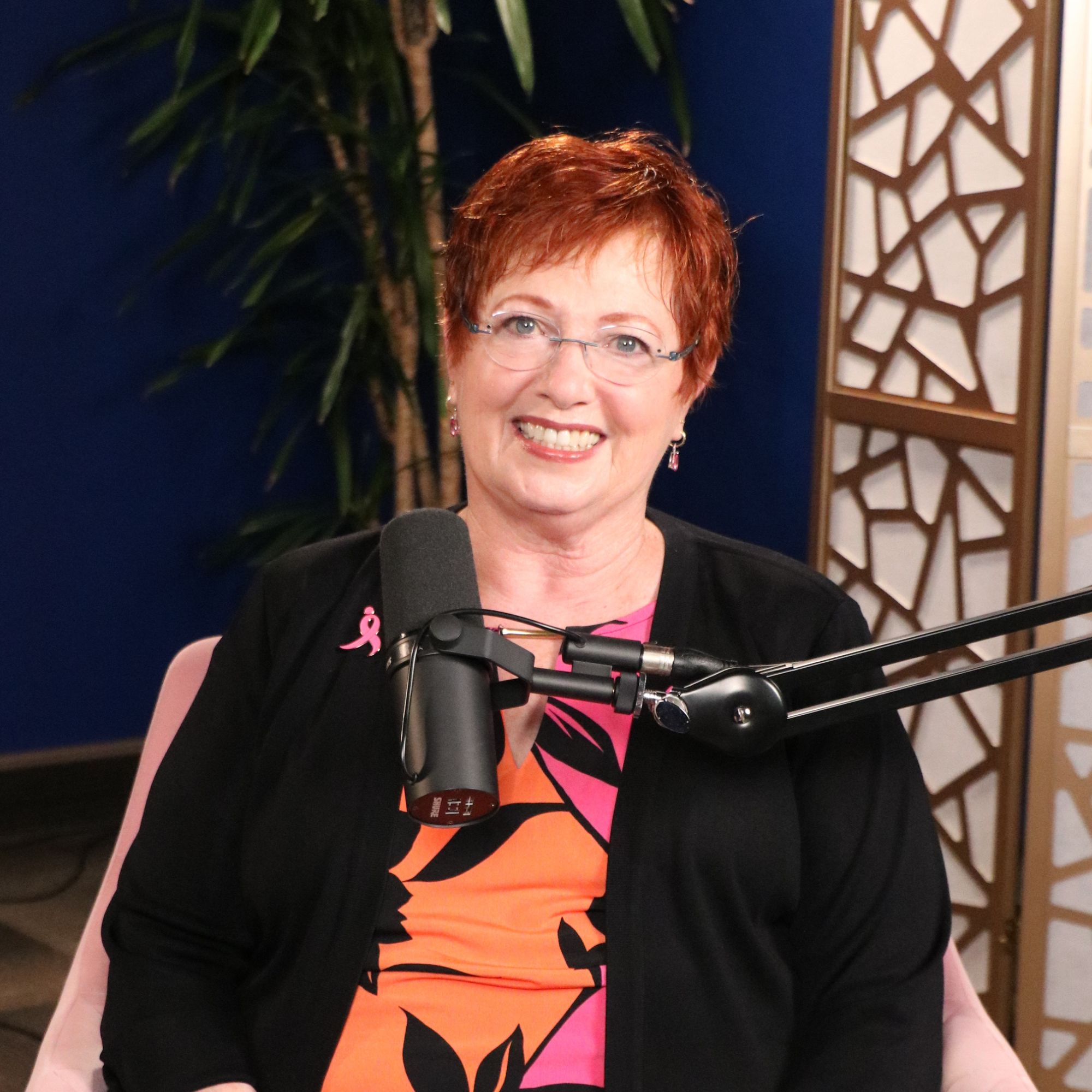
Dorothy: [00:00:00] Anne Meyn helped launch The Rose Buds, which was our second breast cancer support group, and it started back in 1991. Anne had already gone through her own breast cancer experience, and since then she has devoted decades to supporting women facing breast cancer. She shows exactly what real support looks like from encouraging self-exams to continuing to teach, while having treatment, to leading the way in patient advocacy.
But along the way, Anne has become so much more than an advocate. She has served on critical national and local research committees, and she’s had a say from a patient’s point of view about what treatment should be and how it should be conducted. She says she came from a family that valued science, married a man who was a scientist, and it was just natural for her to become immersed in the science that impacts breast cancer treatment.
If Anne’s story [00:01:00] inspires you, please share this episode with someone in your life who needs to hear it. Subscribe to Let’s Talk About Your Breast on your favorite podcast platform, or go to therose.org and support our mission.
Let’s Talk About Your Breast, a different kind of podcast presented to you by The Rose, a breast center of excellence, and a Texas treasure. You’re gonna hear frank discussions about tough topics. And you’re gonna learn why knowing about your breast could save your life.
Anne, it is such a joy to have you here.
Anne: I love being here with you.
Dorothy: We have known each other 36 years.
Anne: —Six years.
Dorothy: 36 years. Oh my gosh. So as our, one of our founding members of the Rosebuds, I want you to go back to, what was that, [00:02:00] 1990?
Anne: 1990.
Dorothy: And tell us what was the rosebuds and why it was so needed at that time.
Anne: I already knew about The Rose. And.
Dorothy: Now how did you know about The Rose though?
Anne: I went, it was a presentation and I can’t remember where the presentation was.
Dorothy: Oh, okay.
Anne: And it could have been through Komen too, because. You were one of the three first recipients of grants.
Dorothy: Yes.
Anne: From our local co and affiliates.
Dorothy: Yes.
Anne: And continued the entire time we gave out community grants. Well, yes. To receive them, but the passion that you and Dixie had and the way that you set up the paradigm of the whole concept of The Rose, having women who are insured going in and having mammograms that then can cover women who are not insured. It, it was wonderful concept. And then at that time, [00:03:00] at the beginning, you had radiologists who were reading. The scans for free. I mean, they were donating their time. I mean, the passion around it, it, it took my heart.
Dorothy: Yeah.
Anne: I mean, it was really, it was really something and you just exuded the passion. And I can’t thank you enough for all the women you’ve saved because truly you have, and I, I have supported you wholeheartedly as long as
Dorothy: Oh, I know you have. I can remember. Yes.
Anne: And um, so when you opened a second site on Still Link at six 10 next to the All Cat Vet?
Dorothy: Yes.
Anne: We sat in that tiny little space and sat on the floor and I can’t really remember how I found out about, I guess you sent us some of us. Letters or something about, [00:04:00] about starting a support group. Through the, and you already had a support group at your original location.
Dorothy: Right.
Anne: But there was no support group for the Southwest area or in central area. So I remember sitting on the floor with Dolores Kennedy. And I can’t, I mean, there were four or five of us. Uh, Linda Yager. And we were sitting on the floor of the Joan Gordon Center for The Rose stuffing envelopes and how we got all the names of the people, I don’t remember either, but we sent letters to, to women who had been diagnosed with breast cancer to see if they were interested in coming to a support group. And it’s important, I mean, I had informally talked to people and I’d been, um, a reached recovery volunteer too.
But. It’s very important, I think, exchange knowledge. And we, we invited speakers to [00:05:00] come to the original. I can remember which they all came and explained about clinical trials because so many people did not have a clue.
Dorothy: Yeah.
Anne: About even what a clinical trial was, much less the benefits.
Dorothy: Right.
Anne: So, yeah, it was, it was important to do. And I think back on some of the members and some of ’em are no longer with us.
Dorothy: That’s so true. That is so true. But you remember back then, the whole concept of support groups was a little out there. You know, I have support from my family, you know, I, I don’t need this kind of support, but there was a study that came out. Do you remember that? And we used that in all of our letters, all of our, you know, just it, it was very important how it showed the difference in the emotional wellbeing and everything.
And so I, that group, The Rose at one time before COVID had six different support groups.
Anne: Oh.
Dorothy: We had The Rose garden. [00:06:00] Which was our original, The Rose Buds. We had the metastatic group, we had the, uh, young women’s group and we had an African American group and we had a Hispanic group, so it was like. And, you know, there’s different needs in every population at every age. Uh, the young women, when we started our young women’s support group, it was entirely, entirely different than like The Rose Garden.
Anne: Right.
Dorothy: Which was primarily older women. And, and you know, I mean, you remember how we had to separate
Anne: Yeah, I, I do. Remember that. I can remember you pulling me aside and ex saying. As we had two that we knew were metastatic. They were both pregnant when they were diagnosed and both metastatic and their needs were much different than a newly diagnosed who’s just first of all. [00:07:00] You know, deer in the headlights, you know? I’ve just been diagnosed with cancer and what am I gonna do and what can I expect? That’s a whole different ballgame than somebody who is probably terminal. And at that point, I mean, in 1990, the, well.
Dorothy: That’s a whole, yeah.
Anne: The statistics were quite different.
Dorothy: Quite different than they are today. Yes, yes.
Anne: And, um, so it was, it was rough. And I can remember. It wasn’t a shock, but I can remember going to visit the two who, the first two we lost. And you were saying, you know, those needs are different. And that’s when we broke off Rosebuds too.
Dorothy: Right.
Anne: For the metastatic group.
Dorothy: Right.
Anne: So we had Rosebuds one, was was two.
Dorothy: It was such a, uh dynamic group, though, like you said, you, your group always insisted on speakers on more knowledge on, and it was a, a younger group. Anyway, that [00:08:00] we, that we looked at it, it, it was always so dynamic. In fact, the Rosebuds eventually became their own nonprofit and you know, and that worked for a while, but I think. I think what has happened since COVID is we’ve really lost that ability to get together in person. We realize so much on Zoom and it’s just different.
Anne: It’s not the same. And I see this not just with The Rose Buds, or support group, but, and people aren’t willing to travel as much to go someplace to meet. I mean, it’s, it’s so, there are many factors that.
Dorothy: Oh, yeah.
Anne: Changed during COVID, but certainly zoom isn’t.
Dorothy: The hugs are therapeutic. Remember?
Anne: They, they.
Dorothy: How often we talked about that.
Anne: Yeah.
Dorothy: We have to hug each other just to get through this stuff. Now Anne, you were diagnosed before then when?
Anne: Oh yeah. I was actually still in treatment when we started.
Dorothy: When we started. Okay.
Anne: Because I was [00:09:00] diagnosed. And this so much has changed. I mean, I, my gynecologist was wonderful. Jack Moore taught me how to do breast self exam. I faithfully did my breast self exam and found two lumps and went in to see him. And he said, well, the first lump that he felt, he said, well, that one’s a cyst. And then I said, well, what about the other one? And it’s at six o’clock. And he felt it and his expression changed. Pulled out a ballpoint pen, drew around it, sent me down for a mammogram and told me at that time, I don’t care what the mammogram shows, you need to see a surgeon.
And had the mammogram, probably one of the roughest I’d had ’cause it was a Friday afternoon and the techs wanted to go home. But, um, he called me the following Tuesday and said The mammogram doesn’t show anything. [00:10:00] Although, I mean, I was clearly palpable. He said, but you need to see a surgeon. Do you want me to set it up or let Ray, my husband wasn’t in experimental radiation oncology at MD Anderson. So he set it up, but it was long before we knew about dense Breasts.
Dorothy: Right.
Anne: And at that point they were saying 5% don’t show up on a mammogram.
Dorothy: Yeah.
Anne: And. I was in that category.
Dorothy: Right.
Anne: And, but it was, it was very aggressive. Um, they’ve, they’ve changed what the, the um, the schedule they used.
Dorothy: Yeah, the protocol.
Anne: The grading. The grading system.
Dorothy: Right.
Anne: And, mine was, at that point, it was one, but one on that scale was the most aggressive. So between being premenopausal and my, you know, so you got my [00:11:00] age factor and you had the pathology came back and where the DNA, where the cells were reproducing were bad, I mean at the stage they were reproducing and the speed they were re reproducing, it meant chemotherapy.
Dorothy: Pretty standard though. At at, at that point. At that point there everybody, I mean, yeah.
Anne: And I was. On the cusp of when they start, they stopped doing surgery first. Ah, because all the chemotherapy I had, we just presume it shrunk any cells that were left. But right after that and the, the very year after that, they started doing chemo first to see if it was shrinking the tumors. Which makes total sense.
Dorothy: Oh yeah.
Anne: But you know, and back then. There were no breast surgeons. You had cancer surgeons who could care less about [00:12:00] cosmesis. They just cut out the tumor. And that was it. And got clear margins and sew you back up.
Dorothy: Yeah, that was it.
Anne: That was it.
Dorothy: So, and some of those sew ups were not done where you could reconstruct it at all?
Anne: I had a very strange reconstruction.
Dorothy: Oh, you did?
Anne: Very creative reconstruction, because my tumor was at six o’clock and they did what they called a segmental mastectomy, which they don’t do anymore either. They took a pie shape piece. And mine being at six o’clock, they essentially took everything under my breast. So my profile was like my nipple pointed to the floor and it looked like gonzo’s nose.
Dorothy: Oh my gosh.
Anne: So, and pulled so tight. It was shiny. It was. So anyway, so I did the, I did the chemo and taught [00:13:00] full time. I would schedule it on a Friday and they put me on a pump. And I finished the chemo at home. My husband would disconnect me, take the pump back, and then I would be at work teaching school on Monday. So it was six months, because also what has changed is now you have drugs that can boost your cell count. We just had to wait until my cell count was high enough to zap me again.
Dorothy: Yes, yes.
Anne: So that was six months of the cocktail of the day. Five FU, Adriamycin Cytoxin. And then I had a clinical trial of two more drugs for another four months. So it was 10 months of chemo.
Dorothy: Wow.
Anne: And then it was, um, uh. Uh, then I had some reconstruction. ’cause I’m so fair, they were afraid to do radiation.
Dorothy: Mm.
Anne: They’re [00:14:00] afraid they wouldn’t be able to do any reconstruction. So I had this creative reconstruction and then, um, um, did radiation for six weeks.
Dorothy: You had everything.
Anne: 13 months of.
Dorothy: Oh my goodness.
Anne: Treatment.
Dorothy: But, you know, you were volunteering during that time with us. And somewhere else. Were you, I mean, you, you never really stopped.
Anne: No, no. I didn’t stop. I really feel if it’s possible. And everybody reacts to differently.
Dorothy: Yeah.
Anne: Differently to keep as normal life as possible. You have to listen to your body. And if I were going to do something at night, I would ha, I knew I’d have to take a nap. And for me, radiation was a piece of cake after.
Dorothy: Oh yeah.
Anne: After the chemo. And I would teach during the day and go do my radiation after. I’ve taught all day. Oh, now I did get really fatigued by.
Dorothy: Oh yeah. [00:15:00]
Anne: And that was really my only side effect from the radiation.
Dorothy: And we’re, we are talking back in the eight, nine.
Anne: Yes.
Dorothy: 90. We’ve learned so much. But, you know, and, and, and I wanna point this out, you came from a scientific family.
Anne: Yeah.
Dorothy: And your husband was a scientist. You have that kind of brain.
Anne: My parents were both in research. My dad was an MD. Who started out in pathology and then wanted to know what was causing, you know more about the microbes that were causing some of these deaths.
Dorothy: Right.
Anne: So then became a microbiologist and actually started the microbiology department at the University of Kansas Medical Center.
Dorothy: Oh.
Anne: And my mother went the PhD route and she ran his lab. And they wrote papers together. And so yes, I’ve had a passion for research. Appreciated it since.
Dorothy: So when did you first start being that [00:16:00] patient advocate in the research world? In the re which, talk about that just a little bit and why it’s important.
Anne: Yeah. Well, clearly I’ve understood the, the need for research.
Dorothy: Right.
Anne: When I retired from my career in education, I, um was asked to be a patient advocate, which I’d never been on MD Anderson’s breast Cancer spore grant.
Dorothy: Oh.
Anne: Which were through the government. And, um, so I did that and then I thought, man, I don’t understand. I mean, I did have science courses in college, a lot of them, but. This was all different. And then I was asked to represent MD Anderson as the patient advocate on the Translational Breast Cancer Research Consortium. Uh, which was the, the 18 largest cancer centers in the country. And they did [00:17:00] medium sized clinical trials. And really got patient’s perspective on them. So every proposal they made for these clinical trials had to be reviewed by patients. Who were the patient advocates on this? Well, I thought I need some more science to be up to date. And then National Breast Cancer Coalition has a fabulous. Absolutely fabulous course. And I mean, course called Project Lead. And it’s a week long intensive course.
Dorothy: Right.
Anne: In the summer. It’s done in the summertime. And they take 50, the maximum is 50 people to be participate in this training. It’s like taking a semester course in a week. I mean, it’s, it’s intense.
Dorothy: Yeah. It’s so.
Anne: But by the time it’s done, you’re not intimidated. To hear and you usually get the gist even if you don’t understand every [00:18:00] single part of it. Yeah. Part of what the science that they’re talking about.
Dorothy: Oh, it was a great, great course. Yeah.
Anne: So, and then it mushroomed, I started reviewing grants and, uh, it just, it really did mushroom from, from there. It’s, it’s a very recognized in the patient research advocacy world.
Dorothy: Right. And there was a time that that didn’t even exist. So you were there at the very beginning?
Anne: Well, not the very, very beginning.
Dorothy: But pretty close.
Anne: Pretty early on. Pretty early on, yes. I did that course in 2009. So it was, uh, and I see, still see many of the people, people, oh, and I can remember, um, unfortunately losing a very passionate young man who had been in the military at Camp Lajeune, and they did, in fact, he, he testified in front of Congress and they [00:19:00] finally did realize that there really was something in the water. And there were so many men diagnosed with breast cancer, much less the women that had been at Camp Lejeune. Yeah.
Dorothy: Gosh, that’s a piece of history.
Anne: Yeah. It’s a piece of history. And, um, he was very critical in Finally doing that.
Dorothy: You know, I was thinking the other day you have been a survivor almost half your life.
Anne: Truly. Yeah.
Dorothy: I mean, yeah.
Anne: Yeah. I’ll be 79 this month, so, yeah.
Dorothy: Wow. Wow. So, and, and. You were a young woman. You had young children. I mean, uh, you know, I, I’m always astounded with the number of young women that we diagnosed, but it really hasn’t changed all that much.
Anne: No. In fact, I think we’re diagnosing more and more young women, I think.
Dorothy: Oh yeah.
Anne: Part of it being that no one thought young [00:20:00] women could get breast cancer way back when.
Dorothy: And then when it presents itself where it’s, we’re not screening and it’s at the age we need to.
Anne: Right. And when you look at the fact that, generally speaking, most of the young women have very aggressive disease.
Dorothy: And it makes no sense.
Anne: No.
Dorothy: So as you, as you look back, how much further do you think we’re gonna go?
Anne: It’s one of those, those adages, like the more you know, the more you know you need to know. I mean, it’s, they keep coming up with more and more, you know, they used to just say triple negative, which is kind of a misnomer. What it is, is it’s not a lot of other things that.
Dorothy: Right.
Anne: So it, it’s estrogen receptor negative and it’s, you know. HER2 negative, they didn’t even test for HER2. They didn’t know about HER2. When I was diagnosed. I have no idea what my, HER2 status was. Oh. But [00:21:00] I mean, truly. I mean, they, they have come so far, they’re also. We’re trying to find the root of what is, why are so many people susceptible to aggressive disease. And what can they do to prevent the metastasis, not just how do you treat the metastasis? So there’s two different angles there. How do you treat the metastasis once someone has metastasis? And then how do you prevent it from metastasizing in the first place? And they’re testing, circulating tumor cells in the DNA in your bloodstream. And so they have come so far. There’s so many things now, and yet we still lose 40,000 women a year, men and women a year. Not just women.
Dorothy: But I think. Yeah, you’re a perfect example. I mean, [00:22:00] look at all the years you have survived and not just survived. You’ve had a bang up life. I mean, you’ve done things people dream of, but also the fact that when you say there’s so much more to learn or so much more to discover, then that just says to me. That there’s still that, that desire to find it.
Anne: Yeah.
Dorothy: You know, we used to say, if you could figure out what caused breast cancer, the 17 different types that you have, then you could, you could cure any, and you’d know what caused all cancers. But I think we’ve just discovered it’s a lot more complex than we ever thought.
Anne: Yeah. And, and now mind you, there’s so many things they know now. And test for now. Um. Mutations, you know, the, the genetic testing is imperative that they do now.
Dorothy: Oh.
Anne: Um, the onco, the typing.
Dorothy: Right.
Anne: You know? Right. So they know from the get go, they have an idea of how it should be [00:23:00] treated. You know, by doing the.
Dorothy: It’s not just one treatment for everyone. No, it’s not just, yeah.
Anne: So we, we do have personalized medicine now. We do have targeted therapies now. I mean, this didn’t exist. Back when I was treated. You know, they had a cocktail and my poor sister-in-law was 35 when she was diagnosed. They just threw drugs at her. I mean, there were no cocktails in 1981.
Dorothy: Oh, my living when she misdiagnosed. Oh my goodness.
Anne: But she got, she is having a lot of side effects from long-term survivorship type. Side effects from some of the drugs. Cardiac issues.
Dorothy: Yeah.
Anne: From some of the drugs that she had. But she’s still here and she’s living a pretty good life despite that.
Dorothy: So let’s, let’s look at 50 years after you’ve died. What do you think breast cancer will be like then? The treatment? I, will it be cured?
Anne: I would, I would, I would hope.
Dorothy: Yeah.
Anne: [00:24:00] I would hope it would be, I mean, when I think about how far we’ve come at this point, and some, and some types are just much more aggressive than others. But as aggressive as, say, inflammatory breast cancer is, which people didn’t even know about.
Dorothy: Right.
Anne: But I know people who have lived for 25 years with that.
Dorothy: Yeah.
Anne: That have had inflammatory breast cancer and.
Dorothy: That used to be they would be gone.
Anne: That was it. Yeah.
Dorothy: Yeah.
Anne: Yeah. And um, so there are many things and there’s like Herceptin as a drug for somebody that has the aggressive, HER2 that used to be one of the deadliest types. Of breast cancer you could get. Well, now it’s a very treat, it’s one of the most treatable ones.
Dorothy: Yes.
Anne: Because there’s a targeted drug for that.
Dorothy: Right.
Anne: So it’s sad to say we haven’t, we haven’t cured it. We have certainly come a long way. [00:25:00] There are many kinds of cancers that are very receptive. A lot of the blood cancers especially, that are very receptive to immune therapy. Basically they call breast cancer cold term tumors, and you have to turn it on to be hot in order to treat it. So one of the clinical trials, um, is that they actually give a very small dosage of radiation before they even do the surgery. And the chemo to so they can give some immune because that will turn it hot and they can give them immune therapy.
Dorothy: Really?
Anne: Yeah. I mean, what’s happening now in research is truly amazing. Another thing that’s happening is there are a lot of deescalation uh, trials out there now. [00:26:00] So, you know, do you really have to have, I had five weeks of one kind of beam of radiation and one week of a different kind. That’s called a boost, and now many of them are half that dose. Or I mean, you, there’s so many different kinds of radiation treatments now that are much shorter in duration than.
Dorothy: You know. I hadn’t thought about that in a long time.
Anne: Yes.
Dorothy: Yeah, that is, that has changed a lot.
Anne: Well, and it’s also changed who does it. Many women who work just wanted to do the double mastectomy so they wouldn’t have to do radiation. Because that was six weeks of treatment. Well, maybe it’s not six weeks of treatment anymore.
Dorothy: Anymore. Yeah.
Anne: So.
Dorothy: You know, that was the number one reason why most of our uninsured, even after we got coverage for reconstruction or any of that, was like, [00:27:00] no, I, I can’t afford to be gone. I can’t afford to not work.
Anne: Yeah.
Dorothy: I can’t. Yeah. But that, that’s really, that’s really different.
Anne: So, I mean, we have come an amazing
Dorothy: Oh yes. All right. Now, I know Ray had his own cancer, right? Tell me what was harder being the patient or being the caregiver?
Anne: Being the caregiver. I mean, at least I knew, I mean, I knew what to expect from the treatments. Now, mind you, I had chemotherapy before Zofran, which is the miracle anti-nausea drug. Um, and. MD Anderson was very creative and had these capsules. They just called a BH, and I basically would sleep. I also could be talking to you right now like this and have no recollection of it the next day.
So if somebody called me on the phone, I learned I had to write it down or I would not have any memory of it. [00:28:00] The worst side effect was I was, I was sleeping a lot when I would be on the treatment. And, but when I would go off, I couldn’t sleep for two days.
Dorothy: Oh.
Anne: And I couldn’t teach full dime if I couldn’t sleep.
Dorothy: Right.
Anne: So I. I said, what is a BH? This cocktail that they created? Ativan, Haldol, and Benadryl.
Dorothy: Oh my gosh.
Anne: So I said, wonder, I said, I can’t do it. And so he said, well, the only other thing we have is Compas Compazine. And he said, it’s not gonna touch the nausea. So.
Dorothy: So Ray didn’t have to do any of that?
Anne: Oh, yeah.
Dorothy: Or he did.
Anne: Ray had metastatic. It had squamous cell.
Dorothy: Oh.
Anne: And it started here, and they Did surgery had to refa, and then it was whack-a-mole, you know? It, it moved from here and then be, because it, it [00:29:00] traveled in a nerve, and when cancer cells are in a nerve, they tend to jump. So it jumped. And it was in his lymph system. So then they had to do a neck dissection over here, and then he, they had to do a neck dissection over here, and then it was in a sub clavicle.
Dorothy: Okay.
Anne: So it was like whack-a-mole, you know, we’re just gonna get one. And, and so each time it met surgery, more radiation than he had necrosis in the jaw. So they had to re take bone out of his leg to create a new jaw where it had so much radiation, that was much harder for me, well, than, than my own journey. A different kind of cancer. I mean to Yeah. But he also, he’d have a feeding tube and he would feed himself while he was having his lab meetings. I mean, he, he took a paper clip and, and put the [00:30:00] food up on a cabinet and what they’d have their meeting and he’d be having this, you know.
Dorothy: That’s enough. That’s enough. We, we’ve got the picture of right here.
Anne: All right.
Dorothy: Closing.
Anne: Yeah.
Dorothy: What message do you have for women today?
Anne: Part of it is just from the very beginning, what I’ve always said, know your body.
Dorothy: Mm.
Anne: Know your body know if something’s different.
Dorothy: Right.
Anne: Although they don’t promote it so much anymore. If you’re taught the proper way to do a breast self exam. Do it.
Dorothy: You will know. And if you do it routinely.
Anne: Regularly.
Dorothy: Yeah. You’ll know and it’s free.
Anne: Yeah. And, and hopefully. The sooner you can catch a cancer, the more treatable it is, right? So. Do your screenings, get your mammograms. If you don’t have insurance, go to The Rose. You know, it’s, you know, it’s even, or if you have insurance, go to The Rose. Even, even if you have the insurance, you can go to [00:31:00] The Rose and be educated. You know, the more you know, it’s not an easy journey if you’re going through it, but if you know what’s happening and you keep yourself educated. But go to reputable resources for your education, you know?
Dorothy: Right.
Anne: There’s a lot out there that’s a whack-a-mole. It’s just.
Dorothy: Yeah. I, I think it’s, uh, actually in the nineties we didn’t have so much, so you, it really.
Anne: Yeah.
Dorothy: Today is a lot harder.
Anne: Yeah.
Dorothy: It’s very hard not to Google Doctor. Dr. Google.
Anne: Go to them.
Dorothy: Yeah. So that’s great advice. Great advice. Know your body. Educate yourself and, and stay on top of screenings screening. Yeah.
Anne: Yeah. One of the things that you mentioned was what, what impact I might have had.
Dorothy: Oh, yes.
Anne: Yes. And one thing I thought about was, you know, when different people, I [00:32:00] felt like I’m an educator, let me educate. And I was teaching in a jumbo elementary school. And I felt it was important for to educate both the other teachers, the parents, the kids. So there were two other families who had children going, the mothers were going through breast cancer a little bit behind me in treatment. So like one day I saw the mother of a friend and who was going through breast cancer.
I asked how she was doing and well, she’s losing her hair and it’s pretty traumatic. And I said, well, it is. So I hadn’t to have their daughter who was in third grade in my computer lab that day. So when we, when the kids came in, I said, oh, it’s kind of hot in here. I think I’ll take my hair off, and pulled my wig off and put it on the desk.
And [00:33:00] of course the kids were silent. You could hear a pin drop. And then I explained that I had breast cancer and that I was being treated, and I showed them my sub clavicle catheter and explained that that was how I was getting the medicine, and that the medicine was so strong that it kills fast growing cells like the cancer, but it also kills fast growing cells like your hair.
And I said when I’m done with the medicine, my hair will grow back, but right now I don’t have any hair. And then the little girl talked about her mother, which is exactly what I wanted. My daughter happens to be very artistic. And so the last day of school, I had my daughter paint my head the entire head with flowers and vines and a face in the back.
And I went to school that way and I made [00:34:00] sure I went to all four of the classes that had children whose mothers were in treatment. Well, this, these precious little boys in kindergarten and first grade. And I had happened to have met the mother at MD Anderson, and so I made sure I went in those two classes and I had a note from their teacher, the first grade teacher, saying she had tried to get Javier to talk about what his mother was going through.
I never said a word. The second I left the classroom, he jumped up out of his seat, which he never did, and he said, my mother is bald too. And then the, I got a phone call in less than a month from the mother. Telling me that she had to stay home from work one day and let the boys paint her head but it did exactly what I wanted. To take the fear away.
Dorothy: [00:35:00] Right.
Anne: And I cannot tell you for years later, I had parents coming up to me saying. That was so good because when I was diagnosed, when my sister was diagnosed, they said, oh, Mrs. Meyn had cancer, and she’s okay now. So, you know, that was exactly, exactly.
Dorothy: Right.
Anne: I mean, it’s something you go through. But you can generally speaking, get on the other side of.
Dorothy: Oh dear. So good to see you. It’s been fun to have you on the show and.
Anne: Oh dear friend.
Dorothy: Good luck on everything,
Anne: Well.
Dorothy: That you got lined up. What?
Anne: And good luck with your.
Dorothy: Oh, yes, yes.
Anne: Newly New Retirement, when it’s coming soon. I can’t imagine.
Dorothy: No. Yep. We’ve been there through a lot.
Anne: Through a lot. Yeah. So.
Dorothy: More to come.
Anne: More to come. And you’ll always be my dear friend.
Dorothy: Oh, you for sure.
Post-Credits: Thank you for [00:36:00] joining us today on Let’s Talk About Your Breasts. This podcast is produced by Speke Podcasting and brought to you by The Rose. Visit therose.org to learn more about our organization. Subscribe to our podcast, share episodes with friends, and join the conversation on social media using #LetsTalkAboutYourBreasts. We welcome your feedback and suggestions. Consider supporting The Rose. Your gift can make the difference to a person in need. And remember, self care is not selfish. It’s essential.