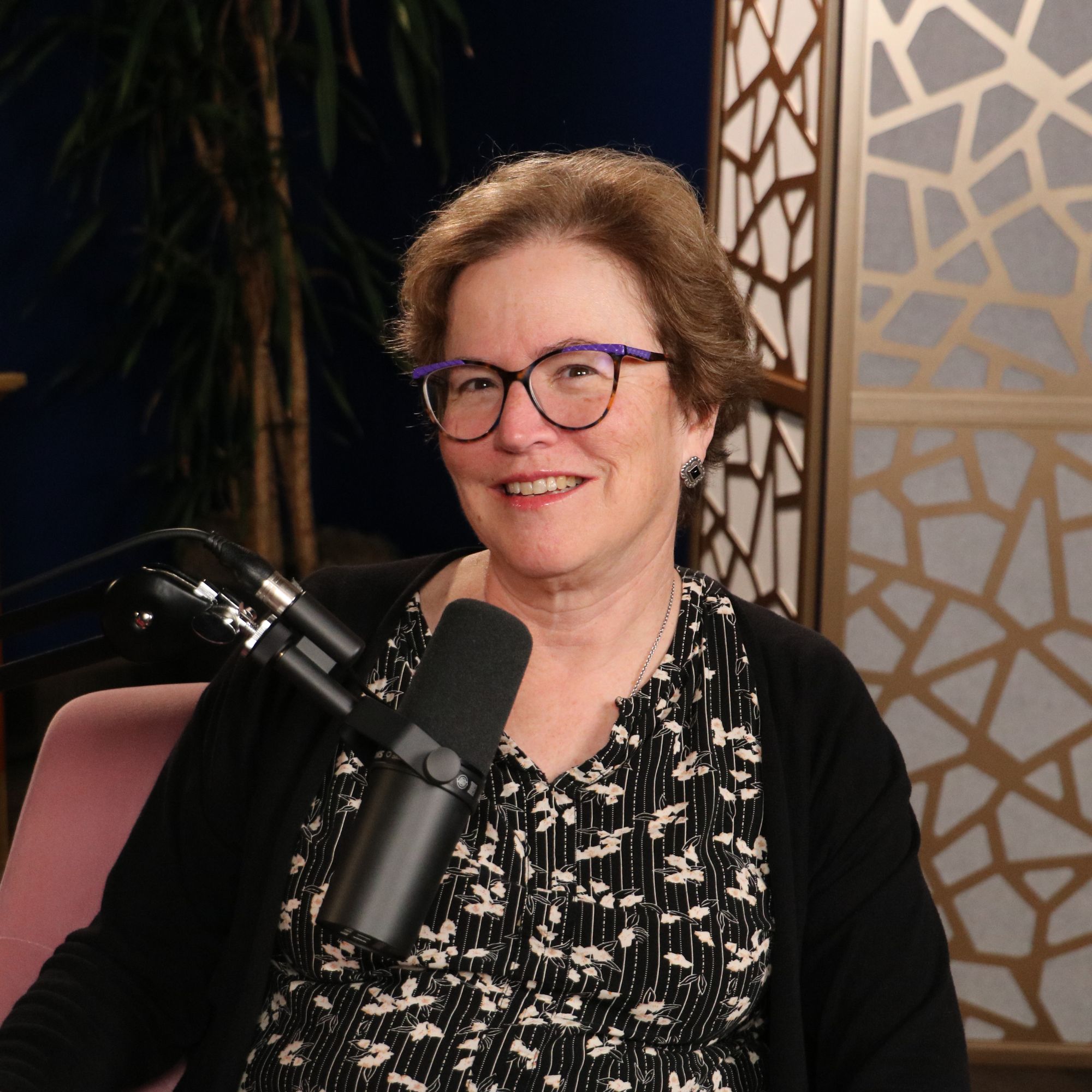
Dorothy: [00:00:00] I am so tickled today to have the chance to talk to Elizabeth Bonefas. Dr. Bonefas is a legend here at The Rose in the breast cancer community. She is someone who we all admire, someone who really stands up for her patients. Someone who’s been doing this a long time, almost as long as The Rose. And she’s also a physician who not only helped us with a lot of patients who were diagnosed with cancer, but with our youngest ever diagnosed breast cancer patient. Her story is one of love and caring and of being a woman at a time when women were not accepted that much and who refused to take no for an answer.
When you subscribe to our show, you help us grow. Someone you know may need to hear this story, so please share with your family and friends and consider supporting our mission at therose.org.
Let’s Talk [00:01:00] About Your Breast, a different kind of podcast presented to you by The Rose, a breast center of excellence, and a Texas treasure. You’re gonna hear frank discussions about tough topics, and you’re gonna learn why knowing about your breast could save your life.
Dr. Bonefas, thank you so much for being with us today. You know, you’re a legend. I mean, you are a legend in, in all of the breast cancer world in Houston area. I, I don’t remember a time when I didn’t know about you, but as you were saying, you were at St. Josephs? Yeah.
Dr. Bonefas: I did my residency at St. Joseph from 1984 to 1989, and then when I came out, I chose to stay in the Houston area. Went into practice with Dr. Kramer. Uh, stayed with him for approximately four years and then took the big plunge and went out on my own.
Dorothy: Are you still solo?
Dr. Bonefas: [00:02:00] Yeah, pretty much. I share offices with, uh, Dr. Concepcion Diaz-Arrastia.
Dorothy: Oh, yes.
Dr. Bonefas: Yes. Who’s, uh, she’s in gen oncology. We felt like that was a good, uh, marriage, so to speak. So we share office space and that’s worked out very well. Yeah. 1989. Went out into private practice, and then in 1993 went out really on my own. And since that time I’ve been out on my own, I’ve had occasional people that I’ve, uh, shared office space with. And, um, and that’s how that’s gone. I’ve been at, um, Baylor College of Medicine since 1994.
Dorothy: Okay.
Dr. Bonefas: And that’s probably been my biggest introduction to The Rose because I was at Ben Taub In, in their general surgery and breast clinics.
Dorothy: Right. And you took care of so many of our patients.
Dr. Bonefas: Yes.
Dorothy: Oh, [00:03:00] that, that was a really tough time. I, we had just started doing ultrasounds and biopsies at that time, and so, uh, the whole the environment was changing and you couldn’t just call on people to get folks in anymore. It was, it was really a, a tough time. We were so grateful for Ben Taub.
Dr. Bonefas: Yes.
Dorothy: We really were.
Dr. Bonefas: And that was, uh, a win-win for us because we had a lot of young surgeons eager to learn. And so those patients would come over and we gave them really good care because we also were affiliated with Baylor College of Medicine. We had access to their oncologists. And that worked out very well.
Dorothy: Oh, it did. Really did. Did you always wanna be a doctor?
Dr. Bonefas: Yes.
Dorothy: Really?
Dr. Bonefas: Yes. I had one little time when I told my dad that I wanted to, I wanted to be a forest ranger. [00:04:00]
Dorothy: Oh my.
Dr. Bonefas: And he said, Hmm. Okay. Well. Forest ranger, you can go to college, do that, and you’re on your own. Or I’ll help you if you decide you’re gonna go to medical school. And I went. Hmm. I think I will go back to my original decision of going to be a doctor.
Dorothy: But now that’s such a a.
Dr. Bonefas: I know.
Dorothy: I know.
Dr. Bonefas: But when you’re a teenager, you know.
Dorothy: Oh wow. Okay. Yes. So he encouraged you somewhat.
Dr. Bonefas: Yes, but my mother is probably much more of the encouragement for me. She started out as a medical technologist, uh, worked at Herman Hospital and then worked in, uh, with Brown and Associates, which is a private laboratory here in Houston for many years. But she had wanted to be a doctor, then met my dad, had five kids, and then at the end he goes, well. You could go [00:05:00] back to medical school and she goes, no, that, that time has passed. But I was very interested. So she.
Dorothy: So were you the youngest, oldest?
Dr. Bonefas: I’m the oldest child. Oh, yes.
Dorothy: Yeah.
Dr. Bonefas: Yes.
Dorothy: How neat that, that’s a good story.
Dr. Bonefas: Yeah.
Dorothy: Yeah. That she got you really going. But why did you pick breast? You’re a general surgeon first.
Dr. Bonefas: I’m a general surgeon, so when I came out I was doing all the general surgery things. So there was a lot of breast, gallbladders, trauma, all of it. And as I went through my practice, women started to want to see women. And so I started seeing a lot of women wanting for breast. Also for gallbladders, hernias and such, but I ended up with probably at one point 75% breasts for my practice and I went, ah, okay. And one night my son called and he was [00:06:00] nine. You haven’t been home all day and I’m in surgery, you know, doing an appendectomy.
Dorothy: Oh yeah, yeah.
Dr. Bonefas: At like 10 o’clock at night. Dad says, I have to go to bed. And I was like, oh man. Daggers. Daggers. And, uh, a friend, a friend of mine, Beth Dupree, who’s up in Pennsylvania, had told me a couple months before, you should really just go to breast because it’s very fulfilling. Lots of patients. The surgery’s interesting and you can manage your life a little bit better. And you have a child and you’re gonna want to get to the point where when he’s in junior high and high school, you can be there a little bit more.
Dorothy: Oh yeah.
Dr. Bonefas: So that’s why kind of, it was kind of a lifestyle thing, but it was also, it’s kind of a it’s time to do that.
Dorothy: Before we continue this episode, I have to let you know about something that is happening [00:07:00] throughout this month of July. Our anonymous donor is at it again, and she wants to match your donation up to a hundred thousand dollars. So think about it, $20 is now $40, a hundred dollars is now $200, and if you’re feeling really generous, a thousand dollars is now $2000. Just think about all the women that we could help with your donation and our Anonymous Donors match. Please go to therose.org. It’s easy to make your donation there and as our donor said, every dollar counts. Now back to the podcast.
How different is it now from those early days at Ben Taub?
Dr. Bonefas: Oh, it’s, it’s changed tremendously, actually. Um. The system itself has changed. You know, I, I think when I was, when I was a resident as, you know, like, you know, walk through the snow, blah, blah, blah. No. When I was a resident, there was a lot [00:08:00] less, um, if you were in the Ben Taub system or a system like that, there was less super supervision in a way. And you were supervised, but you had a little bit more freedom. You certainly worked a lot more hours. But as they started looking at education for, for surgeons, they realized that you had to have people in the OR that kinda knew or were interested in what that was.
And so, um, they now have very good professors that in the, in the OR that do all of that in the clinics, because it used to be young doctors would be in the clinic, you could access someone, but. It’s a little different when someone’s right there and you can just turn around and go, Hey, Dr. Smith, what about this? And get some, some, uh, input.
Dorothy: So is is the, has the surgery changed a lot from [00:09:00] what?
Dr. Bonefas: Surgery itself, I will say surgery and for breast has changed a lot.
Dorothy: Okay.
Dr. Bonefas: Okay. So as a resident, I spent six months at MD Anderson. I did so many mastectomies and it was the modified radical mastectomy. You took out all the lymph nodes, you know, you did all you know, and women and the, the, that, that time, that was before ultrasound. A lot of ultrasound biopsy. You would take a woman to surgery, you’d say, we’re gonna do a breast biopsy, we’re gonna send it to pathology. If this comes back as cancer, you’re gonna wake up without your breast. Now that’s a very difficult thing.
Dorothy: Oh yeah.
Dr. Bonefas: To place on a woman. It really, it no matter what age you are.
Dorothy: Right.
Dr. Bonefas: So that’s, that was tough on women. And so you go into the nineties and they decided, okay, well you could do the biopsy and you didn’t need to do the mastectomy right there. You could make some [00:10:00] decisions because we were starting to do more lumpectomies. We were still doing all the lymph nodes. Then you got to where you were doing ultrasound and stereotactic biopsies. So you had the ability to plan your surgery, and the partial mastectomy was gaining more momentum because the studies were starting to show that the survival rates were the same, whether you did complete mastectomy or lumpectomy, but it took some time for that to come along.
Dorothy: It took a long time, it seems like.
Dr. Bonefas: Yeah, it did. It did. Then you go and we are still doing a lot of, of taking out all the lymph nodes. The lymphadenectomy.
Dorothy: Yeah.
Dr. Bonefas: And you’re having to deal with the issues with the lymphedema. Which can be very devastating because it can be very difficult to control. And about 1995, they came out with this sentinel lymph node biopsy where you could take out a lymph node at that time because it was so new we [00:11:00] would check the lymph node. If it was positive, then we would do the axillary dissection.
Dorothy: Hmm.
Dr. Bonefas: We continue to go through the studies. Then they figure out, oh, guess what, Z 11 comes out. It’s a study where they looked at, doing, sentinel lymph node alone. Our sentinel lymph node with axillary dissection. And the upshot of that study was that if you had two or less positive nodes, so one or two positive nodes, you didn’t really get any benefit by taking out a bunch more nodes.
Dorothy: Yeah.
Dr. Bonefas: You could continue on with your radiation and whatever treatment, and you could have the same survival rates. So it’s like. Well, that’s good because when you’re doing only a sentinel node, your lymphedema rates are only about 5%.
Dorothy: Right.
Dr. Bonefas: Whereas if you’re having to do a complete lymphadenectomy with a, [00:12:00] with or without radiation, you’re gonna run into the 30 to 40% range. So that was good for women.
Dorothy: Oh, yes. Yes.
Dr. Bonefas: So, so now we do a lot more lumpectomy with sentinel lymph node. Still a lot of radiation. Radiation has changed. Because instead of doing six to seven weeks, well 30 to 35 treatments, now we’re down to 15 to 20 treatments. Depending upon what you have, there are protocols for certain tumors where you can just do five days, which partial breast. So that’s very…
Dorothy: oh yeah.
Dr. Bonefas: And it’s a game changer. You’ve got women who used to live, say way out in the country, and to come in for a couple of hours or you know. Two hours in, two hours back just to do. That one treatment.
Dorothy: Yeah.
Dr. Bonefas: Quick, quick re radiation treatment. They just didn’t have the [00:13:00] time.
Dorothy: And if you were uninsured, like so many of our patients, you couldn’t take off work.
Dr. Bonefas: No.
Dorothy: To do that. And that’s, you know, we, we were so curious why once we finally had, uh, Medicaid breast and cervical cancer cover.
Dr. Bonefas: Oh yes.
Dorothy: You know. Uh, reconstruction and, and all of those things. We thought, oh, this’ll, every single one of them will want to have that. No, because having the mastectomy was gonna let ’em get back to work faster.
Dr. Bonefas: Yes.
Dorothy: And that, that just infuriated me.
Dr. Bonefas: Yes.
Dorothy: I can remember how frustrating that was, but then. They had family to feed.
Dr. Bonefas: Yes. You know? And, and that, you know, kind of ties into with, and this, this is more of my pet peeves, it’s just how expensive the whole cost of it is.
Dorothy: Yes.
Dr. Bonefas: Because even if you’re insured these days, I have people walk in, well my, my [00:14:00] deductible is $5,000.
Dorothy: Right.
Dr. Bonefas: And I’m going like, well, okay, you go get a biopsy. If you’re going through one of the systems like Methodist or Herman or you know, you’re, you’re gonna spend, they’re going to ask for pretty much all of your deductible. And so, so, okay. So you get there very quickly. But most of us, you know, really don’t have $5,000 just to slap on the table to do this. The other thing that really bothered me about a lot of that was that you could, um, I could, if I could see it on ultrasound or feel it, it’s much cheaper for me to do it. If a patient asked for cash price, it’s much cheaper. But the way all these insurance companies and stuff run, they don’t put it towards your deductible. Which is, I feel is very [00:15:00] unfair.
Dorothy: And what happens to young women?
Dr. Bonefas: Ugh.
Dorothy: I mean, it, it’s like, it’s gonna be called diagnostic, it’s going to cost more.
Dr. Bonefas: Correct.
Dorothy: It’s, you know, most of all, it’s misdiagnosed so many times because they are young or they’ve just had a baby, or we’ve had so many guests. Same story over and over.
Dr. Bonefas: Yes.
Dorothy: Whether insured or not insured. Either way it was a real hassle to have to, to try to get in.
Dr. Bonefas: Yes. Case in point, I saw a young woman today biopsy shows cancer. She’s 36 and she three kids at home. No insurance, but her husband said, we’ll get insurance. And I’m going like, and I know what marketplace is gonna do to you. Um, but she’s going like, it took me this so much time just to get in to get a mammogram and ultrasound. Then I had to [00:16:00] get the biopsy then now I’ve gotta see you. And she’s, she’s feeling very pressed.
Dorothy: Oh yeah.
Dr. Bonefas: But, you know, and I’m go and I know she has to have the insurance or it’s just, it’s too expensive.
Dorothy: Yeah.
Dr. Bonefas: And then I love that, that Medicaid plan for breast and GYN, The Rose I know, worked very hard for that too, but, um, saved a lot of lives. Because there were women here, they just wouldn’t do anything about it. Or they’d get to a point, it’s like, well, I can’t afford that.
Dorothy: Hmm.
Dr. Bonefas: I’m not gonna do that.
Dorothy: Yeah.
Dr. Bonefas: So it helps.
Dorothy: Yeah. Oh, absolutely.
Dr. Bonefas: It helps.
Dorothy: But still.
Dr. Bonefas: But still. It’s really tough.
Dorothy: You know, we, we have said this often, uh, healthcare for women in Texas is just not what it could be, and especially uninsured women, it [00:17:00] is very, um, there’s not enough and it’s too hard to get. And, you know, we diagnose 450 to 500 women every year.
Dr. Bonefas: Yes.
Dorothy: Half of those are uninsured.
Dr. Bonefas: I believe that.
Dorothy: And, you know, the changes that are happening now, I mean, it is, it’s very scary.
Dr. Bonefas: Yes. It’s getting, it’s getting harder and harder. Um, it’s also harder because, okay, so I’m in private practice. I’m halftime at Baylor. So if you don’t have any money, you know, don’t have any insurance, you can call my office. I’m gonna give you a cash price. And then I’m gonna try my darnedest to get you in by hook or by crook.
Dorothy: Right.
Dr. Bonefas: Some way to, to get you covered into that. But if you were to come see me at the Baylor College of Medicine, it’s very expensive.
Dorothy: Very expensive. Yeah.
Dr. Bonefas: You know? To get into a place [00:18:00] like MD Anderson, you know, you have to be The Sheik of Araby to be able to plunk down the money.
Dorothy: Right. And you probably know they do not take the state plan. So that has been off the table for our ladies since 2017.
Dr. Bonefas: Yes.
Dorothy: Yeah.
Dr. Bonefas: Yes.
Dorothy: It’s just, and where does everyone wanna go?
Dr. Bonefas: Anderson.
Dorothy: Of course.
Dr. Bonefas: Of course they do.
Dorothy: And you know, I, believe me, they do great work.
Dr. Bonefas: They do.
Dorothy: We know, but it’s just, it, it’s not the same when you’re uninsured or poor or you know, even right now the cold cap isn’t covered.
Dr. Bonefas: No.
Dorothy: Why? I mean, you know, what’s it gonna take to get that covered?
Dr. Bonefas: It? Why? Why is that? And it’s, that’s cheap compared to a lot of the other things they’ll cover.
Dorothy: Oh, oh, yeah.
Dr. Bonefas: Or you know, or things that they’ll cover that are benign or whatever. And you’re going like, really? You’ll cover that? But, but not do [00:19:00] this?
Dorothy: This. Yes. You know? And you know, for our ladies, many times they’ll, they still have that limit of the number of medications you could have.
Dr. Bonefas: Yes.
Dorothy: And so what are they supposed to do? They have no idea which one to give up.
Dr. Bonefas: Right.
Dorothy: And they have to give up one because they don’t have money outta pocket to go and get it.
Dr. Bonefas: Right.
Dorothy: It, it’s.
Dr. Bonefas: You know, so frustrating. You know. And I know, and pharmacy is a tremendous part of the whole breast cancer experience. So if you’re looking at women, um, who need Tamoxifen. And I remember when people would fall into donut holes for Tamoxifen and Aromatase and all that, and you’re just like, and they’re going like, I don’t, I don’t have $400 a month to pay for this medicine.
Dorothy: Oh. I remember one patient saying to us, if I had $400 a month, I’d have insurance.
Dr. Bonefas: Right.
Dorothy: I mean, how am I supposed to do this? You know?
Dr. Bonefas: Right. Um, and so when they’ve changed a lot of the, there [00:20:00] are a lot of bad things that are said about the pharmacy industry, but back in the day, your reps would come around and they would leave samples, and you’d use those samples to cover your, your underinsured or non-insured patients, but you don’t have that luxury anymore. I mean, because it’s, for whatever the, the powers that be think, they think, well, everybody is number one supposed to have insurance by law, right?
Dorothy: Yeah.
Dr. Bonefas: They’re supposed to. That’s not really feasible when you look at, at what the cost of insurance is. I mean, so people, you know, try and catch as they can. It’s, eh, it makes me. Growl a lot. I think that is something that, going forward, I hope that people will get more of a sense of [00:21:00] how we need to reexamine what’s going on, you know? You got a new administration. Why don’t y’all look at pharmacy? Why don’t you look at women’s health? Uh, because you have to have your moms and your, you know, your, your women healthy to be able to, to go forward in this world, you know, so.
Dorothy: That’s, I’m not, I’m not too well.
Dr. Bonefas: I, I don’t know. But, you know, every time I, I don’t know that they’ll do anything. I always seem to, I always, it always seems to me that there’s always just something else that they need to be more in touch with than what I want them to be because I, you know, I want people to have healthcare coverage. I want it to be reasonable. I don’t think, I don’t think a $5,000 deductible is a reasonable thing with another 3000 [00:22:00] co-insurance or whatever.
Dorothy: Right.
Dr. Bonefas: I mean, by the time you pay all that, if you are on a, a, I mean, you could be making $70,000 a year and have a couple of kids, you’re not gonna be able to, to afford that. And so you end up paying all that money. And so then if you need it, okay, it’s there catastrophically, but most of the time you’ve already paid for everything.
Dorothy: For everything. Right.
Dr. Bonefas: You know, so.
Dorothy: So what else would you change, Dr. Bonefas?
Dr. Bonefas: Yeah, I would change drug costs. Um, I think access is, access has always been a problem. Um. I don’t think that, you know, I hear lots of complaints about Medicaid. I understand why physicians don’t like Medicaid because it can be very difficult to cover your costs.
Dorothy: Oh, yeah.
Dr. Bonefas: You know, and so it’s like, well that’s great. You can [00:23:00] see people, I can see lots and lots of people, but if I can’t pay my bills to keep my doors open.
Dorothy: Right.
Dr. Bonefas: What’s the point? You know? Um, so I think that’s, that has to have a word.
Dorothy: But even with Medicare, it, uh.
Dr. Bonefas: No.
Dorothy: No. I, it’s, it’s so fascinating to me that, that, um, unless you’re in the healthcare world we think insurance does it, but there’s different kind of insurance and there’s different kind of coverage and, and it makes it harder and harder for the physician or an imaging place to provide all you want to provide because there’s just no coverage. You know, our patient navigation program has no reimbursement.
Dr. Bonefas: Right. And that’s true in all of of these, uh, like Baylor. Um, HCA, they, they pay for it.
Dorothy: Right.
Dr. Bonefas: Because I think those systems are looking to [00:24:00] try, if they’ve got patients in the system to keep them captured. That doesn’t always help me as a private practitioner trying to get my patients navigated through a system. You know, because if they are, if I’m not gonna use HCA or I’m not going to use, uh, Baylor, where do I go? Where do my patients go? Um, they don’t pay for navigation. Uh, genetic counseling is actually not paid for.
Dorothy: It’s not, we’re doing that now, just for you to know.
Dr. Bonefas: Oh.
Dorothy: And we’re doing it for, uh, through a Natera is helping us with our uninsured people. So, hey.
Dr. Bonefas: Yeah.
Dorothy: Yeah. You know, why not?
Dr. Bonefas: Why not? Um, I know The Rose has always done a very nice job about getting prostheses and, and, uh, cranial prostheses.
Dorothy: Yes. Yes. We have beautiful wigs. Beautiful.
Dr. Bonefas: So, uh, but a lot of women [00:25:00] can’t afford some of that, or their insurance company doesn’t cover that. The other issue for me is because as a surgeon, a lot of times I have a, a patient who, she chooses mastectomy. She’d like to have a reconstruction, but in some of these plans, you cannot find a plastic surgeon who will take it, because for them, they just can’t make their costs, you know? And so you’re just some. You just bang your head against the wall and you just keep trying. And some patients will go, look, I, I will just do what you need to do for the cancer and we’ll worry about the other later. I can worry the, I can do the bra and prosthesis, you know, I can do this. Radiation is a problem. Very expensive.
So I, you know, was very glad to see that these costs, to a certain extent have come down because those were always paid for, [00:26:00] as you would say, by the clinic, you know? So the radiation for breast, if you can do a five day, uh, course, is gonna be much cheaper than.
Dorothy: Yeah.
Dr. Bonefas: Six to seven weeks.
Dorothy: Weeks. Absolutely.
Dr. Bonefas: So it’s, that’s, that’s been a, a plus. But I don’t see that those costs are coming down so much that a patient could just walk in and she goes, well, I’ve had this. How much is radiation gonna cost? They still. We will put it at that, that’d be 20, 30, $60,000, thousand dollars. Right?
Dorothy: Yep. So are you seeing more young women now, do you think?
Dr. Bonefas: Yes.
Dorothy: Yes, we are too.
Dr. Bonefas: I, I’ve been seeing women in their twenties. I’ve got a, a couple of them. 25. I’m just like, I just diagnosed a 31-year-old.
Dorothy: Um, we should compare because it, you know what people will say to me is, oh, there’s better screening. There’s no screening for [00:27:00] young women.
Dr. Bonefas: No, there’s no screening. We fought hard just to get the USF, US Prevention task force people to agree to go back down to 40.
Dorothy: 40. Yes.
Dr. Bonefas: You know, it’s like I would have patients walk in, well, what do you think about screening? They say, I don’t have to do it till I’m 50. I’m like, okay, well let’s have a little session on that. You know, if you look at those studies and they’re mostly, you know, they base all that stuff out of the European studies. ‘Cause that’s what the Europeans do.
Dorothy: Yes.
Dr. Bonefas: Those are women who have nothing that would suggest that they have, they’re gonna have breast cancer. So they don’t have a family history. They start their periods when they’re supposed to. They don’t, they go through menopause when they’re supposed to. They have their first child before, you know, the age of 35 or whatever. They don’t ever use hormone therapy replacement. And they’ve never had a biopsy that showed a type of that. Right. And you’re going [00:28:00] like. Okay. And then add to that you’re overweight. Okay. Probably at least 50% of America is overweight.
Dorothy: Yes.
Dr. Bonefas: So a lot of us women are overweight. That’s, that is a risk factor. You know, and you don’t exercise. I don’t have any time. The kids have this. My job says that you gotta find the time to exercise. You gotta take that time out for yourself to do it, but they don’t. So if you’re not going to do those things. And you don’t meet all those criteria, you should be getting your mammogram starting at 40.
Dorothy: Absolutely.
Dr. Bonefas: Absolutely. And how many women have we diagnosed in their forties? Who would’ve met all those criteria?
Dorothy: None. I, oh, handful. If handful, yes.
Dr. Bonefas: Yeah, they all have, they have something, something, they have family history, they have, you [00:29:00] know, um, it’s usually family history. And then they’ll present with a lump and you’re just like, okay. Yeah, because I had people complain about mammograms. I said, no, no, you don’t understand. You wanna find it on mammogram and ultrasound?
Dorothy: Yes. I know we had someone I remember a, a huge criticism. Well, as long as you tell people that you’re gonna find it. I mean, why are you telling women they’re gonna find it? I’m going, how else are you gonna say this? You know?
Dr. Bonefas: Yeah.
Dorothy: It’s like, yeah, we are not children. No. We don’t need to be patted on our heads and told, oh, well this isn’t gonna matter.
Dr. Bonefas: Yeah.
Dorothy: I know. Yeah.
Dr. Bonefas: Yeah. So, um.
Dorothy: Well, I’m glad to hear that, that you’re promoting mammograms.
Dr. Bonefas: Yes. And, and it’s, it’s tough for women because they, they’ll hear, oh, it hurts. I’m going like, okay, I’ve been getting mammograms since I was 40. It’s uncomfortable, it’s gotten a lot better with digital [00:30:00] mammography. Um, and I think if you, you, you can. It’s much faster Than what it used to be. And the imaging is much better, the callbacks are less. Um, so I and I, and they’ll go, but you could do an ultrasound and see the same thing I say, Hmm. Happens that it’s complimentary. That’s complimentary, not, they don’t rule each other out. You’re not gonna see fine calcifications on ultrasound, but if say you’re diagnosing lobular carcinoma, you may see that on ultrasound and not on mammography so much that’s, I would like to see it so that it wasn’t such a pain in the butt to order a screening ultrasound, especially when the radiologist says. I really think with the dense breasts, I would like a, an ultrasound. Now, as doctors, we all understand that that’s not a true screening test. Now they were [00:31:00] working on screening ultrasounds, the bus and, and such like that. But it’s hard. It’s hard to get that stuff paid for.
Dorothy: Oh, yeah.
Dr. Bonefas: You know, and the machines are expensive. You’ve got a learning curve with your, your ultra sonographers that you’ve got to go through. You’ve got train people to do it, and it just, it hasn’t really caught on as well here. But a lot of the, the breast radiologists are very good at just regular old ultrasound and I’m always, uh, impressed with the texts.
Dorothy: Oh yeah, yeah. Oh yeah.
Dr. Bonefas: Come here. Yes, let’s look at this. You know?
Dorothy: Right. They know.
Dr. Bonefas: So they know. But it’s getting the codes, you know, ’cause there are actually codes to do it. It’s just convincing your insurer to pay for it.
Dorothy: Yeah. That is it.
Dr. Bonefas: So.
Dorothy: Well, thank goodness you take some people who don’t have insurance and thank goodness you’ve taken care of so many of ours. I, I will tell you. [00:32:00] We wouldn’t have made it without you.
Dr. Bonefas: Oh.
Dorothy: No. I’m very serious. Very serious. And thank you so much for being with us today.
Dr. Bonefas: It was my pleasure.
Dorothy: Making this trip and coming in. Oh, it’s such a delight to see you.
Dr. Bonefas: It was always delight to see you too.
Post-Credits: Thank you for joining us today on Let’s Talk About Your Breasts. This podcast is produced by Speke Podcasting and brought to you by The Rose. Visit therose.org to learn more about our organization. Subscribe to our podcast, share episodes with friends, and join the conversation on social media using #LetsTalkAboutYourBreasts. We welcome your feedback and suggestions. Consider supporting The Rose. Your gift can make the difference to a person in need. And remember, self care is not selfish. It’s essential.