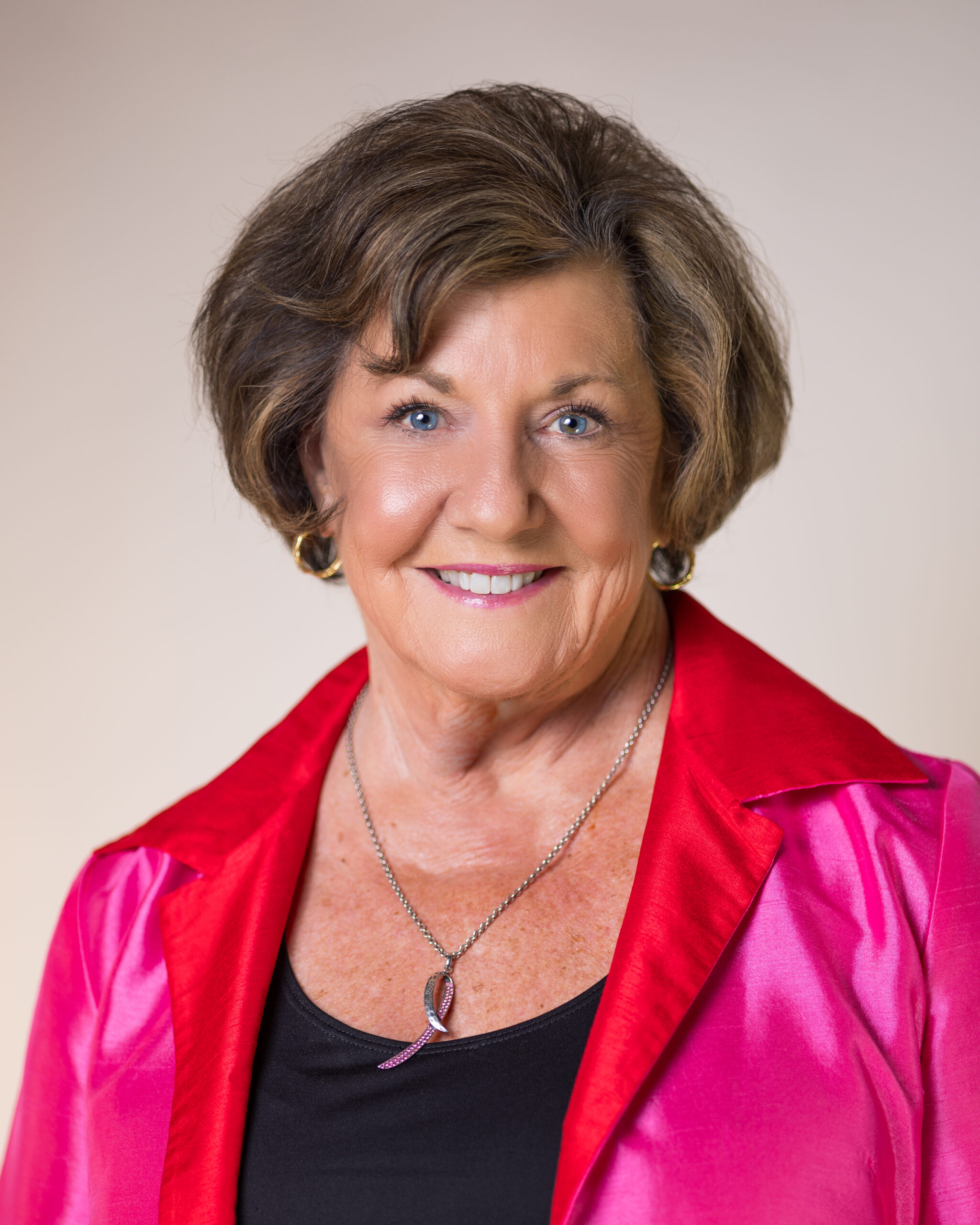
Roxann: [00:00:00] Hi, I’m Roxann Hayford, and today I am interviewing the co-founder of The Rose, Dorothy Gibbons. As she shares, highlights and history from her time as CEO these past 40 years, helping to build something nobody had named for in 1986. You can help us recognize Dorothy’s commitment to quality care and service to women by a gift to a special fund created in her honor. We are calling it the Promise of The Rose. She made the first 40 years possible. You can help ensure The Rose stays strong for the next 40 years. For more information, go to therose.org.
Dorothy: Welcome to Let’s Talk About Your Breast, a podcast brought to you by The Rose Breast Imaging Center of Excellence and a Texas Treasure. I’m Dorothy Gibbons, your host and co-founder of The Rose. During this season, you’ll also be hearing from co-host Roxann Hayford and others as we bring you stories from survivors physicians, caregivers, researchers, employees, and supporters. These are real people sharing [00:01:00] difficult times, celebrations and personal stories of hope, despair, and faith.
Roxann: Hi Dorothy.
Dorothy: Hi Roxann.
Roxann: Well, you know why we’re here today. We’re here because you are wrapping up an incredible 40 year.
Dorothy: Yeah.
Roxann: Career here with The Rose. And so we wanted to sit down with you and just ask a few questions that have been submitted by employees, by fans of the show.
Dorothy: Okay.
Roxann: To just understand a little bit more in depth about your tenure and how things have, uh, changed within the breast cancer world since the mid eighties, early eighties. So.
Dorothy: Wow.
Roxann: There’s a lot to cover.
Dorothy: Yes.
Roxann: So I’m gonna jump right into it.
Dorothy: Okay.
Roxann: Okay. So one of our questions that came in was, tell us how you and Dr. Dixie were received as two women who were creating something completely new that no one had ever heard of before. How, how was that received back then in 1986, 1985?[00:02:00]
Dorothy: You know, I, a couple of things come to mind for one thing, remember Dixie was like the second female to graduate the residency program in general surgery at, at uh, UTMB. So she was already making waves. I mean, she, she already was doing things that they didn’t expect women to do. And of course I’m watching her and I’m hearing all the stories, but I remember being in a director’s meeting ’cause I was a director at the hospital and, and I had been so inspired by Dixie. I was like 35 years old. And of course I wasn’t eligible for a mammogram yet. Most of the people at the table are men. But I, she had inspired me so much and I was going, you know, everybody here needs to be aware that people need, their women need their mammograms, and I don’t care if you’re married or if you’re, you know, if it’s your sister. And I’m just spewing it everywhere. And you know, these [00:03:00] faces are looking at me like. What are you talking about?
Roxann: Really?
Dorothy: It was like I was immersed in it just being around Dixie and here was a world that didn’t even know what I was talking about. And I think that’s the the best example. When we talked about we needed a place for uninsured. When we talked about we needed, as Dixie used to put it, to do it right and to be conscious of that woman. It’s not a number. It’s not anything like that. And when we went to women and said, will you help us? Will you come as a paying patient? And they did. I mean, all of those things were new.
Roxann: So, you know, you’re talking about that pushback that you got, even just the facial expressions. The reactions. Was that intimidating as a, as a woman coming into this that, you know, as you mentioned, it’s, it’s a room full of men that you’ve got to convince, I’ll say.
Dorothy: Alright. Alright. [00:04:00] Let me give you another example. Oh, I was always intimidated, you know this about me. I’m the shyest person in the world, so.
Roxann: Dorothy.
Dorothy: But I could stand in Dixie’s shadow and I could arrange for things to happen. And, you know, all of that kind of stuff. So it was a, it was a very great relationship, you know, to watch her go out and fight. And to learn so much from her. But there was one time we’d had The Rose, maybe three or four years open and I’m, we’re at a doctor’s conference. Okay. You know, you know the story how Dixie always draged me everywhere.
Okay. So I go with her and of course I’m not physician, I’m a lay person. All of those things. There are these, these little huddle of men and they were all always men talking. [00:05:00] And one of them was from Ohio and he said, ’cause this was a international type conference. And he said, you know, we’ve got a mammogram machine at the hospital and, and we’re seeing women, but what do we do? What do you do with the uninsured?
You know, our hospital doesn’t take uninsured. And then Dr. Khadembashi from MD Anderson and Dr. Victor Vogel from MD Anderson, who were two of the doctors that took our patients, said, well, we have a place in Houston, Texas.
Roxann: Wow.
Dorothy: It’s called The Rose. And I mean, I’m eavesdropping, but not because I’m expecting to hear that. I was just, you know, I was just like you said, intimidated. I’m not gonna be talking to anybody. And Dixie goes, they’re talking about us. And I went, oh my gosh, they’re talking about us. And, and that was, I think you have to remember, doctors really have always wanted to take care of people. [00:06:00]
But our system didn’t allow them to. Our system had so many problems even back then. And so when there was some place, I remember another doctor saying to me, you were the only place in town that was reasonable for my ladies who had some cash, but you know, didn’t have insurance. And I thought, so in many ways we were accepted, for different reasons, than being females in business.
Roxann: Wow. That’s incredible. I’m sure that was an amazing moment to sit there and hear.
Dorothy: Oh, was, it was one of my favorites. Yeah.
Roxann: Aw. Since you had that experience, obviously there’s been so many patients at this point, it’s been over a million lives that have been touched. So tell me about some of those early patients, the, the ones that came in and, and also the volunteers that were there. And it took a whole team of people. I know it wasn’t. Tell me about that. What some of those early patients that you remember or.
Dorothy: You know, I still have our first [00:07:00] appointment book.
Roxann: Really?
Dorothy: And I look in there and I see names that I remember. I mean, they were the people that came to our fundraisers that, you know, had bake sales for us.
Roxann: Right.
Dorothy: I mean, we had bake sales, we had garage sales.
Roxann: Right.
Dorothy: That’s how we raised money. But I, I think the, the two that I left such an impression on me the most were two ladies that Dixie had, uh, diagnosed. One was Annabelle. The other was Diana. Diana was from the south and I mean the south. And she had this beautiful southern accent with a beautiful soft voice. Annabelle was country and just about as country as you can get, and told some of the raunchiest jokes. Oh my gosh. And I was not that, you know, I just never, I was such a around that. Yeah. Yeah. And, and so, but she had diagnosed both of them and they were our first two volunteers who [00:08:00] became employees. But if it hadn’t been for them, we wouldn’t have been able to open The Rose. Diana was diagnosed at stage four.
Roxann: Wow.
Dorothy: Her cancer had come out of her skin.
Roxann: Mm.
Dorothy: She and, and I look back now, she lived for 12 more years.
Roxann: Wow.
Dorothy: You know, long after she had moved out of, out of Houston, I thought, isn’t that amazing how, even back then with hope and with, you know, that determination. That women were living even, even with that late stage. But of course so many were dying too. But Annabelle and Diana were the first encounters I ever had with cancer, with breast cancer, and Annabelle joked about it all the time, and Diana was very serious about it. Diana would stay on the phone for 30 minutes with any patient that called just learning all about them. [00:09:00] And Annabelle would be over there going, why don’t you get off that phone? Just make that appointment. And I was like, so I think what I’m trying to say is they, they were showing me how many different ways women deal with.
Roxann: Right. The different approaches. So those two patients, um, obviously now we have this podcast and you’re telling me these stories of, of these earlier patients who are employees and volunteers. So why is telling these stories of these patients so important? Why, why, why? Why is that?
Dorothy: Because what do we hear? Even today, we heard, oh, I had to fight to get my mammogram because I was under 40. How many patients have shared some version of that story. Whether it was they didn’t have insurance, they were too young, whatever. You know, if you see or hear someone that is telling a story very similar to your own, and you say in [00:10:00] your mind, oh my gosh, someone else has been there, someone else knows what it feels like.
Or on the other hand, if you find yourself saying, well, you know, I didn’t think this lump was anything because he kept telling me I was too young. And that motivates you to do something. Heck yeah. They’re worth it. I think for me personally, I am always so touched by the courage of our guests, our different patients. But the other common theme that I’ve heard through these last three and a half years has been that faith. It’s important. It is so important to believe in something beyond yourself. I, it, it, that’s what life is. That’s what makes life worthwhile.
Roxann: Yes, we have heard many, many stories and I, you’re right, that’s always seems to be that [00:11:00] common thread through a lot of the stories that we’ve heard, you know, for different types of cancers, different caretakers, so many different people, they seem to share that. So that has been definitely good to hear. As I mentioned the podcast now, I know there have been many accomplishments over the last four decades. So what are some of the things you are most proud of here at The Rose?
Dorothy: Oh.
Roxann: I know there’s a lot.
Dorothy: There’s a lot. When. When we became a center of excellence was a, a real proud moment when we.
Roxann: So for our listeners, explain the Center of Excellence Accreditation.
Dorothy: There’s, there’s very few, uh, breast centers that have that accreditation, and it really means that you have done that extra step towards being a center that focuses on quality. Focuses on, on, uh excellence, but you also have to prove you’d done it. You know, every piece of equipment has to be measured and checked and passed certain standards. Every employee [00:12:00] that is in mammography has to complete certain amount of hours of continuing education has to, and the doctors also. So, I mean, it’s not just one thing. Okay? It is the staff. It is the equipment, it is the outcomes. All of those. And, and it’s very rigorous. I mean, to even go through this thing, it is the next level of accreditation. Most, most centers are happy just to be accredited, and, and we were, until we realize that, well, maybe we could pass it. So there’s only like 14 in Houston and we’re the only freestanding that has it. So that, that was a biggie. I, I think, for me, the accomplishments were more often seen in the employees when I saw them do something or achieve something, or [00:13:00] you know, they moved mountains to get women in and that’s accomplishments.
Roxann: Because we’ve seen so many changes in the last 40 years in staff, whatever it might be, but it, with those accomplishments, obviously you had to have some very, some values that were non-negotiable for you. You had to have some, some things that you said, this is the way we’re gonna do it no matter what. So tell me what some of those non-negotiable values were for you.
Dorothy: It was always a value of women. You are not gonna put women down in front of me. I’m not gonna let you. Talk about women, like they can’t think. You know, we’re never going to, no matter how educated, uneducated, we value women, that is non-negotiable. If we are gonna, if we’re gonna say that we’re gonna do this. Then we better, we better stand behind it. And that means in so many different ways. Whatever her spiritual belief is, that it helps if she wants to broom or [00:14:00] you know, do smudging or any of those things, and she believes it helps. She can have that belief. We’re gonna stand behind her. We’re gonna stand beside her. So, and that, that’s employees too. Don’t talk to me about, women don’t, can’t do the same job as a man. Don’t ever talk to me about that. ’cause I’ve never seen a man that could do the same job as a woman.
Roxann: Oh, I agree.
Dorothy: And I, I, and I will tell you the, and you’ve heard this story, I’m sure before the, the telephone guy that was trying to sell us telephones and, and he came to me and he said, you know, ma’am, you don’t need a new system. You don’t need more phones. What you need is to get these women off the phones in the afternoon. They’re all calling their kids. And I went, we are all working mothers here. You know?
Roxann: Yeah.
Dorothy: He did not get the order. Believe me. I mean, it was like he didn’t even get to finish, I don’t think. But it’s things like that. If you’re gonna stand up for your employees or [00:15:00] for women, you gotta realize that means all parts of them. Whether they, they’re a mother, wife, they’re not. There’s too many ways women are, can be, made to feel minimized, made to feel less than. And boy, my, my mission in this world is to make sure we, that I’m never a part of that.
Roxann: And I think that’s why it was surprising when I saw that question come in from staff, whether that was intimidating for you to be in a room full of men, because of course I know you now I know, I know how you feel about women the way you’re describing things, so I can’t even imagine you being.
Dorothy: Oh.
Roxann: Being.
Dorothy: Of course I was.
Roxann: So, but, um.
Dorothy: But I hadn’t been around Dixie either.
Roxann: Well.
Dorothy: And that was certainly, you know, eye-opening and, and yeah, we’re very [00:16:00] different people, but you know, we, I had never been exposed to a lot of this, so.
Roxann: Well, another question we’ve had is we have come so far. But not that far. So if you can talk about the changes, what’s better and what still needs to be done?
Dorothy: Oh, imaging is so much better. You couldn’t even compare ’em. Uh, our approach to screening is so much better. There was a time when you couldn’t say the word breast in public on tv, on the radio. But all of the awareness that came out in the eighties and the nineties, it, that, that moved mammography, that moved early detection. Absolutely. Um, family history was something no one talked about.
And now we, I mean, we hear it almost every time we have a guest. Know your family history, find out about [00:17:00] it. Those are all things that have definitely shifted along with treatment. Now we don’t treat, but we certainly have been with women who are in treatment and we certainly keep up with all of that. And it’s so different. It really used to be one, one chemo. Everybody got it no matter what.
Roxann: One size fits all treatment.
Dorothy: Yes. And now it’s very, very personalized. What hasn’t changed is a better way to take care of the uninsured. Our low income, what hasn’t changed is we still marginalize certain women and certain cultures, and we don’t meet them where they are, which many times is a lot more advanced than what we think. You know, we, we still haven’t learned how to, as a society, how to [00:18:00] insist on providing the kind of support a woman needs to put herself first. It’s not there.
Roxann: So seeing those barriers, whether that was in the eighties, nineties, two thousands, we’re still seeing that some of that, um, I guess discrimination against poverty, I think is one way that we’ve, we’ve described it here. Were there ever times that you thought, why are we doing this? We just need to close our doors. Were there, was there any point in time that you wanted to call it quits? And if there was, what pulled you back outta that mindset?
Dorothy: There were lots of times I was disappointed when we couldn’t raise funds that we needed, when we had more people knocking on our doors than we had money to be able to take care of them. Lots of times I was disappointed, but it never occurred to me to quit it. It was always like. There’s one more thing to do now in the last few [00:19:00] years, realizing how little policies have changed. That has been hard. That has been very hard.
Roxann: The policies, seeing the, the funding that is allocated for women’s studies or.
Dorothy: Like you want to say, let’s, let’s go and create a whole new system. And I, I do believe that’s what The Rose has done. I believe we created a system, little bitty, that we are, that actually challenged the status quo that said we can do breast cancer differently.
Roxann: Well, policy changes, advocacy has also changed over the years. So tell me. About that. That was one of the questions that we also had, you know? How in your view has advocacy changed? Earlier we mentioned before [00:20:00] we started, um, the podcast, how before it was one in 15 women than it was one in 13. And now we’re down to one in eight. So, um, tell me a little bit about advocacy and how you think that has changed.
Dorothy: Well, we are talking about it more. I mean, people are willing to share their stories. When I think advocacy as related to policy. Yes, there have been some really good major changes, and probably the most significant of all of those has been the Cancer Research and Prevention Institute of Texas. That was a change that came about to provide prevention and research monies and that were beyond, uh, state monies that were beyond the foundation’s monies. This was a very different way of approaching, uh, especially in the prevention world. And that was a major good change. [00:21:00] Did it come about because of advocacy? Yes. People had to tell their stories about why it was important and, and certainly The Rose had. Many, many patients who would go to Austin and talk. So that’s changed. But what hasn’t changed is the only way that we really can make these steps is for, is from people telling their stories. I mean, you don’t. The political arena is very, very different and very alien to me. But if you can talk to one person as a person, then that’s when we can see things change.
Roxann: I know CPRIT has done wonders, their program has done wonders for The Rose. And for our patients, extremely grateful for that. Um, and of course we do fundraising throughout the year. We have our signature events, we have third party events. Is [00:22:00] there a gift that you, that stands out to you that is extra special to you that The Rose.
Dorothy: Well, the million dollar donor, I mean, you know, she walked in in overalls. I mean, come on. I had, had never met her before. Had no idea that she had been watching us. Had no idea she was walking in with the intent of giving us enough money to have another coach. So, uh, yeah, that doesn’t happen. And, and Roxann, if I told you how many times we prayed for a million dollar donor. How many years We just wished somebody with some kind of money would walk into our doors, through our doors and and, and help us. And then when it came, it was surreal.
Roxann: I’d imagine. Yeah.
Dorothy: Just surreal. Yeah.
Roxann: Well, one of the stories that I think about, and I know it’s in, in your book. [00:23:00] Is the, the $1 donation?
Dorothy: Oh yes. That one was always very special. We had our transport vans that were coming from Arizona and um, the driver had pulled in, it was in El Paso. He had pulled into a service station and to fill up, and he, and of course these transport. Vans were for a portable mammography machines, and it had the rows right on the side of it. And it was always pink. I mean, it’s kind of hard to miss, of course. But as, as after he filled up this truck, came to his side and, and it was beat up and old and it was full of like junk in the, in the bed.
And this man was holding a dollar bill out toward him and, and as I remember the, the, uh, man telling us his name was George. I remember George saying [00:24:00] my Spanish was about as bad as his English. And the man kept saying, for The Rose, for The Rose. And, you know, George wasn’t gonna take the dollar. And the man said, help my mother for The Rose. And so George said, yeah, he, he took it, put it on his dashboard and thought about it all the way from El Paso to Houston. The Rose was doing something right.
Roxann: What a touching story. Whether it’s a dollar or these, you know, $1 million. It’s just every, every penny helps, every dollar helps, every donation helps. And you don’t know kind of what ripple effect that will have. And so.
Dorothy: Yeah, but I will tell you the ones that always meant the most to me were the ones from the sponsored patients, the sponsored women who would do something. Like Marian and her skydiving. I mean, look at all the money she raised, but we all once had a lady named Noni who took care of Eagle’s nest babies.
Roxann: Oh.
Dorothy: And I [00:25:00] mean, truly, she was as close to homeless as you can get. She lived in a trailer that was not any bigger than here, but that’s how she made enough money just to live. We did her biopsy. She was, she had cancer. We helped her, and then she came in one day with $800 that she’d saved for three years.
Roxann: Oh.
Dorothy: So that somebody else could have a biopsy. That was where she was. And I, I didn’t wanna take the money. I mean, it was, but it was so important to her, so important to her that she she made it possible for one other person to get it.
Roxann: That is so special. So special. Wow. Well, um, you know, listening to these stories, you know, the next question I feel like I, I, I kind of know the answer there, so we’re coming up on our 40th anniversary. How do you keep the same passion for helping women that you had in 1986, after so many decades? And I’d imagine it’s because of [00:26:00] stories like the one you just told us, but how do you, how do you keep that going?
Dorothy: You know, 40 years goes by so quickly, and I think, I don’t know how, how you keep it in a lot of ways. I know what makes makes me happy is when I hear these stories, what makes me feel like the 40 years have been worth it is hearing the stories, but I’ve, I’ve always had this passion about trying to make things better for women. That has always been there, so I don’t know how you do it.
Roxann: Well, are there any unfinished or unresolved things for The Rose Dreams that you still have for The Rose?
Dorothy: No, I, I think The Rose is a big girl now. She can create her own dreams.
Roxann: Really?
Dorothy: [00:27:00] Yes. Yes. It’s, it’s time for mom to let her go.
Roxann: Now with letting go, you know, some people believe that there’s, you know, there’s different energies. And do you believe in energies? And if you do, what kind of energy do you hope to leave here at The Rose?
Dorothy: I hope to leave an energy that says you can do it. And I do believe in energies and I do believe that we convey things through our energies that we can never convey through our words. So, uh, and if it’s, if there were one other energy, I hope I leave, it’s that our employees know how much they were appreciated, that they walked down the hall and said somebody cared about me. And, and because, you know, being, being the person taking care of everyone [00:28:00] can really sometimes take its toll. But I hope they know that.
Roxann: On one last question that’s not on here, and I thought of this earlier today. I remembered one of our, one of our former patients, uh, she was one of our younger patients, Marisol, she always describes you as an angel dressed all in pink. And so my question to you is, are you still gonna be wearing pink after, after you leave The Rose?
Dorothy: You know, I like the color pink.
Roxann: Okay.
Dorothy: I, I really do like it. Um, because it’s not a normal color for fashion. If you think about it. It’s not, you see it in the spring maybe, but to wear it year round. Mm. It has its own statement. Will I keep all of those pink things? No, I hope, I hope to end up in blue jeans and a pullover and that’s it.
Roxann: Is that what’s next for you?
Dorothy: Somewhat.
Roxann: Anything else you’d like to share with our listeners and our, our team that I know is so [00:29:00] interested to hear these answers?
Dorothy: You know, one of the questions was, what would you tell someone starting a nonprofit today?
Roxann: Yes.
Dorothy: I would say go for it, but as you go for it, keep in mind I’d give them the same advice Rose gave us many, many years ago. Change doesn’t come without policies. Policy change is the only way you make lasting change. And so if your nonprofit is to do something that you hope ends up in changing something for the better. You’ve gotta have that behind you.
Roxann: All right. Well thank you so much Dorothy. So glad to hear these insights and wealth of information from you.
Dorothy: Sure. Sure.
Roxann: So thank you. And you’ll be guest hosting in the future. Um, so just thank you for everything that you have done.
Dorothy: Oh, wow.
Roxann: Definitely.
Dorothy: It’s always because we have employees just like you.
Roxann: Thank you.
Post-Credits: Thank you for joining us today on Let’s Talk About Your Breasts. This podcast is produced by Speke Podcasting [00:30:00] and brought to you by The Rose. Visit therose.org to learn more about our organization. Subscribe to our podcast, share episodes with friends, and join the conversation on social media using #LetsTalkAboutYourBreasts. We welcome your feedback and suggestions. Consider supporting The Rose. Your gift can make the difference to a person in need. And remember, self-care is not selfish. It’s essential.