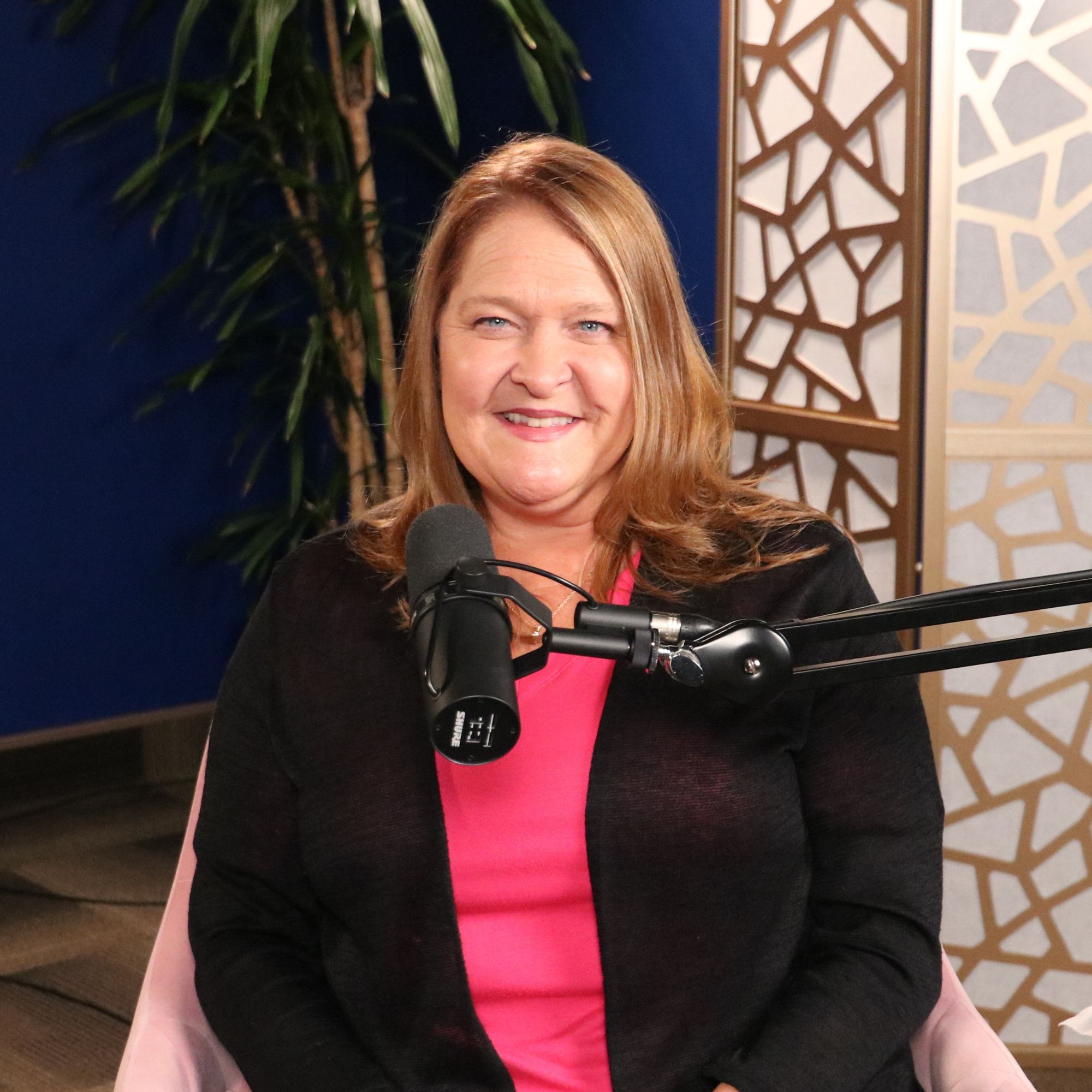
Dorothy: [00:00:00] Music, adoption, Broadway and a breast cancer diagnosis all shaped Julie Stobbe’s story. None of it silenced her voice. She talks about trusting her intuition, and that meant that she caught her cancer early. It was Julie’s breast cancer that convinced her that she needed to be the one to help organize and lead Paint The Path Pink. And this is a fabulous fundraiser that has gone on for years and it has been one of the best, most successful fundraisers of The Rose Paint. The Path Pink is held by Mitchell Intermediate out of Conroe of all places, and it has a wonderful history of how the students and the teachers came together to help support two of their teachers who had had breast cancer and it became this fundraiser that they’ve held year after year for The Rose. Julie’s other theme is Hug Me Like You Mean It. And she certainly does. When she [00:01:00] gives a hug, you know, you’ve been hugged. She also talks about How “Stobbe Strong” became a rallying cry for her students and for the women served by The Rose.
Share this episode with your friends and family, and if you’re able, consider making a donation to The Rose. You are gonna help women get lifesaving screening and treatment.
Let’s Talk About Your Breast, a different kind of podcast presented to you by The Rose, a breast center of excellence, and a Texas treasure. You’re gonna hear frank discussions about tough topics, and you’re gonna learn why knowing about your breast could save your life.
Julie, thank you so much for being with us here today. We are just delighted to have you.
Julie: Well, thank you for having me.
Dorothy: You know, I don’t know where to start with you because I know music has been a big part of your life and that’s what brought you full circle [00:02:00] to The Rose in a different kind of way. But tell us a little bit about your background.
Julie: Well, I was born in San Antonio, raised here in Texas. I, uh, did my bachelor’s at, uh, Texas State University. Which was formerly known as southwest Texas State.
Dorothy: Yes.
Julie: And uh, just prior to going into college, I had always wanted to be a doctor. Really, really wanted to, I was going to ut into their medical program.
And then I found out some very, very important information that totally changed the trajectory of my life. I was adopted as an infant. And I had written to get some non-identifying information about my birth mother, and discovered in that process that she and my birth father were both musicians.
They both sang. And my, uh, birth father played the guitar, wrote his own music. And so I had that talent growing up, but never thought I would ever pursue it as a profession. But I discovered that [00:03:00] and, uh, totally changed what I did. So I put the medical part on hold and decided I’m going for it.
Dorothy: Wow.
Julie: We get one chance to do this and I will not have regrets. So I.
Dorothy: No, that is amazing.
Julie: I pursued it and then eventually married my husband, uh, moved to Canada. I did my bachelor’s here in Texas, but then I did my master’s in Vancouver at uh, university of British Columbia.
Dorothy: And music singing.
Julie: Yes.
Dorothy: Has been a part of your life ever since?
Julie: Ever since, yes.
Dorothy: As a profession?
Julie: As a profession. After I got my bachelor’s, um, and I went off to Vancouver, I began teaching and I started teaching at the University of British Columbia when I was a student there doing my masters. I also taught at Trinity Western University, which is a suburb in Langley, bc.
Dorothy: Yeah. Yeah.
Julie: And then, uh, I got my big break. Uh, we had a producer come through Vancouver and one of my [00:04:00] teachers told me, you’ve gotta get down there and you’ve gotta audition. And I said. Okay. I’d been studying opera, but my heart was always for music theater because I felt like it was America’s opera and it was for the everyday people, and I got a great break and started doing Broadway with them and traveling and enjoying myself very, very much by being able to sing and perform.
Dorothy: My goodness, we’re in the presence of a star here.
Julie: Oh, no. No, not really.
Dorothy: But now you, you ended up going into the public school system.
Julie: Yes, I did. Uh, that happened actually after we came back to Texas and we ended up settling in the woodlands and was not looking to go into teaching. Um, I still had my home studio that I was teaching private voice with.
But my children were in great school at the time, so I thought I’m gonna go ahead and just volunteer at one of the local, uh, elementary schools. My daughter was in a [00:05:00] choir and fell in love with it. And at that time the teacher said, you know, I’m gonna be leaving and you need this job. And I said, I don’t think I can do that.
I, I taught university, I don’t know that I’m gonna be able to teach elementary. And he said. You need to do this. And so one thing led to another, and I’m starting my 16th year now.
Dorothy: Oh my goodness.
Julie: Of teaching in the public education system.
Dorothy: Oh!
Julie: And I love it.
Dorothy: All right. Now you’ve got all of this musical career behind you, or.
Julie: Yes.
Dorothy: That you’re still involved in. But a year ago, is it? A year ago?
Julie: Yes.
Dorothy: You, you were diagnosed with breast cancer?
Julie: Yes, I was.
Dorothy: So tell me about that.
Julie: Well, it was an unusual situation I was conducting in San Antonio. I was being able to, to work with the Texas Elementary Honor Choir as one of their clinicians, and I will never forget the moment.
Uh. I did [00:06:00] not realize that I had it. There was no lump. There was nothing that I found, but I just had this feeling that something was, a miss, we’ll say. And I was literally conducting, and I had my cell phone on my podium just so that I could monitor the time. And right at a cutoff, I saw my screen light up and it had my doctor’s name on it.
And I thought, well, that’s unusual. I’m not gonna look at that right now. And I turned it over and that thought came through my mind of he’s never called me after a mammogram. And so I thought.
Dorothy: Hmm.
Julie: Something’s up. And so I waited for my break and I phoned and he said, I need you to come to the office tomorrow. I said, well, I’m in San Antonio. Let’s put a pin in that. I’ll be back and can I see you on Monday? And he said, first thing I said, okay. That was in July of 24. And I called him, made an appointment, saw him [00:07:00] the following Monday, and he looked at me and said, we think you have breast cancer. And I said. Okay, now what do we do? And.
Dorothy: So wait, Julie, what? What mammogram was this? This wasn’t your first, right?
Julie: Oh, no, this wasn’t my first.
Dorothy: Okay.
Julie: No, ma’am. It was just a regular mammogram.
Dorothy: But you had a feeling, did you go in to have your mammogram because of that feeling?
Julie: No, I just. I had a sense that when I went in that time, it was just a normal time that there was something up, but I just kind of put it to the back of my mind. I will admit, uh, it had been two or three years, so don’t ever wait. I know that now.
Dorothy: Right.
Julie: Um, but I was caring for my, uh, parents who were aging, I had lost my father and then was taking care of my mother, and I just put my own personal health on the back burner.
Dorothy: Something we many of us do as women. Yes.
Julie: But, uh, I encourage everyone not to do [00:08:00] that. Take care of yourself first and uh. So.
Dorothy: So what stage was it?
Julie: It was one stage one.
Dorothy: Oh, good.
Julie: So it was very early.
Dorothy: Yeah.
Julie: I, I went through the guilt of thinking. I should have found out. I should have known.
Dorothy: Okay, let’s cancel that one too, because.
Julie: Right.
Dorothy: We have enough to be, feel guilty about. We don’t need anything else.
Julie: Isn’t that the truth?
Dorothy: Yes.
Julie: And my doctor told me that.
Dorothy: Oh, good.
Julie: Immediately she said, you would not have found this. You, I had, uh. DCIS. And so it was ductile and she said, you would not have felt it, you would not have been aware of any of this.
Dorothy: So, but I’m just intrigued that you had a feeling.
Julie: I did.
Dorothy: You know, we’ve heard that so many times on this show. And so it’s, it’s the other message, when you have that feeling, don’t, don’t discount it.
Julie: That’s right.
Dorothy: It, and it will train us to always pay attention to intuition going, going forward.
Julie: That’s right.
Dorothy: You know, I, I just, I, I just. Believe so strongly in that. So thank you for [00:09:00] sharing. You know.
Julie: Absolutely.
Dorothy: That’s, that’s kind of a wooy wooy thing. And, and.
Julie: Well, yes.
Dorothy: Here we’re, you know, but it is true.
Julie: It is true.
Dorothy: Yes.
Julie: And I think that we definitely need to tune into that.
Dorothy: Ah, yes. So your treatment involved?
Julie: My treatment involved, uh. I went in to do a biopsy and those are not always the most pleasant experiences. And he told me we would be taking four to six samples. And I thought I can handle that. And of course, you’re in a very unusual position hugging this massive machine and not, but I was constantly.
Dorothy: But you had a stereotactic, right?
Julie: Um, yes.
Dorothy: Yes.
Julie: Yes. And so he eventually, after 25 minutes, said, do you wanna take a break? And I said, well. It depends, how long are we gonna be at this? I thought by now you’d have all of the little pieces that you need. And he said, no, I think we’re taking 24. And I said, 24.
Dorothy: Oh my.
Julie: And he said Yes. And so then of course I knew this was a lot more than I was [00:10:00] anticipating. Yeah, I was thinking maybe just one little place where they would need to go in, but apparently it was. All within it. There was one little area that had been invasive, but believe it or not, that one biopsy, one of those spots apparently pulled out the cancerous part that had become invasive. So the rest of it had remained intact inside the ducts. So I felt I was extremely fortunate.
Dorothy: Yes. That it’s So they had not gone forward then.
Julie: Exactly.
Dorothy: It could have been a different diagnosis in it.
Julie: That’s right.
Dorothy: Yeah.
Julie: That’s right. So after we did that, we did the MRIs and um, you know, through these, uh, traumatic types of treatments, I always look for humor because I think humor gets us through a whole lot in life. And, uh, there were a lot of humorous moments for me, especially with the, [00:11:00] uh, MRI, um, I could not apparently fit into their particular machine, and he looked at me and said, I, I think we’re gonna have to call it quits and do something else. I said, oh no, we’re doing this today. I’m not coming back for this. And so we laughed our way through it and they got creative. And, um, I just thought, you know, I clearly am going to have to go through this and so I’m gonna find the positive moments and if it, if it can be lighthearted in any way, that’s the path I’m gonna choose. So, uh, after that we went back and they said we’re gonna need to do a mastectomy. Um, fortunately mine was not, I don’t have the gene where it will jump from one side to the other. And so I thought, well, I guess I only need to have one breast removed. And so that’s what we did.
And then, um, I did that on Friday, September 13th. So it really was a Friday, the 13th moment for me. [00:12:00] And, um. It was a seven hour surgery. I am very, very grateful for my care team from St. Luke’s. They were magnificent and still are. Um, and then my plastic surgeon came in and did all that he needed to do, and I, uh, after healing, went back and did a reconstructive, a reduction on the other side. And, uh, I’m, I’m grateful, Dorothy. I’m just so grateful.
Dorothy: Yeah. Yeah. So the real reason you’re here.
Julie: Yes.
Dorothy: Is, uh, Paint The Path Pink?
Julie: Yes.
Dorothy: But I, I just am so impressed with the way that you look at your. Your diagnosis and your treatment and everything. Let me ask you one question on that same line. How old were your children then?
Julie: When I was diagnosed? They’re [00:13:00] adults.
Dorothy: They’re adults.
Julie: 24 and 26.
Dorothy: And how did you tell them?
Julie: You know, I, we did a family FaceTime and uh, I just said, guys. I wanna tell us, tell you what’s going on. And they said, okay. And I, there’s a little phrase that we use when I look at my children, when they were very little, I would look ’em in the eye and I would say, now, trust me.
Ah, and they would know that whatever it was we were gonna get through it. Whether it was scary or whether it was something really big or really small, I would always look at ’em and say, now, trust me on this. We’re gonna go through this together and it’ll be fine. So I looked into the camera and I said, guys, I need you to trust me on this.
And my son Connor, and my daughter Catherine, just took a deep breath and said, okay. And I said, I have breast cancer, and there was a big silence and I said, but this is not the end of my story. [00:14:00] This is, this is a speed bump and this is something that we are gonna get through together. And then I immediately told them that out of all of the cancer and out of all of the scenarios, I truly believe that I was most fortunate. I don’t know why, but I am. Very grateful for it and I started educating them and we began supporting one another like we always have. And they have been beside me, along with my husband, who is an absolute prince of a man. Um, they have been an incredible force of strength for me.
Dorothy: And they were your support system?
Julie: Absolutely.
Dorothy: Absolutely.
Julie: And that of my friends both locally here in Houston and uh, across the nation from my, my past, and all of the different friends that I’ve made, just like we all have, we all move away and we stay in touch. And I, my school at Mitchell Intermediate was incredibly supportive of me. We’ve had several [00:15:00] teachers who have had breast cancer and uh, they came together and they definitely gave me the support I needed. They did collections, they prayed it. It’s just been incredible.
Dorothy: They held you in that safe space.
Julie: They did, and they made it okay. No matter what was going on, no matter whether I was having a good day or a bad day, one person would come by and just say, it’s gonna be okay. We’re gonna do this together.
Dorothy: What a gift.
Julie: A huge gift.
Dorothy: Yes.
Julie: A very big gift.
Dorothy: Alright. Now tell us about the event, so, and how you got involved in it.
Julie: You bet. Paint The Path Pink has been at Mitchell now for 16 years. It was begun because two wives of two of the teachers were diagnosed at the same time and they brought them together and they thought, well, let’s do something. Let’s get active. Let’s promote a group that [00:16:00] will help bring awareness and education.
Dorothy: And this was 16 years ago?
Julie: Yes ma’am.
Dorothy: So very different level of knowledge then a real need for awareness and.
Julie: Definitely.
Dorothy: And for being very public with.
Julie: Yes.
Dorothy: This kind of information.
Julie: And making it okay.
Dorothy: Yeah, yeah.
Julie: Make the, removing any kind of stigma or removing any kind of fear. Um, as educators, we’re naturally interested in learning. And we’re naturally interested in sharing our knowledge, whatever it is. And so. Uh, whoever the person was that found The Rose, I guess made that connection. And it began as having a walk and, and just bringing you guys to the Conroe Independent school district area and reaching out into the Alden Bridge area of the Woodlands, which is where our school is located. And through the years, it has grown tremendously.
Dorothy: It’s become what, an almost all day event or.
Julie: It’s, it’s all morning for [00:17:00] sure. It is a full half day of family fun.
Dorothy: Yes.
Julie: Yes. And so, uh, this past year in March, it was March 1st was our most recent fundraiser for The Rose. We had a 5K run. We had all the divisions. We had the adult division and the children’s division, and there were all kinds of things for the kids to do. Chalk and, um, balloons.
Dorothy: It’s like a fair.
Julie: Oh, it is. It was like a mini county fair.
Dorothy: Yes. Yes.
Julie: And the, uh, different hospitals came out different, uh, dentists, orthodontists. We had a huge, uh, silent auction that raised quite a bit of money.
Dorothy: Yes.
Julie: A lot of local support. Then we had, uh, baskets by most of the learning communities at our school offered up donations that were full of wonderful things for people to bid on. And, um, of course we garnered sponsorships um, of local [00:18:00] businesses that would help us promote it. Wonderful time. We had a big ribbon cutting and, uh, balloons everywhere. And it was the largest event we’ve had so far.
Dorothy: Oh my gosh.
Julie: Every year it grows, it grows. So.
Dorothy: And raises significant funding.
Julie: Yes, ma’am.
Dorothy: It is,
Julie: I believe. It This last year, it was in excess of $60,000, I believe.
Dorothy: Yes. I mean, it’s just how does this one school do this? I mean, I, I know you’ve spread, but.
Julie: Sure.
Dorothy: It is amazing.
Julie: It is, and I think what’s wonderful about it, Dorothy, is that we get engaged with our, our roots, our grassroots of our families.
Dorothy: Right.
Julie: And our families are uh, so connected to the school and we with them that we’re really doing life together. And so an event like this really does draw out the humanity of the educators at the school that we, in fact, as teachers do not live in the school building. We [00:19:00] do leave.
Dorothy: Yes. Yes.
Julie: And, and it’s, it’s a wonderful time to be able to just be real people together. We’re not teachers that day.
Dorothy: Right.
Julie: We’re just real people walking real lives together with our neighbors.
Dorothy: And I know we have a wonderful video of that day and I, I hope we can put it in the link for our show notes because it truly is a family affair. It’s, it’s not, it, it’s so unlike anything else, you know, that you imagine with schools.
Julie: That’s right. Yeah.
Dorothy: Yeah. It’s really special. So how did, what is your role with this event now?
Julie: Well, last year I, for the first year, became a member of our committee and hit the pavement and asked for donations. I mean, I was fearless. If I was eating in a restaurant, I was, guess what? And here’s this and I’ll wait for you to return to the table.
Dorothy: Oh my gosh. I, I bet few people said no to you.
Julie: I, you know, it really, it’s, [00:20:00] I’m not afraid because this is something that one in eight women are going to encounter. That is a very high statistic.
Dorothy: It is very high.
Julie: And why would we sit back? If I have information that can help somebody and they can help me get that out, why would I be remain silent? And I found so many people in the community: golf, wineries, uh, variety of restaurants that were saying yes, and then sent us pictures of the event and let us know how it went. And what is The Rose? And I would take the information about The Rose and I would say, here’s what you need to know, right? This is why the people that are coming in to be patrons of your organizations are walking through this.
Dorothy: Right.
Julie: Difficult disease, and knowing that your name is helping us is only going to help you as [00:21:00] well.
Dorothy: Oh, absolutely.
Julie: And so, uh.
Dorothy: How many did you, did you meet new or diagnosed people during that time?
Julie: Yes, ma’am.
Dorothy: Yeah.
Julie: And especially the day of the event. It was really neat because we had sashes for people who said Survivor. We had different stickers. We had different things that would say, you know, you’re walking through it or you have survived, and that was the best time for me.
I had just come out of recovery, I think it was two to three weeks prior to the event of my second major surgery at.
Dorothy: Heaven. Girl!
Julie: I was not missing that, Dorothy. There was no way I was missing it. But I showed up and I sat, I got to see my students and that I think was also, um, a really important thing. I’ve had a lot of feedback from family, uh, from parents saying, thank you for walking through this with strength and courage and authenticity [00:22:00] in front of my children. Um, I want them to know that these things are gonna happen, obviously with age appropriate information. But my 10, 11, and 12 year olds, no, their own families are going through difficult things. And so I wanted them to see that cancer doesn’t have to be a big, scary word.
Dorothy: Now, did you announce it to your children?
Julie: Yes, I did.
Dorothy: You did?
Julie: And I did.
Dorothy: And you were not having chemo or any of that at that time?
Julie: Not at that time, no ma’am.
Dorothy: Ok.
Julie: I just told them at the beginning of the year that over the summer I’d been given this diagnosis and that we were going to walk through it together and I wanted them to know and to not be afraid because I think when you aren’t allowed to ask questions, you can fill in the blanks with a lot of fearful.
Dorothy: Yes.
Julie: Unfounded information.
Dorothy: Yes.
Julie: And so I wanted the kids to know what was going on and uh, they were a huge source of comfort for me. I have a large notebook. [00:23:00] I should have brought it a large notebook full of letters and pictures and drawings and sentiments and things that the kids would send to me, uh, as I was gone. You know it, I was out for eight weeks the first time. I would send them weekly videos, just two to three minute videos showing them: Okay. I’m, I made it. We, my, my phrase was, we’re kicking cancer to the curb and I’m clearing the hurdle. The first hurdle has been cleared. And, and so I would send that home and they would write back to me and sometimes send little videos.
And I think just walking that together helped really squelch any unnecessary fear when they could see I’m okay. I may not, you know, be looking like I’m walking down the runway, but isn’t that real life?
Dorothy: Yeah.
Julie: We all have those moments and I think that they saw the power they [00:24:00] had as young people to be super positive for me, they were giving to me. And I think children need to know that. Children need to know that what they have to offer. This world is desperate to receive. And so that was the way that I chose to look at it, uh, and have my kids be a part of it, and the families involved. Yeah. So.
Dorothy: That is, that is so impressive. I mean. We don’t think of children having that kind of depth of understanding or.
Julie: But they do,
Dorothy: or sympathy. Or empathy?
Julie: Empathy.
Dorothy: That’s right. Or empathy. Yes.
Julie: And you know, I know that with social emotional learning and post COVID, you know, children have gone through so much. And I am a firm believer that as long as you, uh, like I tell my choir kids all the time, we’re a family. And I will not lie to you and you will not lie to me. We will be walking in [00:25:00] truth and in love, and in honesty and in integrity. And so if you have a question for me. I will gladly answer your question and we will do this together. And I found that the kids really responded well to that. There were a lot of tears initially, a lot of fear because they thought this was the end of my road.
And I said, no. I’m not gonna be fearful of this. We’ll tackle one thing at a time. Why jump to the end of the story when we’re in it today? I’m not gonna lose my life over what has happened or what might happen. We’re in it today and that’s what we’re given and we’re gonna make the most of it today.
And the children really responded. The the school created wonderful t-shirts that say Stobbe Be Strong. The pink t-shirts.
Dorothy: Oh.
Julie: We had our little hashtag of #StobbeBeStrong and Um, then that actually spread to the junior high where [00:26:00] my kids promote and go to the next level at McCullough Junior High, and they. Really surprised me, Dorothy, they had a special coffee house where the kids got together and they sang and they raised a awareness and they raised funds for me that I did not know about until after the event, and they raised $2,000 from that.
Dorothy: My goodness.
Julie: And you won’t believe, well. Maybe you will. I’m a firm believer that everything happens for a reason. And my faith in the Lord is what keeps me up and keeps me going every day of the year. But we had just received a bill in the mail for just over $2,000 and we were looking at it going, okay, well we’ll find it somewhere. We’ll just, this is what we do, and. Literally that week, that director drove over to the house and said, we [00:27:00] have something for you.
Dorothy: Ah!
Julie: And just put all of that in my hands. And we were stunned. And that just shows how important community is.
Dorothy: Yes.
Julie: Those children that I had taught from elementary, intermediate, junior high, and high school, I had all of those kids coming back to participate in Paint The Path Pink. Oh, they bought t-shirts. They ran, they came up, they hugged. We high fived. We really enjoyed the day together and to this day, just last week, I was at one of their concerts and they came up big hugs, how are you doing? And I said, I’m doing great. And you know, they get to see the next stage of things. And uh, they see it something that you are diagnosed with.
You hit straight up, you’re not gonna cower in fear and then walk through it. The good, the [00:28:00] bad, the ugly. The good days, the rough days. And we come out of it. And we come out wanting the world to know that women are strong, women need the resources and the education. But right before coming in to meet you, I met a lady who is 26 years strong now, a survivor of breast cancer 26 years ago. Um.
Dorothy: Wow.
Julie: And credits The Rose for being the one that gave her exactly what she needed, and that’s what I want to do. I want to spread the, the word that The Rose has, not just the support, but has the education and has the resources for people that are underserved, and we all need that.
Dorothy: Yes.
Julie: We all need those resources, and so whatever I can do to help bring awareness to that, I’m definitely willing to do.
Dorothy: Oh my goodness. I, I’m gonna give you a big hug right here, [00:29:00] but this won’t work. Oh, what a great, great story. All of it, all of it. I’m, I’m gonna ask you something I had never ask anyone, was there ever an, um, strange question that the, the children ask you or one that caught you off guard?
Julie: No, not really. I think, you know, they first asked, well, what, where is your cancer? And I kind of took a beat and thought, Hmm, no, I, and I finally just said, I have breast cancer. And I thought maybe the boys would react funny or the girls would react funny. No reaction. Uh, I had boys come up to me later, tears in their eyes saying, my grandmother has breast cancer. My aunt had breast cancer. My neighbor died of breast cancer. And you could see that it had bubbled up all that fear in uncertainty and naturally just superimposing their own experience onto mine. And I would, [00:30:00] I had the opportunity to stop, hug, look at him and say, my story’s different. We each have our own story, and I’m in the middle of writing mine.
It’s being written right now, and you’re a part of it, and because you’re a part of it, it’s gonna be better. And so that that partnership with the children, I think helped them kind of revisit their own personal experiences and realize that not all of them have to end with that difficult.
Dorothy: Right.
Julie: Period at the end of this sentence. Um, and today they still come up and ask. Now, there were times where I said, I can’t hug, you know?
Dorothy: Right.
Julie: And, and I’m a big hugger, huge hugger. I say, Hug Me Like You Mean It, you know, because we’re, we’re only given today. And so I, if I’m gonna hug, it’s not gonna be some. Little sidearm slant as we go by. It’s gonna be full on hugging. And, um, [00:31:00] there were moments where I said, now when I come back to school, I can’t, I can’t hug. So how are we going to say that we’re hugging each other? And so I posed a challenge to my students and they created a video for me. So this was one sign, this is a sign for a heart.
And they would look at me and say, I’m hugging you right now. And of course. This and then, then one student showed me sign language that this means hug and then sign language. And I was like, this is fantastic. And again, the children were leading me through a very comforting path. Uh, they could just take a picture of their class doing this and shoot it to me, uh, in a, a Google email and I would see it and be able to respond. And we utilized technology to really keep one another upbeat and I Uh.
Dorothy: And connected.
Julie: And connected, yes. So that they could see, even though I wasn’t in their presence right then and there. We were [00:32:00] still connected at the heart. And, um.
Dorothy: Beautiful story, Julie.
Julie: Well, thank you.
Dorothy: So many beautiful stories. What a gift you are to The Rose and to your students.
Julie: Well, thank you.
Dorothy: And uh, we so appreciate Paint The Path Pink and we, but, but you know, I’ve never heard the entire story, so thank you for bringing it to us.
Julie: You bet. Thank you for having me. I appreciate it.
Dorothy: Always. We may have to have you back.
Julie: I’d be happy to do it.
Dorothy: All right.
Julie: Thanks, Dorothy.
Post-Credits: Thank you for joining us today on Let’s Talk About Your Breasts. This podcast is produced by Speke Podcasting and brought to you by The Rose. Visit therose.org to learn more about our organization. Subscribe to our podcast, share episodes with friends, and join the conversation on social media using #LetsTalkAboutYourBreasts. We welcome your feedback and suggestions. Consider supporting The Rose. Your gift can make the difference to a person in need and remember. Self-care is not selfish. It’s [00:33:00] essential.