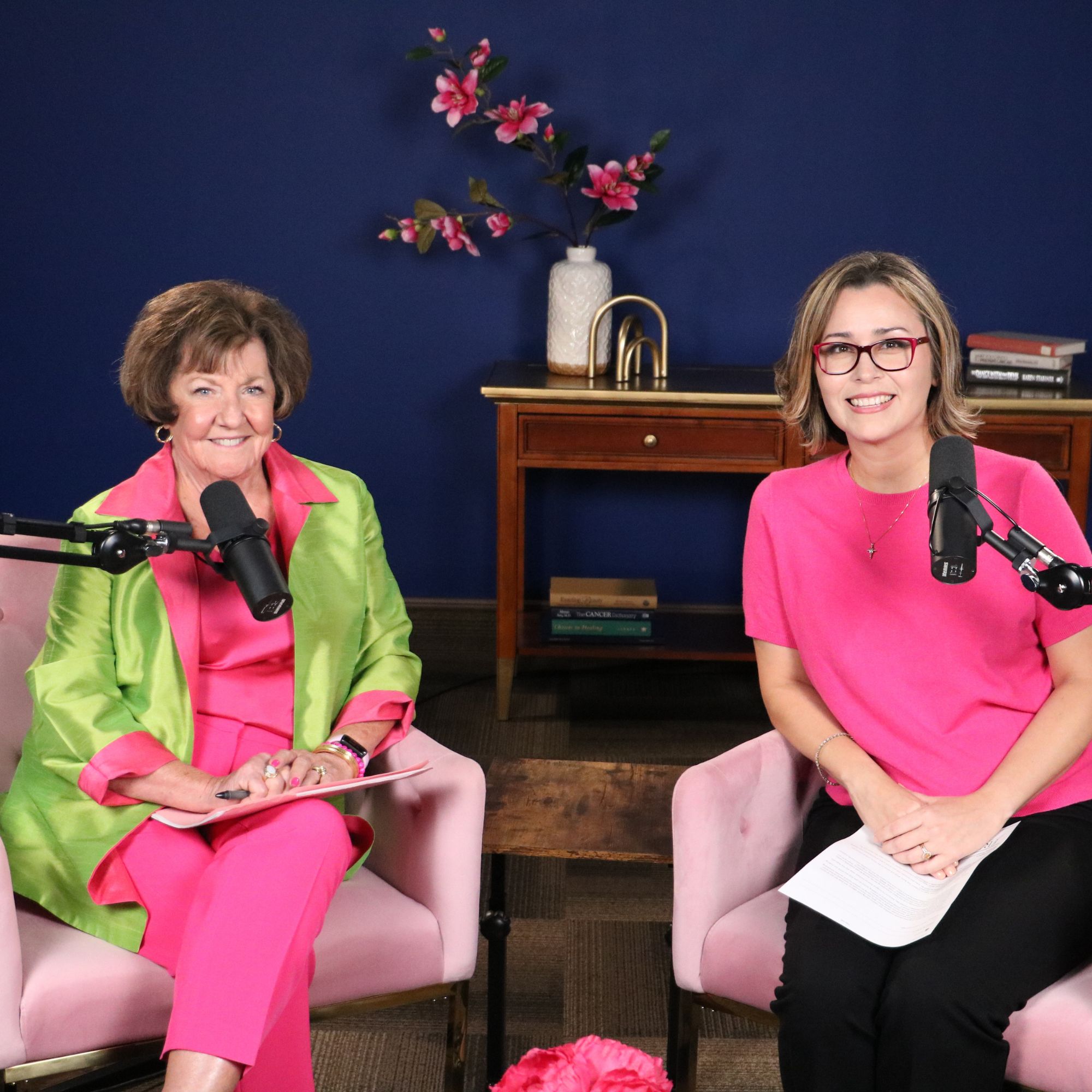
Roxann: [00:00:00] Hi, I’m Roxann Hayford, Marketing Project Coordinator for The Rose, and it is my pleasure to host Let’s Talk About Your Breasts. Today we are sitting here with Dorothy Gibbons, a very special guest here at The Rose, and we’re gonna talk a little bit about Breast Cancer Awareness Month.
Dorothy: Let’s Talk About Your Breast, a different kind of podcast presented to you by The Rose Breast Center of Excellence and a Texas treasure. You’re gonna hear frank discussions about tough topics, and you’re gonna learn why knowing about your breast could save your life.
Roxann: So thank you Dorothy for joining us. It’s a pleasure to have you here on the show.
Dorothy: It’s gonna be fun, Roxann.
Roxann: I’d like to talk about Breast Cancer Awareness Month.
Dorothy: Okay.
Roxann: Takes place all of October. Um, but let’s talk a little bit about the origins of Breast Cancer Awareness Month. I feel like people nowadays, they’re used to seeing the pink ribbons. So they have that general awareness. But how did all of this start?
Dorothy: You know, back in [00:01:00] 1985, actually, it was the brainchild of the American Cancer Society and AstraZeneca, and they decided that we would start with like a breast cancer awareness week.
Roxann: Okay.
Dorothy: And then after that, that was about the time that we did our doing business as The Rose. So you have to remember, this is the early, early days of mammography, of screening, of it becoming the thing to do for women. And so it wasn’t until 90, 1990 that, uh, president George W. Bush made it a national month. You know, it’s a, we’re gonna have a National Breast Cancer awareness month, and right after that, then uh, an article in the self magazine and, uh, Estee Lauder had created the pink ribbon.
Roxann: Mm-hmm.
Dorothy: And that became the symbol of it. So, you know, in those early days of having The Rose, it, uh, we didn’t include the ribbon in our logo. [00:02:00] Uh, everywhere you looked was either a rose, an actual rose, or the, the, uh, ribbon. And, and we really wanted our, our brand at that time to be a little bit different.
Roxann: Mm-hmm.
Dorothy: But we had so much help because of those things. It was about the time Susan J. Komen came in and really started with the walks.
Roxann: I see.
Dorothy: So, you know, it was just one thing built on the other.
Roxann: I see. I see. So do you think at that time, in those early eighties when The Rose was being founded, were women really having these conversations about breast cancer? Was it something that was still not really spoken about too much?
Dorothy: Absolutely. The, the whole thing about the awareness walks and weeks was to get people talking about breast cancer and to encourage that screening, uh, mammogram every year. You have to remember back then there were, we couldn’t even say breast, the word breast on tv. And [00:03:00] there was always this kind of pregnant pause whenever you did, or when you talked about, uh, examining your own breast or, you know, anything to do with, remember that’s early eighties, it, it was different then.
Roxann: Mm-hmm. So do you think na, on thinking nationally, do you think we’ve really move that needle in terms of awareness, of course, but really seeing more of that upward trend of people, of women scheduling those screening mammograms are, is this working?
Dorothy: The awareness is working. The scheduling may not be, and I think we can’t lump all women together because there’s different populations that still have very little knowledge of the importance of screening mammograms or for a variety of cultural reasons. You know, just, that’s just not a part of their day-to-day knowing, or their annual health or any of that kind of stuff. Here’s what happens though, [00:04:00] what has happened. People know a lot about breast cancer. They know that mammograms are important to a point, but there’s been so many different recommendations that have come out over these last few years that so many women are confused.
Roxann: Ah.
Dorothy: You know, at The Rose, we say start at, start at 40, do it every year. We, we also have to remind our listeners that anytime you find a change in your breast or if you have family history, or for any reason you have a concern, you need to get it checked.
Roxann: Right. Right. No, that’s so important. Now I know you mentioned, um, you know, AstraZeneca being involved initially, and so, and of course The Rose is about 39 now, so it’s been about 40 years. So I just wanted to know what are some of those other key moments in history that have really encouraged that awareness or have really encouraged creating that access to care? I know before the show, we were talking a little bit about a president that had made, um some mandates and things.
Dorothy: And that, that was Bill Clinton.
Roxann: [00:05:00] Okay.
Dorothy: You know, it’s so interesting. Before it was just awareness, he made access possible.
Roxann: Okay.
Dorothy: And you know, he was the one that put the CDC program in place for the breast and cervical cancer program. And that was available to all states, every state could apply for this. And then later on he went on to establish the, um, it’s a National Mammography Quality Standards Act. And I cannot tell you how important this was. You had to have that, that ACR accreditation. And this was in, you know, the early nineties . Because everybody was doing mammograms.
Roxann: Oh, I see.
Dorothy: And none of them had any quality control over ’em.
Roxann: Wow.
Dorothy: So this was really important. It it, one of the sad things about the, the early history of, of, uh, mammograms was they were being done on so many, for lack of a better word, bad machines.
Roxann: Okay.
Dorothy: Or with bad techniques that women were being told, oh, you’re fine. When there could very well have been something there. [00:06:00] So that, that act was very important. The other thing that very few people know about is he initiated the Women’s Health and Cancer Rights Act. A big, long title for something so important to women. It was the one that said, if you have a mastectomy, your insurance has to pay for a reconstruction.
Roxann: Oh, okay.
Dorothy: And before then, it was all on your own.
Roxann: Wow.
Dorothy: So think about the difference that made. And then finally he put into place the, um, the treatment part of the Breast and Cervical Cancer program. For a long time there and I, that happened like in 2000. I think for a long time we could, we could use the breast and cervical cancer program’s funding for a screening or for diagnostics, but then we had nothing for treatment.
Roxann: Mm-hmm.
Dorothy: And so that was when we had a physician’s network that helped us get women into treatment. But I will tell you. Something, [00:07:00] he doubled the funding that went toward breast cancer. So pretty significant in those early years.
Roxann: Wow. Yeah. That is significant. And I think, I think sometimes, you know, you forget how far we’ve come, even though we know there’s still a whole lot of work to be done. Those have, those are some major strides that were made, you know, in these past 40 years. Um, as far as the access, the awareness, um, you know, mandates for insurance, things like that. So I really think that, you know, that’s really amazing and I, I wasn’t aware of any of that history. So I think that’s really helpful to know that, and interesting to know that.
Dorothy: I think a year after he went into office, his mother died of breast cancer.
Roxann: Oh. So he had.
Dorothy: He had a real connection to it.
Roxann: Mm-hmm. Mm-hmm. Wow. I didn’t know any of that. That’s so interesting. Now, you know, we just talked about 40 years and a lot, a lot has happened, but going back to the breast cancer awareness month. What were some of those early campaigns like? Like we mentioned, we know there was the ribbons. Uh, but what, what are some of the other ones that kind of stand out in your mind when you think about those early days?
Dorothy: Well, you know, again, [00:08:00] it was the Susan G. Komen walk. That was the thing that started the month and from then on it went to, um, I, I remember one of the campaigns, and of course people do a lot of fundraising during this time for different cancer, a breast cancer agencies, but I remember that Randall’s had a campaign for us in which they’d ask every person, would they like to give a dollar to breast cancer? And I mean, that became hugely successful and it meant a whole lot of funding for us. So, you know, in those early days we did a lot of talks, um, but we didn’t have events during October. And it was always the community that came forward and said, we’re gonna raise money for you this month. We just need you to come out and talk to us, or we need you to, you know, pick up a check or, or whatever. Those were real and there was a lot of push to get your mammogram during that month. [00:09:00] So it was always our best month to have.
Roxann: I see.
Dorothy: You know, screening mammograms done so. I mean, we had national media helping us.
Roxann: No, and you know, I’m glad that you mentioned the Randall’s piece because I think one thing that’s really important for, for our listeners to know, or anybody that is considering hosting an event or doing something like that for The Rose, is that all of those funds raised, of course, stay local. They help women in our neighborhoods. In our church. Um, so tell me a little bit about what that means um, as far as the women that it helps here at The Rose.
Dorothy: You know, we have women from every age, every race, many, many different counties. So, so many of our grants are restricted in some way or another. Some you have to be 40 years old. Some you have to be 60 years old. Some you can’t be over 64. Some have to be dedicated or dedicated only to Houston. Not Harris County, but Houston proper. Some are dedicated to Fort Bend or Brazoria. [00:10:00] So anytime we have a woman that doesn’t fall in the the criteria of the grant, this kind of funding help, it’s called unrestricted funding and it helps us to take care of those who fall out of that criteria.
Roxann: So let’s talk a little bit about the services or programs that this funding can go towards. ’cause I know here at The Rose we have quite a few different services and programs that we offer. So if you wanna share a little bit about, you know, some of those programs so that you know others who might be listening, um, can understand better where it goes.
Dorothy: Yeah, everything always starts with education. It always starts with awareness and, and outreach and just that alone, we, we are reaching something like in between 10,000 and 12,000 people every year through health fairs, through small presentations, through a um, any kind of mobile event that we’re doing education with. So that’s where you start. And then you know that screening mammogram is [00:11:00] so important. You have to think about breast cancer. That is really the first step in treatment.
Roxann: Mm-hmm.
Dorothy: Because you don’t have that screening mammogram, you know, that’s your best chance. That’s when you find it early. That’s when, when, uh, survival is the best. It’s 99% sur five year survival For anyone who’s finding it early. But after that, you have, you have so many needs for diagnostic workups, and that includes a diagnostic mammogram different than a screening mammogram, ultrasound, a physician’s consult, physical exam, anything that’s going to help you get to that definitive diagnosis.
And after you go through that workup, then it’s determined whether you need a biopsy or not. Many times you don’t. Many times whatever abnormality the patient was feeling or was found on the mammogram can be resolved just with that diagnostic workup. But when a biopsy is needed, then that’s [00:12:00] another service that we do.
And we do stereotactic and ultrasound guided core biopsies. This is actual tissue biopsy that has to have a pathology report and analysis. So at that point, that’s when the road splits again, because if you’re diagnosed, you’re gonna need treatment. Our insured women have usually been referred to us by their, their family doctor or their their PCP. So they will go back to that doctor and set up a treatment plan. Our uninsured women do not have that.
Roxann: Right.
Dorothy: And that’s when it’s our radiologist telling them that they have breast cancer. It’s our patient navigators who are in the room when they get the diagnosis and our patient navigators who are finding treatment programs that they qualify for, helping them get into those [00:13:00] programs, helping them fill out the application.
But most importantly, they’re talking to them about, here’s what we know is gonna happen. Yeah, here’s what you need to expect. Here’s why it’s important for you to make these appointments and you know, and, and many times our navigators are also the ones who are telling the family.
Roxann: Mm-hmm.
Dorothy: Helping them to understand what’s about to happen, and then they’re there to be with them all the way through their treatment. They do, they do, you know, routine checks, and you have to remember, an uninsured woman will need possibly other things, other resources help with rent. Uh, learn how to get to a different food, uh, source. I mean, there’s so many different things they might need.
Roxann: Mm-hmm. I’m so glad that you walked us through that because I think if, if you don’t have a personal connection to breast cancer, whether that was you, yourself was diagnosed or a close friend [00:14:00] or family member, you might not realize all of those steps that are involved. Um, and how giving really helps. Through so many of those steps, it, and especially as you mentioned, the unrestricted funds how, and those are in place for good reason with different, you know, organizations that have those and, and grants and such. But I think it’s helpful for, for folks to know how much, how many steps there really are and how involved it really is and, and the patient navigation program as far as ensuring that these patients, they go into a plan that is the best fit for them. And we hold their hand that entire time to make sure that, as you said, they’re, they’re at every single appointment, they’re following up everywhere. So I just wanted to make sure that everybody was, was really aware of everything that’s involved. And that is why the community fundraisers that are typically held for us, I mean they’re held throughout the year, but during breast Cancer Awareness month, that’s when there’s that laser focus right on, on breast. Cancer, and we see lots of community supporters coming out with lots of different events.
Dorothy: Oh, yes. What [00:15:00] was it? We had 160 last year.
Roxann: It, it was, it was over a hundred year, but.
Dorothy: And we weren’t sure. We weren’t, weren’t even sure we caught ’em all.
Roxann: Yes, yes. So, I mean, those are different things from, you know, pink products, like pink tacos to. you know, we, I mean we’ve, you know, dessert sales, there’s a whole lot of different fundraisers that, that take place, that benefit.
Dorothy: It’s food, it’s events, it’s sporting things. It’s bra October.
Roxann: Yes.
Dorothy: Where we have special brass created that are auctioned off. Uh, it’s, it’s well-known local restaurants.
Roxann: Mm-hmm.
Dorothy: And it can get as simple as just. Having everybody in the company buy a t-shirt and donate part of the money that they, you know, spend to The Rose. I mean, it, it can be, it can be so, uh, elaborate or simple as our, our, what do we call them, our third, third, uh, party fund…
Roxann: Fundraisers. Mm-hmm. [00:16:00]
Dorothy: I think we’ve gotta find a different name. You know, these are the individuals who are out there. There’s always a champion.
Roxann: Mm-hmm.
Dorothy: There’s always someone in the group that said, why can’t we?
Roxann: Mm-hmm.
Dorothy: And those why can’t we? Allow us to do what we can do the best.
Roxann: Mm-hmm. And I know that there people can get involved in a lot of different ways, like we mentioned, whether that’s visiting your favorite restaurant that happens to be having some sort of promotion to benefit, you know, the uninsured women of The Rose, or they can attend an event. But what do you say to the person that says, well, I wanna help but I don’t own my own business, or I don’t have the resources to do something for The Rose right now, but I wanna help.
Dorothy: Well, you know. Pirate’s Beach has a walk where they just have a hundred people get out there, pay 30 bucks, and they walk. I, I mean, somebody started that. It’s like. You’re gonna have to help me with this one. Our folks up north that do the board splitting for the kids.
Roxann: Oh, yes. At Ty, the TaeKwonDo.
Dorothy: [00:17:00] Yes, yes, yes.
Roxann: Yes. Where the children go out there and they, they, uh, break boards as, as part of this event in October and raise, raise money that way for, for breast cancer. Res.
Dorothy: Uh, chicken and pickle is doing.
Roxann: Yeah. Chicken and pickle.
Dorothy: Uh, pink party. Right. Every, at every one of their stores, it seems like.
Roxann: Mm-hmm. Pea cups or cup sales. Mm-hmm.
Dorothy: And, uh, let’s see, what were some of the others? Of course, we just had nice wineries kickoff, but people can buy The Rose all month long and as long as it lasts. And every bit of that comes to The Rose.
Roxann: Yes. We have like Chick-fil-A that does the Cookie sales, brownie sales. Little Woodrow also has their pink parties.
Dorothy: Right. And. You know, then a lot of times, like Halliburton will have a group that gets together for a golf tournament.
Roxann: Mm-hmm.
Dorothy: Or, uh, women in business will come together and, and have a, now that one, that one leadership, uh, group is nationwide. It’s not just local.
Roxann: Oh, okay.
Dorothy: So, you know, it, it could be [00:18:00] anything in any, any way.
Roxann: Mm-hmm.
Dorothy: I, I will tell you some of the, some of the events we’ve gone to, I have been amazed at the creativity that they’ve held. It’s just, it’s just crazy. And then we have our long-termers, like Serve Up the Cure Who have a tennis tournament. They’ve been with us 24 years.
Roxann: Yes.
Dorothy: And of course we also had the skydiving event. Right. Jump for The Rose and.
Roxann: Which I participated in.
Dorothy: I know. I did too.
Roxann: And you did too.
Dorothy: And I, you know, I think, I think that one ran for 15 years. It’s, it’s just different types of events that make this month so special now. We also do things internally. You know, we have National Mammography Day and Corky Turner and Casa Olé.
Roxann: Yes.
Dorothy: Come out and thank the employees for all their work with an amazing lunch at both centers. And always make sure that our mobile folks have, you know, their, their, uh, gift cards [00:19:00] or any of our remote people. And sometimes we have these little events happening inside. You know, what, what year was it? Year before last When we had a Barbie day.
Roxann: Yes. It was a couple of years ago.
Dorothy: And the whole place was pink. But it, it is a way that we could say, we’re a part of this and, you know, and make it a little less serious.
Roxann: Mm-hmm.
Dorothy: A little more fun so that we, we don’t. I emphasize always the hard part.
Roxann: Mm-hmm. And I also remember a couple of years ago, I think it was the same time when we had the, the Barbie Day, we also did a, a superhero kind of Mona Day.
Dorothy: Yes.
Roxann: And we had a cape and we were so excited because we had patients, uh, that were excited to put on the cape and take pictures.
Dorothy: Yes.
Roxann: Um, because they were so proud of how far they had come and, you know, that they were helping here at The Rose, and we were just.
Dorothy: Oh, we had a couple that took ’em off. I mean, you know, it was like, oh. We need that cape back. No, you could have it. Yeah.
Roxann: Yes. Yeah. Yeah. So that was a really good [00:20:00] way for, for us to, that’s just another way for us to engage with the patients that come here. And like you said, breast cancer obviously is a very serious and heavy thing, but October is one of those times that, that’s a month where we, we kind of make it a little bit lighter. And we celebrate, you know, the, the survivors. We celebrate those community partners that have done so much for The Rose, um, and just continue to raise that awareness, whether it’s for screenings. It’s for greater access. It’s for more education. So I know that, you know, staff here internally always has a great time, whether it’s the pink hair extensions that we do.
Dorothy: Oh yes. That Barbara does for us.
Roxann: Yes, yes, yes, yes.
Dorothy: So, and you have to remember, these things are always donated.
Roxann: Mm-hmm.
Dorothy: So that, that makes such a, a big difference. And so many times it takes just. Someone seeing something like the pink hair extensions And saying, oh, what, what is that for? Oh, it’s breast Cancer Awareness Month. And it gives us an opportunity to say. Have you had your [00:21:00] mammogram? Do you know there’s a place you can go? Some of those, some of our fundraisers cover the cost of a mobile day.
Roxann: Wow.
Dorothy: Which is very expensive.
Roxann: Right.
Dorothy: But allows us to go into a community that otherwise wouldn’t have it. So they are all very important.
Roxann: Mm-hmm. Now let’s talk a little bit about the patients that this serves. You know, we’ve talked about how this helps the uninsured women walk through their journey, but we have met some fabulous patients that have been sponsored, that were supported by some of these funds that were raised. And you know, one person right now that’s coming to mind is Vanessa, who we did a podcast episode with.
Dorothy: Mm-hmm.
Roxann: And she’s definitely come a long way as well. But, you know, are there other patients that you think of that have had their life saved by these community events and the funds that are raised and, and donations that are made?
Dorothy: Oh my goodness. Think about, uh, Montsey 18 years. Oh. Diagnosed at age 18.
Roxann: Mm-hmm.
Dorothy: And, uh, that came from community funds.
Roxann: Mm-hmm. ‘
Dorothy: cause we’ve never had [00:22:00] any kind of grant to cover the young women.
Roxann: Mm-hmm.
Dorothy: I think about the people that participate in the three.
Roxann: Yes.
Dorothy: Three insured women help us take care of one uninsured, or at least do the screening for one uninsured.
Roxann: Right.
Dorothy: Because what we raise money for is all the diagnostic workups that are needed by the uninsured. But I think about the women that come in. To have their mammogram and make a party of it.
Roxann: Yes.
Dorothy: Go later and have lunch or margaritas or something. But you know, that is as important to us as some of the fundraisers.
Roxann: Mm-hmm.
Dorothy: Uh, I think about Marian Sparks who started Jump for The Rose, and she was a sponsored woman who came back and decided she was gonna give back. We’ve had a lot of those.
Roxann: Yes. Yes, we have. And, and like you said, I mean all ages. You know, different life scenarios that they happen to be going, going through and, and as you said, the three for one program, which is so special. So that’s every three insured women who come in for a screening mammogram that helps care for, um, another [00:23:00] uninsured woman for her screening mammogram.
Dorothy: And you know, Roxann, I don’t wanna leave the employees out. I mean, when you think about all the hours they give, and I know you know this is work, but for the majority of our employees, this is mission, right? And I think about our last, uh, holiday party for uninsured women who had been diagnosed. You know, 26 women, 55 kids, I think, and three of those women were pregnant.
Roxann: Mm-hmm.
Dorothy: And it was our employees that came together to make sure all of those kids had at least two gifts and the mother had a little something to, so, you know, this, this is a, a community of, I wanna say givers, but it’s a community of people who do care.
Roxann: Mm-hmm.
Dorothy: You know, and, and when I think about what’s really important in life, what is that we care for each other. I mean, isn’t that what we all want?
Roxann: Mm-hmm.
Dorothy: Don’t we really wanna be in a community where you feel like [00:24:00] you belong, that you’re contributing something, and that if you fall down, there’s gonna be people there to pick you up.
Roxann: Mm-hmm. No, I agree with that. I definitely agree with that sentiment and, and I think also women that are here or that whoever’s making that donation or you don’t know. Who you are helping, but know that you are helping.
Dorothy: Yes.
Roxann: You are helping somebody. Um, and and another thing that we do here at Thos, obviously with this podcast is we like to share those stories. We like to honor different folks, you know, through the podcast and, and giving them that platform, giving them that opportunity to have their voice heard. So in October, also for Breast Cancer Awareness Month.
Dorothy: Mm-hmm.
Roxann: We have a special annual tradition. So why don’t you tell us about that?
Dorothy: Well, in October we, we air a podcast every single day, 31 days. There is gonna be a podcast and a couple, a couple of bonuses thrown in there. So. Every day you have a chance to hear a different [00:25:00] story about breast cancer and it’s not always survivors.
Roxann: Mm-hmm.
Dorothy: Many times it is our donors, it is our community physicians. It is, it is a different aspect of breast cancer and treatment and caring and all of that. But you know, the one thing I think is so important, and I really stress this with our listeners, if you have a story, we wanna hear it.
Roxann: Yes.
Dorothy: You know, if you don’t tell your own story, somebody else will.
Roxann: Mm-hmm.
Dorothy: And as we have learned over these last three seasons, every story is special. Oh my gosh. Everybody has a different experience and there’s somebody out there that needs to hear about it.
Roxann: Right. Uh, you’re right. These last three seasons, we’ve, we’ve had a chance to meet some really incredible people, um, who are doing amazing things. And we’ve also heard feedback that. You know, it, sometimes it’s that therapy session that somebody didn’t even realize that they needed until they get a chance to sit here in these pink chairs and, and [00:26:00] tell their story of whether it was for them and for their spouse.
Dorothy: Right.
Roxann: Um, so it it’s a beautiful, I think, tradition that we have. So I am glad that we, we get to do that.
Dorothy: Yeah. We do need to recognize, you know, who. For coming up with that.
Roxann: Well. Yes.
Dorothy: No, we are very blessed to have a great producer, Freddy Cruz.
Roxann: Yes.
Dorothy: Who has come up with a dozen ideas that we didn’t go with, but that one was one that was really good.
Roxann: Yes. Yes. And that was Freddy’s idea. Freddy Cruz, he’s been a wonderful producer and is kind of, he definitely helped us flesh out these ideas and, and make it a wonderful tradition, I’ll call it our tradition. Um, that we do every year. So just grateful to him and, and for coming up with this idea to really, as I said, just have that focus this month, even through our podcast, to get those voices out there, get the, get the voices heard, so. Well, is there anything else you would like to share about Breast Cancer Awareness Month? Or, or The Rose or how people can get involved to help?
Dorothy: Uh, again, any kind of fundraiser. [00:27:00] Just, just go on our, our website, you’ll see a fundraising page.
Roxann: Yes.
Dorothy: That will give you packets and ideas. And all we need you to do is let us know that you’re doing it. Let us know if you need any help doing it, and then let us know if we need to come for any of the event or the, or the, uh, check presentation or any of that kind of stuff. We, we have the ability to offer a page on our website for people to raise money. You know how they can register through it. But we have to set all that up.
Roxann: Mm-hmm.
Dorothy: So there’s a, a little bit of a process, but it’s not difficult.
Roxann: Mm-hmm.
Dorothy: And you know, one of the things we didn’t say, do you realize that last year it raised over $700,000?
Roxann: Wow.
Dorothy: Breast cancer awareness events during this month. That’s huge.
Roxann: It is.
Dorothy: For us.
Roxann: Yes.
Dorothy: Huge. I mean, so when, when we say that’s what helps us get through the whole year, it, it really is.
Roxann: We mean it, yeah.
Dorothy: Mm-hmm.
Roxann: And that shows you that every, every event helps big, [00:28:00] small, they all make an impact one way or another. Um, so no, definitely. I’m glad you, glad you reminded me of that.
Dorothy: Yeah.
Roxann: Because you’re writing, we said it was over a hundred events.
Dorothy: 160.
Roxann: 160 events, $700,000. So that’s just, I mean, that’s just amazing. And that all stays right here, you know, in our community to the women, in our, in our community, our service areas. You mentioned, whether that’s helping with, with, you know, our mobile, um, program that goes out where either there’s no facility or one facility, right. Um, or right here helping, um, you know, patients get navigated through, through that whole maze of services. So. Definitely, definitely important. Definitely. Um, appreciated for sure.
Dorothy: Mm-hmm.
Roxann: So.
Dorothy: And I, I guess the other thing is, you know, breast cancer happens all year long, right? While we certainly encourage you to get your mammogram during October, if that’s the month to do it, but always get your mammogram and remember you really, really, you’re the most important person in too many people’s lives, [00:29:00] but especially in your own life.
Roxann: Great message. Thank you so much, Dorothy.
Dorothy: Mm-hmm.
Post-Credits: Thank you for joining us today on Let’s Talk About Your Breasts. This podcast is produced by Speke Podcasting and brought to you by The Rose. Visit therose.org to learn more about our organization. Subscribe to our podcast, share episodes with friends, and join the conversation on social media using #LetsTalkAboutYourBreasts. We welcome your feedback and suggestions. Consider supporting The Rose. Your gift can make the difference to a. And remember, self care is not selfish. It’s essential.