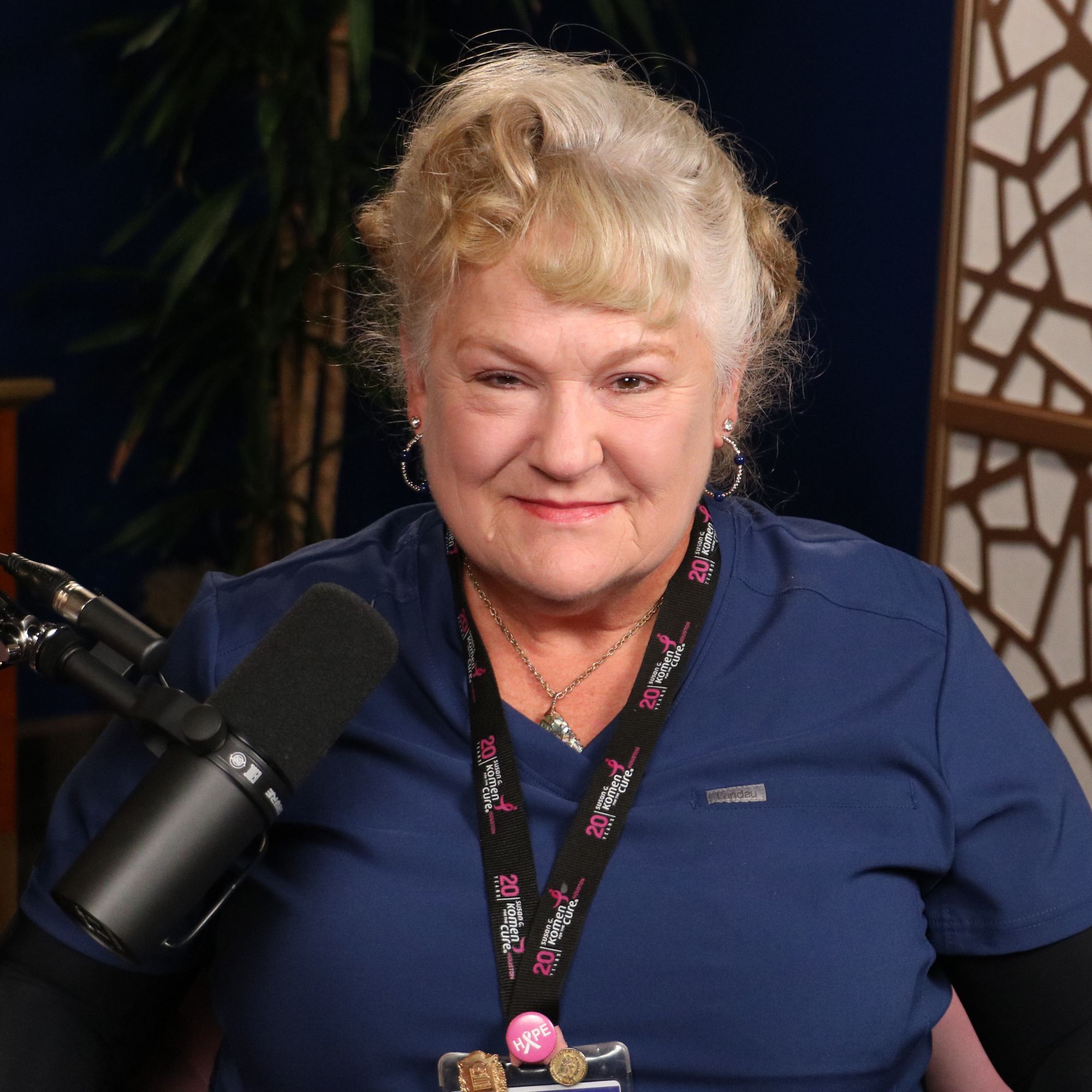
Dorothy: [00:00:00] Peggy Connor brings a wealth of experience from a life shaped by a medical family, and her journey to becoming a doctor is one that is fascinating. She went from running a biomedical engineering firm to dedicating her life to women’s healthcare. Her work at The Rose touches lives in a very special way. She is the first face many of our uninsured see, and she has an ability to talk to patients, hear their stories, and then to communicate the importance of early detection. Listen as she shares inspiring stories from the front lines, and she helps us to understand the real struggles and triumphs of women seeking care. Peggy has a calling and a mission, and her experience is a lesson for all of us.
When you subscribe to our show, you help us grow. Someone you know may need to hear this story, so please share with your family and friends [00:01:00] and consider supporting our mission at therose.org.
Let’s Talk About Your Breast, a different kind of podcast presented to you by The Rose. A breast center of excellence and a Texas treasure. You’re gonna hear frank discussions about tough topics, and you’re gonna learn why knowing about your breast could save your life.
Peggy, thank you so much for joining us today. I, I know that, that you come from a medical family. Your father was a dental surgeon.
Peggy: Yes.
Dorothy: Your mother was a nurse?
Peggy: Yes.
Dorothy: And grandfather was…
Peggy: He was a surgeon, a physician.
Dorothy: Mm-hmm. He was part of General Hospital in Pasadena.
Peggy: He started Pasadena General Hospital back in the thirties on Shaw Street in Pasadena.
Dorothy: Oh my goodness. Yes.
Peggy: So he had left Oklahoma because of the Dust Bowl.
Dorothy: Mm.
Peggy: In Oklahoma, he was literally a [00:02:00] physician that used a buggy and his wife, my grandmother was also a nurse. And they would use a horse and a wagon and go from ranch to ranch and take care of people.
Dorothy: So this, this medicine stuff comes by naturally.
Peggy: Yeah. Dinner table conversation my whole life.
Dorothy: But you didn’t wanna be a physician?
Peggy: No, I, I ran from medicine because it’s all consuming. You know, I spent much of my childhood running up and down the halls of, um, medical centers. When mother was, had to go to my dad’s office maybe to drop off lunch or to pick up books or, and then people get called out. You can be at home at night and tired and you get called out, especially if you’re in surgery. So I think I saw that. And the nurses too, they were exhausted.
Dorothy: Mm-hmm.
Peggy: So.
Dorothy: It is, it’s all consuming.
Peggy: Yeah. Yes. So I was like, no, I’m not going there. I’m not for [00:03:00] me.
Dorothy: So as a young woman though, you did start a business with your husband?
Peggy: Yes, we started a biomedical engineering firm. Um, Texas a and m helped us. My husband was in a master of biomedical engineering program, and it was a wonderful experience. Uh, the Department of Defense funded it. Allstate Insurance funded it. Lloyd Benson funded it. George Mitchell at the Woodlands funded it and the company did very well. We developed a fiber optic probe that was, uh, cutting edge technology. We were in our twenties, so, boy, we could work 20 hours a day.
Dorothy: Oh yeah.
Peggy: Very, very good experience.
Dorothy: And, and during that time, you’re raising children?
Peggy: Yeah. When we graduated, we both walked across the stage, December of 79, Texas a and m University, and we had already started the company brought [00:04:00] in a couple of engineers and I was doing the books at home and we were doing a lot of work on the dining room table at the house. So I made a deal with my husband. Um, you get your master’s and I’ll raise the kids and later on I’ll go back to school. And he honored that.
Dorothy: Mm-hmm.
Peggy: When the kids were older.
Dorothy: Yeah.
Peggy: So it was a good experience. Yeah.
Dorothy: But you did go back to school and it wasn’t.
Peggy: Yeah.
Dorothy: For anything. It was for the very thing that you’d run away from your whole life.
Peggy: Yeah. I think after working with patients, ’cause we did a lot of work at Harris Health. We did our clinical trials in femoral arteries and um, and I had a couple of experiences where I was required to perform in a medical capacity, and one of the Baylor surgeons said, you know, you need to go to medical school. So I did and never looked back.
Dorothy: Okay, but you [00:05:00] didn’t go to the traditional medical school, so let’s, let’s talk about that.
Peggy: Wow. Um, I was older, I was in my thirties. I went back and studied organic chemistry under Charlie Rose at Rose at, uh, the University of Nevada in Reno. Made an a in organic chemistry lab, one of the only a’s he’d ever given. Then when I applied to medical school, one of the professors came to me discreetly and said, you know, they’re not gonna accept you because this is a state funded university medical school. But I know somebody in Mexico that recruits for the autonomous University of Guadalajara. You’re an excellent student. You’re a bilingual, why don’t you just talk to him? I was a bilingual, my husband was Argentine, so we had gone to and from Mexico dozens of times. Loved it. Viva Mexico. Love Mexico. Still do. And it was a beautiful country. [00:06:00] We went down to Guadalajara, got an apartment, and I went to medical school and I was there for four years.
Dorothy: Mm-hmm.
Peggy: Then I started doing an Internado and I worked in Hospital General in Zapopan for a year, mainly in obgyn love delivery. Thought I’d go into obgyn. I was literally an intern running the, the labor ward at night and delivered dozens of babies. And then my mom got sick, so I came here in Pasadena, took care of my mom. It was terminal. One of my neighbors knew The Rose. She was on your board of directors and said they need a bilingual physician there. Hadn’t done my internship wasn’t ready, so I went to work as your sponsorship clerk back in oh 2 3 4, and Dr. Dixie Melillo signed on and I was able to complete my internship and my specialty in breast and [00:07:00] fell in love with it, fell in love with The Rose, took my boards, went into commercial medicine, immediately quit because they don’t give you enough time and compassion. You couldn’t say God, you couldn’t hug your patients. So anyway, I got so interested in cancer that I studied causation. ’cause I was into research and once I started studying causation of cancer, I’d never turned back. I think my mom and dad used to say, my first question was why. So I, I answered that question.
Dorothy: Mm-hmm. Um, but all those years that you were our sponsorship coordinator and, and for folks to understand what this is, this is the person assigned to talk with the uninsured woman about whether or not she’s gonna qualify for sponsorship, which [00:08:00] covers at The Rose, all of her services. She doesn’t have to pay for anything.
And if we do diagnose her then we move her into the, um, state program, the breast and cerv cancer program that helps her to have treatment. It’s a, an insurance kind of, of policy in a way. But how many, you did this for years. You were talking to women, you were. You were saying they’re eligible.
Peggy: Yes.
Dorothy: You were making sure they had all their paperwork. I mean, this was a very, uh, clerical type job.
Peggy: Yeah. But I need to add something. After we sold our company, I became a missionary and I went into Mexico, down at South America and Central America, native American Indian reservations, and I saw this huge need for women’s healthcare. And it was as a Methodist missionary that I became interested in helping [00:09:00] women and we sponsored women under trees.
We would literally like bring salt, sugar, beans. And take care of people in Pueblos, in villages. And after that I couldn’t go back into medicine for money. So when I slipped into that sponsorship position, it was like, oh, I’m home. And do you remember Helen? I was leaving The Rose and she came to me one day and said, you don’t have to be a missionary in Central America.
I was actually, I had interviewed with Mercy Ships and I had actually signed on. I was gonna go to Africa, and she said, why don’t you just stay here? So Helen and I did, and I’m, I’m still associated with The Rose. So from sponsorship, that was about the time when the BCCS grant came in.
Brahana and the state health department sent me to MD Anderson. I got certified in breast and began doing clinical breast exams. And the BCCS grant allowed us to put patients into [00:10:00] Medicaid. And so we could do the full package.
Dorothy: Right.
Peggy: We could interview them by then, I think you had four sponsorship people. A huge navigation department. So we could screen women, um, put them into treatment and counsel them and help them. So why would I leave?
Dorothy: So, so it’s 24 years later. 20.
Peggy: Yeah. Yeah. 24 years.
Dorothy: Basically. And talk about, and you still come twice a month?
Peggy: Yeah. I’m a.
Dorothy: To do our, our do the exams with the women and take all their information. Tell us about these women. These are sponsored women who are going through one of our programs.
Peggy: It’s a passionate job. I couldn’t do it without a team. It’s tough. Wow. Oh, this is tough. But I, we see [00:11:00] women that are abused. We see women that have been in good situations, and that was taken from them. I had a patient walk up from Honduras. I gave her a pamphlet to read in Spanish, and she goes, I don’t read. It’s tough. I’ve seen tattoos, bullet wounds. It’s tough. Let’s move on.
Dorothy: No, but I think this is important, Peggy.
Peggy: Yeah.
Dorothy: Because so many, um, people don’t realize that a lot of our sponsored women, most of them are citizens. Most of them have just, they never had insurance. They need insurance. They need some place they can go to, but they also don’t speak English.
Peggy: Right.
Dorothy: And I think that is one of the, the big gifts that you have.
Peggy: Yeah.
Dorothy: To, to allow them to enter a medical world and in their own language. That’s, [00:12:00] that is one of the scariest things.
Peggy: Yes, absolutely. Most of our staff is bilingual in Spanish. On in both locations. I am fluent in bilingual Spanish, a little bit of French, some Portuguese, ’cause I studied Latin. For medicine at a and m, thank goodness. So I can communicate with most of the patients on the east side, but when you go to the west side. We have six or seven languages in a day.
Dorothy: Yes.
Peggy: So we have translating services. Sometimes they bring a mother or father, a brother, a sister. We take care of everybody. You know, some women from the Middle East have never had a mammogram, but they don’t believe in insurance. It’s, there’s no such thing as preventive healthcare. So we teach them what preventive medicine is. We have women that come from Africa that haven’t had any medical care, and we educate them about the importance of all sorts of medical care and refer them to low cost clinics [00:13:00] that can start them from ground zero.
Dorothy: Right.
Peggy: Um, gosh, I’ve had patients from South America that exiled. Because they were afraid, so they had insurance and very much, you know, a lot of good care in South, south America, but they had to leave and so they were used to very good treatment and we give them high quality care in our sponsorship department, everybody gets high quality care. It’s, it doesn’t matter if you have insurance or no insurance. You know that sometimes the uninsured patient gets more counsel, navigation and love because they need it. And let me say team. Yeah, we’re a team.
Dorothy: Yeah.
Peggy: All of us are.
Dorothy: We’re not talking about a small segment.
Peggy: Oh, 60 or 70% of women don’t insurance.
Dorothy: Right.
Peggy: I’ve had attorneys that come who can’t afford to pay their insurance. Maybe they had a bad year or post covid.
Dorothy: Yeah. Fell on hard times.
Peggy: Yeah. And I had.
Dorothy: And many, [00:14:00] many people that is what’s happened. They had a divorce.
Peggy: Yeah.
Dorothy: Suddenly they don’t have insurance and they don’t have the means.
Peggy: Yeah.
Dorothy: To, to buy it. And they certainly are just scraping by. So we’ve seen that happen so many times.
Peggy: Yeah.
Dorothy: That we’ve had to provide that care.
Peggy: It’s, it’s hard to see somebody that’s worked for 30 years lost their insurance and they paid all their taxes and they were good members of society cry and say, I’m, I’m embarrassed to do this. So we just talked to them and let them know that there’s 50 or 60% of the women in Texas that don’t have insurance right now. I think it’s 65. You know, because I’m seeing women from across the board. And it used to be a lot of Spanish speakers. Now it’s like English speakers that have lived here all their lives, maybe down the road, maybe taught for 35 years. And for some reason they don’t have insurance.
Dorothy: Right. [00:15:00] So it can happen to anyone.
Peggy: Yeah. And it does. Yes. You know, and when I was in, I think I was in Freeport, a man approached me because I signed my name at a museum and put The Rose and he goes, oh, we have a lot of men with tumors now can you come talk to us? And I was like, okay. So not just women, it’s men too.
Dorothy: It’s men too.
Peggy: That was a real eyeopener for me. Um, go back to the cancer causation. We live in such a challenging environmental world today that people that normally wouldn’t have breast cancer have breast cancer. And it’s huge. You know, one in 7.7. Yeah. And for men it used to be one in a thousand. Now it’s depending on the culture and the race. I hate the word race, but depending on their genetic background, some one in 486 men and some, it’s one in 900. So it depends on your genetics. So if you have bad genes, if you have [00:16:00] predisposition, there’s a lot of factors. So The Rose is a blessing for anybody that comes through The Rose. It’s a blessing.
Dorothy: So Peggy, now you’re, you live in the country.
Peggy: Yeah, absolutely.
Dorothy: Uh, you still come into the big city.
Peggy: It’s tough.
Dorothy: To do this work.
Peggy: Yeah.
Dorothy: So what do you find magical about living in the country?
Peggy: Peace. Peace. Quiet. I meditate a lot. I’m deeply spiritual. Um, you pick up pain when you take care of people that are in pain. So you have to put it somewhere. So you carry it off and you bury it. So I think peace, tranquility.
Dorothy: So do you think that is something that all of us could use right now?
Peggy: Oh yeah.
Dorothy: Of sacred place to what place to go? Somewhere quiet. [00:17:00]
Peggy: Absolutely. Stress is 75% of the people I used to do er, a lot of er. 75% of the patients that presented were so stressed out that that was the cause of their visit. Their stomach pain, an ulcer, their migraine headache, stress, um, stress, financial worries. Uh, stress is so bad. That’s what’s, that’s probably what’s hurting most humans today.
Across the board. All ages. Kids pick up on it. There’s a syndrome where babies, they’re around parents that are nervous, cry more. Because they’re picking up on the stress that their parents have. Um.
Dorothy: I hadn’t heard that one.
Peggy: Yeah, I, I, I’ll send you some articles. They pick it up. People share emotion when a mother’s stressed out and she’s with her baby, if she’s stressed out, the baby becomes stressed out. So we have to fix [00:18:00] that. We have to reduce the stress. Because you know, your immune system becomes very weak when you’re all stressed out. So some people that are stressed out taking care of a loved one that’s terminally ill, they develop more cancer because their immune system is weaker. So there’s, there’s a lot to be said for reducing stress.
Dorothy: And you know, I remember a, a leading cardiologist who said, it’s not so much what you eat or even how much you exercise, but the amount of stress you’re dealing with.
Peggy: Absolutely.
Dorothy: When it comes to, to disease period, but especially heart disease. So, yeah.
Peggy: Yeah.
Dorothy: We don’t always put that together.
Peggy: And what causes the heart attack? He can have a very frail structure and live for 25 years, but if you have a stressful event, that’s when the heart attack occurs.
Dorothy: Right. So, so what do you hope for the future, Peggy?
Peggy: I mean, well if I was a, a beauty pageant queen, I would say world peace. But I know [00:19:00] that’s not possible. Um. Education. I think education’s the key for, like locally, I would say we, we just need to educate. We need to educate our kids. We need to educate our adults. We need education, you know? Years ago, you guys put it in into your mission statement, like educating the patients, informing the patients so that they can empower themselves with knowledge. That’s part of the secret. If people understand what they’re up against, then they can avoid situations which lead to health issues. Um.
Dorothy: But especially when you’re trying to navigate the health center system.
Peggy: Oh, yeah. Yeah.
Dorothy: If you have just a little bit of knowledge, you can go so much faster, so much easier if you yeah know it’s gonna be coming down.
Peggy: Solve the transportation issues. A lot of underinsured women don’t have any way to get around. They can’t afford to call a, a ride. [00:20:00] You know, and the bus system doesn’t take us to all parts of Houston and the metro, the Houston metropolitan area is gigantic, so it’s very difficult for a lot of our patients to get to one of our centers. Yeah. We have five mobiles out. We, we, I wish we had 10.
Dorothy: Mm-hmm.
Peggy: Yeah.
Dorothy: I wish we had 10 too. You have to tell about, but now, you know, even from your country experience, you know how hard it is to get to healthcare when you’re in a rural environment.
Peggy: Yeah.
Dorothy: I mean, you travel, uh, 45 minutes, 50 minutes to get to the nearest hospital.
Peggy: Here’s a, here’s a true story, a neighbor. She works at the local meat market. Her mother died of breast cancer when she was in her fifties. This, this lady that I see every time I go to the meat market is in her fifties. She hasn’t had a mammogram yet. I’ve hooked her up with mobile. Mobile has called her.
And I, I went in the other day and she said, I, I take care of my husband. He’s disabled and [00:21:00] if I miss a day of work, I don’t get paid. And I, they called me, but I can’t call him back ’cause my phone’s been cut off. So transportation is a serious issue, and I’ll probably end up driving her in. But that’s, that’s reality for so many people.
Dorothy: Right.
Peggy: Especially in rural environments. They don’t have insurance. They’ve never had insurance. They’re farmers, they’re ranchers, they’re country people. They’re simple people. They’re happy people, but they don’t have insurance. And so when something major happens, it’s quite serious. So that that I see. That. I’ve saw, seen that for 20 years and I’ve brought a lot of patients in.
Dorothy: Yeah. Yeah.
Peggy: So.
Dorothy: And one final question. What would you tell anyone who’s thinking of having a career in healthcare?
Peggy: Go for it.
Dorothy: Even with what you know?
Peggy: Oh yeah. It’s a calling. Mine was a calling. Try arguing with God. Mine is definitely a calling. You know, when you’re put into a [00:22:00] situation where it’s you and there’s nobody else to fix it, you realize really seeing that you’re not alone. You’re not, you know, I don’t know if there’s cellular memory, if there’s spirits that come into your head, but you can be in situations that are extremely critical and the answers come to you and you realize, wait, I didn’t study that, and, anatomy, and I didn’t learn this in, in genetics, but all of a sudden the answers are there. So if you tie into your network, whatever that network is, maybe it’s heart education, university education, spiritual, a church; teams team medicine is good. Most medicine is team medicine. Ours is team medicine. Um, tie into your network. Help people. I mean, it’s so rewarding. I’ve had babies named after me.
Dorothy: Oh, Peggy.
Peggy: I know. Pour the stress. So, no, go for it. [00:23:00] Educate yourself. And it’s, it’s a calling. You have to meditate, you have to know you’re in. It’s demanding.
Dorothy: Mm-hmm.
Peggy: It is demanding, you know, in.
Dorothy: But there’s nothing like it.
Peggy: No. So rewarding. And you’re, for every person that I help, I’m rewarded by Tim.
Dorothy: Easy.
Peggy: Easy, easy. Yeah. So never, never run from it like I did. I think I had to get that experience of my twenties so that I could come out and, and really be effective because when you do clinical trials in your exposed to the hospital environment from a business viewpoint, you understand it well. So then when you go into it as a healthcare worker, community, healthcare worker, whatever, you see both sides of it. There is a business. There has to be a business. But you don’t wanna just see it from the healthcare worker side. You wanna see it from both sides. ’cause they, you have to have both.
Dorothy: Yeah.
Peggy: Yeah. You know, someone’s gotta pay the [00:24:00] bills.
Dorothy: That’s true.
Peggy: Yeah. Yeah. So, um. Follow your calling.
Dorothy: Mm-hmm. Great advice. Thank you so much for being with us today.
Peggy: This was tough. It was tough. It was very tough.
Dorothy: No, it was good to have you, Peggy.
Peggy: Thanks.
Post-Credits: Thank you for joining us today on Let’s Talk About Your Breasts. This podcast is produced by Speke Podcasting and brought to you by The Rose. Visit therose.org to learn more about our organization. Subscribe to our podcast, share episodes with friends, and join the conversation on social media using #LetsTalkAboutYourBreasts. We welcome your feedback and suggestions. Consider supporting The Rose. Your gift can make the difference to a person in need. And remember, self care is not selfish. It’s essential.