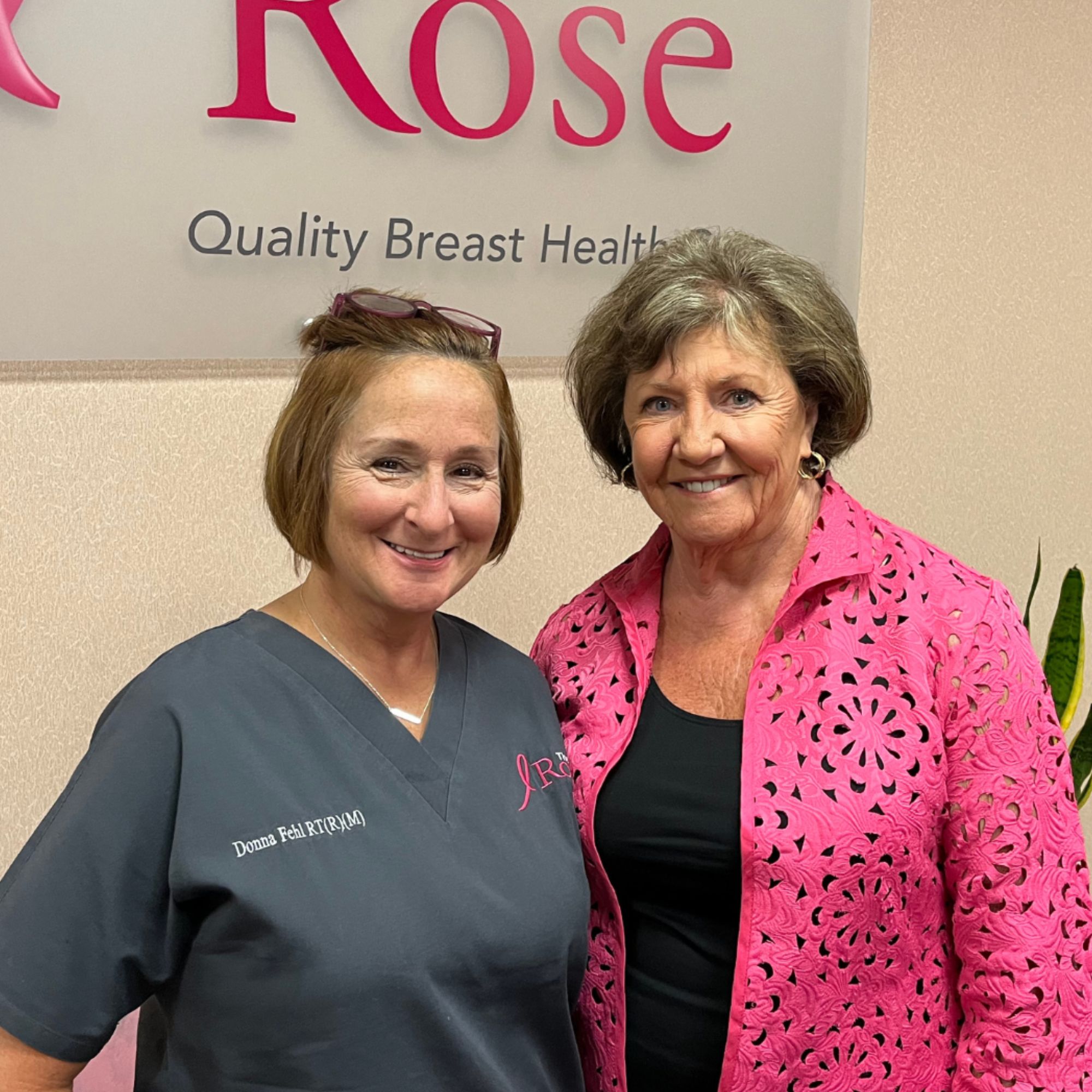
Dorothy: [00:00:00] I’m Dorothy Gibbons, CEO and co founder of The Rose, and I’m your host today on Let’s Talk About Your Breast. She’s seen mammography from inside out. She’s worked at The Rose Breast Diagnostic Centers and on the mobile mammography coaches. Donna Fehl’s journeyed to becoming a mammography technologist. is as unique as her approach to life.
And during it all, she thinks doing what she can to make a patient smile is her real job. She knows the key to a happy life means bringing a little joy to someone else’s day. Here’s why she thinks it’s an adventure to travel three hours on a huge coach to do her first patient. She is asked all the time, did Donna fell?
Yes, Donna did fell one of those times. And we’re going to hear about it today.
Let’s Talk About Your Breast. A different kind of podcast presented to you by The Rose. The Breast Center of Excellence [00:01:00] and a Texas treasure. You’re going to hear frank discussions about tough topics. And you’re going to learn why knowing about your breast could save your life. Join us as we hear another story and we answer those tough questions that you may have.
Well, today we have with us Donna Fehl, who has been with the Rose since 2010, right? And I can’t imagine any job here in mammography that you haven’t done. So tell us what it is like in a day on the mobile mammography coach from a technologist’s point of view.
Donna: It’s actually pretty exciting because Every day is a new day.
Like I get to do what I love every day, but I get to do it somewhere different every day. And so being out there, it, you just feel like you’re helping because you’re on the, you’re on the road, like a driving billboard. People [00:02:00] stop. We’ll stop for gas. People will stop and ask you. questions about the mobile and how they get into have a mammogram.
They want to come right then while we’re filling up with gas and have their mammograms and you get to explain it. And it’s just spreading the knowledge and bringing awareness. to everyone regarding your, you know, having your mammogram. People are excited to see us on the road.
Dorothy: All right, now when we talk about being on the road, we’re talking about a huge coach that is 45 feet long?
Donna: Yes.
Dorothy: Yes.
Donna: Yes.
Dorothy: It is bright pink. It has our name on it. And we are about to get our fifth one. Well, actually we got the fifth one in. And so these coaches go to where when you say be at a different place every day.
Donna: Um, we go, we go to areas, um, just on the outskirts of Houston. We go. Out of the city, we go [00:03:00] to different counties where we do different things.
Dorothy: Well, actually, we cover 43 counties.
Donna: Yes, 43 counties. Yes.
Dorothy: And it goes all the way up to Shelby, up north, out to, uh, Burleson and that area.
Donna: Correct.
Dorothy: A little bit past that, and then south to Matagorda.
Donna: Yes.
Dorothy: So it’s a huge. Part of South East Texas that we’re covering.
Donna: Yeah. So when I say we’re on the road, we, we’re on a road trip every day and it’s exciting.
It gives me the feels to be when we pull up in the morning and there’s no cars in the parking lot, but there’s four coaches with the headlights on. I get emotional. I don’t, I don’t know why it’s an emotional thing for me because I think, wow. We’re going to make a difference today.
Dorothy: And, and it happens every day that, that we are.
Donna: It does.
Dorothy: So. Why is mobile mammography even important? I mean, there’s, there’s plenty of mammogram centers everywhere.
Donna: It is so [00:04:00] important. It is so important. And we hear this on a daily basis, whether it be rural or in the urban areas. Um, we find that in the urban areas, people are more excited because they get to just step away from their desk for 15 minutes versus missing a day of work because missing a day of work is just not an option.
for them to step away and have their mammograms, and they’ll put their mammograms off because of their work schedule. So having the service come to them, they get to step away from their desk for 15 minutes. We get to go have their mammogram done and leave and don’t miss a beat in their workday.
Dorothy: So we go to businesses.
Donna: We go to businesses, we go to school districts. School districts are The teachers are the most excited because it’s so hard to get away and how they usually work is they do it on their off period. And so they’ll come in and or sometimes they arrange for people to cover just The teachers [00:05:00] classrooms as they step away because it’s only 15- 20 minutes at the most that they have to step away and they’re able to get their mammograms.
And then when we go to more rural areas, it’s, it’s about the access, the health care access. We are so lucky because we have the medical center, basically here at our fingertips. And they’re not, it’s not like that everywhere. You, you, we, I, I’ve personally have taken that for granted having that available to me.
And it’s not like that. They don’t have access to healthcare period at their fingertips like that, like we do. And it kind of having mobile mammography, it eliminates. A challenge for these patients, a lot of them don’t have transportation outside of their little common area of where they live. And if they don’t have, um, transportation, they don’t have their, their elderly, they are afraid to [00:06:00] drive outside their common area.
So bringing mobile mammography to them. It eliminates those challenges.
Dorothy: And of course, we talk about the, the technology. We do take 3D mammograms to these areas. And in many communities, 3D mammograms have not even, they don’t even have them. They might have a mammogram center within an hour or two hours drive, but that, that having that advanced technology is really a plus.
Donna: This is true. And I stress this to the patients that we have the same equipment that, that a large, Breast center in the medical center of Houston has, we have the same equipment. So they’re getting quality exams with, um, 3d exams. And they’re excited about that. It’s not just like it’s a hop on, hop off exam.
They, they’re getting, they’re getting quality imaging.
Dorothy: Now, you’re going to have to explain to our listeners, what’s the difference in a screening mammogram and a diagnostic [00:07:00] mammogram? Because on the coaches, we only do screening.
Donna: Right. So, a screening mammogram is when somebody comes in, they presents with no problems.
They do not have any, symptoms, no lumps, bumps, or concerns with their breast. And so we’re going to do their screening mammogram. So then the radiologist will read that. And then at that time it could turn into a diagnostic because that’s when the, if they see anything then the doctors will call them back for their diagnostic exam.
Dorothy: So some of the words we use are routine, annual, and, and. But I know because you’ve told me many times people will come up to the coach and go, I’ve got a lump in my breast. And what do you do with that woman?
Donna: We consider our, our team as a care team. And so we help them. We don’t just give them a number and turn them away.
We find out what’s going on. We advise them on letting their [00:08:00] doctors know, sometimes walking them into the clinic to let their doctors know. And we’re able to navigate, I’ll pick up the phone and call Patricia and say, I have a patient here. She has a lump. When can you get her an appointment for a diagnostic mammogram?
And it’s just a team effort. I mean, it’s from beginning to end, it’s a team effort. I can, the Rose is. So we’re on the road, but they’re here too, and it’s just a team.
Dorothy: Right. And I think that’s so important because you don’t tell her, here’s a phone number to call. You’re saying, let’s see how we can get your appointment made.
Most people don’t understand that it would not be the best protocol to even do that mammogram if you have a lump in your breast because you do need that diagnostic workup. It needs to have that physician Looking at the films that may need the ultrasound, may need the physical exam. But on, when you’re having a screening mammogram, that’s all it is.
It’s a screening mammogram.
Donna: That’s right.
Dorothy: And you know [00:09:00] about a fourth of the women that come to the coaches are having their first ever mammogram. So, can you tell when someone has it? I mean, I know you can tell, but how do you, how do you calm that woman down? How do you handle her?
Donna: Well, I usually start out by telling them they’re the boss.
You’re the boss. If I’m doing something that is uncomfortable to you that you can’t tolerate, you tell me. We’ll do our best. We’ll make adjustments and we’re going to make this a good experience for you. It’s not as bad as the rumors have it. And that usually works. And then when we’re through, I said, okay, we’ve, we survived the, we survived one breast and they’re usually saying that’s not as bad as I thought it was going to be.
And so, um, I just talked to them. Imagine that, I talk, I talk all the way through the exam.
Dorothy: No, I can’t imagine that Donna. Not that you would be talking to them.
Donna: Yes, I talk to them and um, sometimes when they’re nervous I, I may talk about something [00:10:00] else. I may say, do you have grandchildren? And just get their mind off of what we’re doing and then it’s over with and they’re happy.
So, my goal is to make it a good experience for every patient. Not every patient comes in happy and excited that they’re going to have their mammogram done. So, we have to put on quite a few hats. Um, in the field of mobile mammography, we have to wear quite a few hats. We have, we have things that we have to get when we get out there.
We troubleshoot, we have to troubleshoot to make things work because everything’s mobile. And so we don’t have access something to us just in our, you know, in the next office. We have to figure it out and And same with the patients. I’ve learned that you have to wear a different hat with every patient because they’re different.
And if you just handle them differently and to their personalities and their needs, I guess is what I’m trying to say. You can get a good feel doing [00:11:00] mammography usually comes with a pretty compassionate person with a strong passion for women’s health. And I do that.
Dorothy: Right. Well, you’ve been doing it a very long time.
Donna: Yes.
Dorothy: And you’ve done both, uh, in mammograms in the centers and mammograms on the mobile coach. Uh, the, um, but I, I know you’ve gone back and forth, but it seems like you always gravitate back to mobile.
Donna: Yes.
Dorothy: And it is that variety.
Donna: Yes.
Dorothy: I think that, that attracts you because you like that.
Donna: I love that. Yeah.
Dorothy: So, if, how would you explain, um, you know, when we talk about a day in the life of mobile, You’re up at four, five, six o’clock.
Donna: Correct.
Dorothy: On the road, can be an hour to three.
Donna: Up to three hours sometimes.
Dorothy: Yes. And then how long does it take for you to set up?
Donna: We usually, um, about An hour, because that’s getting [00:12:00] everything up and running because things sometimes aren’t as they appear to be. So when we get there, we’ve got to figure out also how to make those coaches work in the spaces that we have available.
And so we do our setup. It takes about an hour total to get our paperwork done. Get all the testing done on the machine.
Dorothy: And that’s important. You know, most people don’t realize every mammon machine has to be tested Every morning before it’s used.
Donna: Yes, some patients think they woke up. They knock we woke up We haven’t even put the stairs out yet and they’re knocking they’re ready.
Dorothy: They’re ready.
Donna: Yeah, we have to explain to them that it’s a process it’s us it’s we have to do testing on the machines to make sure that everything is um calibrated and within limits and It usually takes us about 30 minutes to an hour to get everything done.
Dorothy: Right. And that’s a good point. And I know so many people think it’s like the blood machine or the blood.
Uh, you know, when, when you give blood, yes, the blood bank, but for mammography, that coach has [00:13:00] to be absolutely level, has to be on grounds that do not sink.
Donna: Yes.
Dorothy: I mean, that’s a huge machine. And so lots of times people go, Oh, well you can bring it to my church or my this, but we’d have to do onsite visits.
And then even after we do an onsite visit, sometimes there are, like you said, are challenges. They’ve got to put out the cones or we’ve got to find a different way to to make it in—
Donna: —to get it level. Yes, and it’s, thank goodness we have very experienced drivers that are able to manipulate any situation and get us in any situation.
But yes, you’re right. Sometimes we’ll be in the middle of testing. I’m like, and they’re getting on and off the coach to, to prepare the outside of the coach. And I’m like, um, I don’t think that we’re level enough because when. Somebody gets even on and off that bus, you can feel it in the back and it will rock you.
And so we start over.
Dorothy: So quality mammograms, 3D mammograms. On the, [00:14:00] at the exam, 15 minutes, maybe 20 minutes.
Donna: Correct.
Dorothy: Yeah. You do almost everything beforehand.
Donna: Yes.
Dorothy: Register, give us information about you. And we do both insured and uninsured women.
Donna: Correct.
Dorothy: On the, on the coaches. And I always think that that’s the great equalizer.
You know, anyone that comes on the coach, they’re, you know, have nothing else going on in their breast. Anyone that we diagnose from that original coach exam is, is like a 2B. Nothing above a 2B. And that may not mean a lot to our listeners, but stages are very important in early detection. Almost all of our staging on the coaches are zeros, or ones, or twos.
That is the best news possible, because that means you’ve got so many options. And treatment’s a lot easier. All of the things that go along with breast cancer. Now, we hope you don’t, we don’t find anything. And [00:15:00] that’s the point of it, though. You know, you want to catch it when it’s early. Let’s talk about Donna now.
Donna: Oh, Ok.
Dorothy: You had to go back to school to do this.
Donna: I did. I did. I decided to go back to school. I worked, um, Being a mom is just the greatest joy. job ever and I loved it and I did what I needed to do while my kids were young to be close to them. But when they started school, I wanted to do something that I was already doing, which was making a difference because I worked, I don’t know, people may dismiss a childcare position working in, um, a childcare.
I worked in my Kids daycare that was also a private school and it taught me a lot because kids are brutally honest and You it teaches you how to do things in Ways that it just made me feel needed it felt like a purpose to me And so I wanted to do something that I could feel like I [00:16:00] was had a purpose as well Turning a kid’s day around I wanted the interaction of that.
I didn’t want an office job. So I started the mammography, actually the x ray program because we had to do the x ray program first. Yes. And so after graduation from that, I had a huge opportunity and a door opened for me that led me straight to mammography, which I was Already interested in because when we did our clinical rotations, we were at Bayshore Hospital and Dr. Melillo would invite all of the x ray students to come to her Tuesday tumor boards. And so that made it interesting because in the tumor boards, they would show the pathology and the imaging and the everything behind it. And so it. It really makes you curious. I’ve been curious all my life. I’m curious about something.
You lay something in front of me. I want to figure it out. And so I was able to start doing [00:17:00] mammography straight out of x ray school and had no idea that it would be part of a passion of mine.
Dorothy: So when you, when you get out of the x ray school, you can do any kind of x rays.
Donna: Yes.
Dorothy: But when you do the mammograms, you have to have special training.
Donna: Yes.
Dorothy: So, and that’s kind of. Just for folks that are listening, that’s kind of what makes it different. And you have to do so many under supervision and you really have to understand the anatomy of the breast.
Donna: Correct.
Dorothy: It’s, uh, positioning is so important. Compression is so important.
Donna: Yes. It’s a separate license than your x ray license.
Dorothy: Right, right. That’s an important point.
Donna: Yes. As a woman, it just, makes you feel good to do for other women. Women care about women.
Dorothy: Yes, absolutely. Now I want to go back to something you said about someone may discount a daycare position.
Donna: Yes.
Dorothy: After COVID, I don’t think anybody would ever discount that again.
I mean, you know, that, that held our communities together. And [00:18:00] when we didn’t have that, uh, resource and my gosh, all the mothers that Had to stay home and,
Donna: yes,
Dorothy: didn’t have that. Oh, that was just but you know, that’s that’s the other thing mothers always mothers women in general seemed to have a lot of responsibilities and so Putting that mammogram ahead of anything else is just almost impossible.
Donna: Yes, not on the no, it’s not on your list of to do things.
Dorothy: No, and so I think that’s why the the coach makes it Easier, more convenient.
And you know, you said something a while ago about the clinics. We do go to many clinics. We go to many, uh, federally qualified health centers. We go to some of those, uh, to doctor’s offices. Because it’s, it’s going to be wherever they are used to going that we have our best success. And of course, you have to have that collaboration with the community person.
With that [00:19:00] facilitator within that center, it won’t work either.
Donna: Correct.
Dorothy: We have so many requests about, we’d love to have the coach here and, you know, we’d love to have it there.
Donna: Mm-Hmm.
Dorothy: Let’s just talk about some of the things that are gonna have to happen to have a successful day. ’cause we sure want it to be successful.
Donna: We do, and the facilitators are very excited. They’re like, how many did we do today?
Dorothy: Yeah.
Donna: You know, they’re, they’re excited. It’s a lot of hard work. Mm-Hmm. or ladies in the office have to make sure we have, I mean, it’s. It, once we get there, they make it look easy as a process because scheduled patients are easy and it saves lives.
Fifteen minutes. We save a life.
Dorothy: And you go through a little bit about being sure they know to check themselves and I love the way that our techs actually talk to the women about what’s going on in their life because many times there’s other things that are happening that have nothing to do with that mammogram that have made them anxious and.
And it’s always nice to have someone that actually [00:20:00] says, are you okay? Does it feel right?
Donna: Correct.
Dorothy: I love that you let the woman or you encourage a woman to be the boss.
Donna: Yes.
Dorothy: All right. Tell me the story of being hired at the Rose.
Donna: So the beginning of the Rose was, it was good. So in 2010, I interviewed for a full time position on the mobile team, and I never knew that they would.
offer me a position. I went in for an interview on Wednesday and I would hear from them as soon as Friday. So my name is Donna and my last name is Fehl. So I get that a lot. Donna, did you fall? Yes. Yeah, Donna fell. Yes, she did. And that’s what I had to tell Amy Rigsby when she called to offer me the position.
She said, Donna Fehl? And I said, as a matter of fact, I did. I fell yesterday and broke my hand in 12 places.
Dorothy: Oh, no!
Donna: We need our hands to do mammography. She’s like, [00:21:00] that’s okay. Your start date will be Monday. six to eight weeks whenever your healing is done and the doctors released you and I was flabbergasted that not only it was an immediate position that they were trying to fill and So at that point I felt like the Rose chose me And they waited, and I started six to eight weeks later and haven’t been there ever since.
Dorothy: So Donna, you do know about being chosen.
Donna: I do.
Dorothy: Yeah, I, I just, as you were talking with me, I never had any ideas. So, what, what does that mean to you?
Donna: It means a lot to me because I was adopted. As an infant, I was adopted and I just grew up knowing that I was adopted. But being adopted, I felt chosen from, from day one.
It’s like God chose a family for me. And I’m so thankful [00:22:00] and then in many other aspects, I felt chosen with, with that. But because I’m here and I’m talking about the Rose, I felt chosen at the Rose because I thought this is the place for me because of the mission that the Rose has and the strong family part of the mission at the Rose.
It is truly. a family. I get up every day. I see people every day and they have become my family here. It’s a family atmosphere. I’ve never known anybody to need anything that everybody didn’t stand up. And so that’s why I felt It’s a family thing. I said, there’s no way that they would wait six to eight weeks for me for a position.
Otherwise it’s part of, it’s, it’s a fan. It’s going to be a new family for me.
Dorothy: And, and we do [00:23:00] think that’s an important value. It is one of our values. We do talk a lot about, you know, you’re, you’ve got to take care of your family first. And we, and we also want our patients to feel like family. You know, we don’t believe in statistics.
We don’t believe in being a number. We don’t, you know, we think every person, no matter where they are in life, really deserves the very best from us when they walk through that door.
Donna: I feel that way. And I’m, I’m not all about the science part of it. Mammography, I’m not. I’m 100 percent on how I make my patient feel.
I want to treat every patient like they’re my grandmother. At one point in my grandmother’s life, she was having, um, in her medical care, in her access to her care, she didn’t always get treated the best. And I, I regret not being there, sitting with her in her office to make sure that she was treated right.
So I said, you know, I’m gonna, um, I’m gonna make it a point. That [00:24:00] I’m going to make sure that everybody knows that their loved one is being taken care of.
Dorothy: What are the questions women ask you?
Donna: Is it going to hurt? I’ve heard that it’s going to hurt. So then we go through the process. They ask how long I’ve been doing it.
They ask about how I got into the position. How could they get into the position? They ask why. We ask some of the medical history that we ask. And I’m able to explain to them, like, why do we need to know if they breastfed? Why do we need to know what year their child was born? How many children they’ve had?
Did they breastfeed them? Have they taken hormones and for so, if so, for how long?
Dorothy: All of those things are important to know in that history.
Donna: It’s all very important. And I explained to them why. You know, most of them say, well, I wasn’t even going to come because I don’t have a family history of breast cancer, but I came and again, we get [00:25:00] to discuss why that is not, um,
Dorothy: it is a factor anymore.
Donna: That’s right. It’s not, it’s not. I tell them, I said, well, you know, 80 percent of ladies that are diagnosed. May not even have a family history. So you’re here and you need to take care of you.
Dorothy: Right. It’s a little bit higher. But once what we’ve discovered. Mm hmm. Is it once someone is diagnosed and they find out That someone in their family had it.
So oh my gosh. How- why did I not know,
Donna: Right.
Dorothy: And,
Donna: right.
Dorothy: “Sue”.
Donna: Right.
Dorothy: You know, had this but people didn’t always talk about it.
Donna: Correct.
Dorothy: Besides all the seriousness and besides the work you’re doing which is, like you said, life saving. I mean, we sometimes say that the things that we do here at the Rose really save lives, but it does.
And it sometimes can be very serious and sometimes can be very sad. But on the coach, y’all have fun.
Donna: We do.
Dorothy: I can’t believe I didn’t know about Ken on the coach. [00:26:00] Who is this?
Donna: So this is a Ken doll, just like Barbie and Ken. It’s a Ken doll. And we travel him with us on the coach. And when we go to each facility, we document his travels and we hold him up in front of the sign at the facility that we’re at.
Um, it’s just fun. It’s just it just.
Dorothy: Today ken is at…
Donna: Yes. Yes. Ken traveled here. We put him in. We take pictures with him with the People where we’re at we it’s just fun. It just lightens the mood and reminds you that— to smile.
Dorothy: It’s okay to have a little fun. It’s okay to play.
Donna: Yes.
Dorothy: Yes, and and I think it also makes it easier to help women feel comfortable and to Learn more about what’s going on especially with their health.
Donna: That’s right.
Dorothy: And you know, we we say this over and over They’ve got to take care of themselves first, you know, it is about self care. [00:27:00]
Donna: That’s what I tell them I say well if you don’t take care of you, how are you gonna take care of all these other people?
Dorothy: That’s so true. So true. So Donna, tell me, what is your happiest and your saddest memory of being here at the Rose?
Donna: I have to tell you that the happiest, it’s not a moment, it’s a moments, is seeing the village that it takes to, to run the Rose. I mean, it takes a village. It’s not just the employees here. We have so many volunteers that have their hearts. In this the annual shrimp boil.
Dorothy: Oh, yes.
Donna: The annual shrimp boil is part of my happiest moments because seeing everybody gather Is a happy moment for me.
I I truly can’t believe and i’ve never seen before The people that put their heart and soul into this and then they show up for this rather it be for a family member And I have a personal reason Or some personal friends [00:28:00] that would show up every year. And I always look forward to that because I always took their picture every year at the Rose.
And it was a happy moment. It was always a happy moment. They’re like, where’s Donna? We need our annual picture. And so I would show up and they were like, oh, thank God, our annual picture. And the Just trying to think of the word, the amount, the amount of volunteer that they did for The Rose just put meaning behind what The Rose was about for me.
But on the contrary, it also happened to be. One of the saddest memories of mine at the Rose. When we lost Bob Domec at the Rose. I it was sad It was sad. I felt like I felt like my father had passed away It was that big of a deal because he put so not only he his entire family Put so much into the Rose and continued to do so.[00:29:00]
It was just like we just lost such a big presence Of our volunteer community when we lost Bob, I know that he was gone in a way that doing something that he loved because it didn’t matter. He had many health problems, but he still was there. He still showed up and and that was sad to me. That was a sad memory for me here at the Rose.
Dorothy: But like you said, his family’s continued to be part of us.
And I think what you’re describing Donna is community.
Donna: Yes, community.
Dorothy: We Have this incredible community. All different kinds of people, all coming just to help, and to help us take care of people they don’t even know.
Donna: Absolutely. It’s crazy. We would do the, any fundraising that The Rose puts together makes me emotional.
I get emotional when I see, because it’s just a care that you don’t see at other, at other facility, at other facilities. You just don’t see it. When I [00:30:00] leave, Work at the Rose. I feel like I made a difference. It didn’t matter if it was a good day or a bad day. When I get in my car, I sigh because it was because we made a difference.
Dorothy: Donna, thank you so much for being with us today. I hope people have a better idea about what happens on the coach. And right now we are booked pretty solid. But believe me, if there’s a place we need to be, We’ll find a way.
Donna: That’s right.
Dorothy: That’s right.
Donna: Thanks for having me.
Dorothy: Oh, you’re most welcome.
Donna: Thanks.
Dorothy: So that wraps it up for today, and don’t forget, we’re doing a episode every single day. You’re going to get your daily dose of Let’s Talk About Your Breasts during the month of October.
Post-Credits: October is the month of pink, and for The Rose, a breast center of excellence, that means we’ll be airing podcasts every day in October to celebrate Breast Cancer Awareness Month.
We’ll be sharing everything from bikers riding for breast cancer to areola tattoos. Be sure to share with family and friends because there’s a little something for everyone. To find out ways [00:31:00] to help The Rose, visit our website at therose.org. Remember, self care is not selfish. It’s essential.