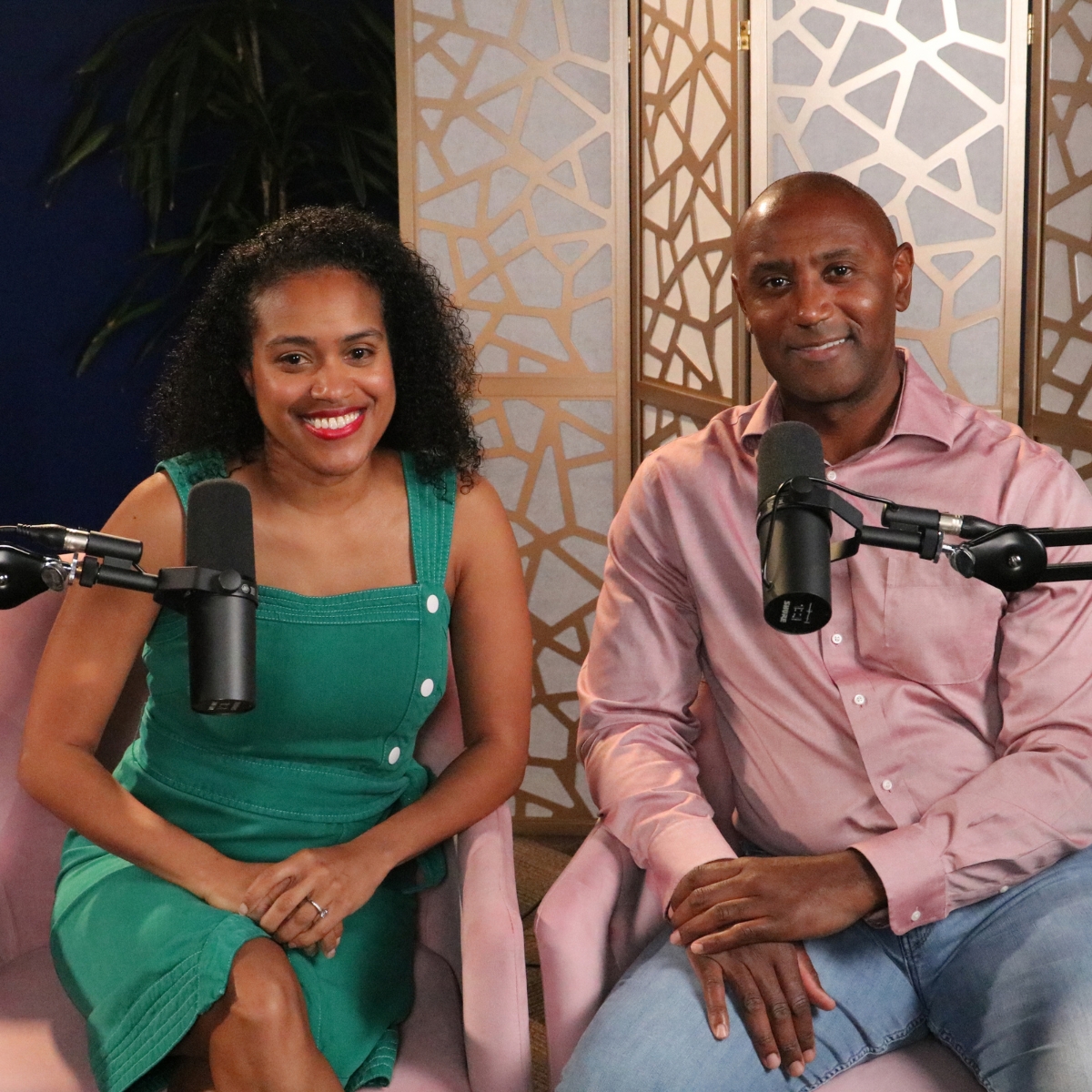
Angie: [00:00:00] I wanna introduce you to my friends Breanne and Michael Thomas today. Our daughters have been longtime school friends, and we’ve been part of the same community for more than a decade. Breanne and Michael are both cancer survivors, and I wanna talk about their experiences managing cancer and young family. Thank you for joining us today.
Breanne: Thank you for having us.
Angie: But first, Breanne, could you tell us a little bit about yourself? Where did you grow up?
Breanne: I grew up in the Bronx. I was born in the Caribbean, Saint Lucia, and I went to college in Florida, and when I moved back to the city, I lived in Harlem, where I met Michael.
Angie: Michael, where did you grow up?
Michael: Well, I was born in New Orleans, Louisiana. Uh, six weeks after I was born, we moved to Houston, and while in Houston, I actually also lived in Bakersfield, California, not while I was in Houston, but growing up, we moved between Houston and Bakersfield, California, several times. I graduated from high school in Bakersfield, California, and then went to university at Santa [00:01:00] Clara University in California, moved to New York after I graduated, and I lived 14 years in New York, but before I left New York to come back to Houston, I met Breanne.
Angie: And can you tell me a little bit about your family?
Breanne: In Houston, my mom lives here as well. Brought her down, and my sister moved with her, and Michael has his parents here and some immediate family from Louisiana also live here. But in our home, we have three children, and Kennedy’s 14. She’s our oldest, and then Talia’s 12, and Cole is 10, and we also have a dog, Midnight.
Angie: One of the things that’s always impressed me is how you sort of cultivate your, your kids’ interests. They’re involved in some really fun activities. Or what are some of the things that you guys like to do as a family?
Breanne: Vacation. We like to vacation. I mean, we should do things like locally, like, “Oh, we like to go to the park,” but we don’t usually go to the park together. As a family, we do travel. We’ve been to Paris. We’ve been to London. [00:02:00] We like to ski in Colorado.
Michael: Every year, we go to Saint Lucia-
Breanne: Where I was born …
Michael: where Breanne was born.
Breanne: Yes.
Michael: We have a great trip there, but we do enjoy traveling as a family, and recently, we’ve actually– While we enjoy traveling as a family, it does get more complicated as the kids get older because their interests are diverging.
Breanne: Yeah.
Michael: And so I’ve started taking them on individual trips. And so Cole and I went to Montana together. Talia and I recently, uh, went to New York, and Kennedy and I went to New York as well. And so now we’re-
Angie: Oh, that’s fantastic …
Michael: actually talking about their next round of, of trips.
Angie: Oh.
Breanne: But you’ve done that as well.
Angie: I, I also am a big fan of taking, having some one-on-one time with the kids. Yeah, I really enjoy that as well. Um, well, I sort of wanna talk a little bit about how cancer has affected your family, and, um, I know, I believe, Michael, you were the first in the, in your immediate family to be diagnosed with cancer. Can you tell us a little bit about that?
Michael: Sure. [00:03:00] Um, you know, when… It’s funny ’cause on the way over here, Breanne and I were talking a little bit about kinda the history of, um, our respective kind of backgrounds have had with cancer, and- I think the first time that I recall knowing anything about cancer was in middle school when my friend’s mom had cancer, and she ended up dying of breast cancer.
And, you know, when I, when I was diagnosed, kind of y- there’s a little bit of a numbness, and then you start thinking about kind of the worst of what cancer can bring to-
Angie: Yeah.
Michael: Um, to your family, to your life. And so, you know, I was thinking about that. I even thought about TV shows where people had, you know, died of cancer. So tho- those are kinda my immediate thoughts. And then you start to learn, or I started to learn more about what [00:04:00] my cancer means for me, what the prognosis means, what the options are, what recovery can look like. And when y- you start hearing the word recovery and, you know, positive things around prognosis, kind of the, the history around, you know, the history and understanding of, of cancer shifted for me a bit because growing up, the word cancer associated with any individual usually meant that that person was going to die.
And, you know, I was able to, thankfully, because of, I don’t know, advances in medication and kind of my personal situation with what I had, what I had been diagnosed with, it wasn’t so much as trying to avoid a death sentence, but, okay, I have cancer. What’s the best way to, you know, get it out of my body? And what does moving on look like? But there, there was, there was a lot of kind of [00:05:00] many stages that I had to go through before, before getting there.
Angie: Boy, it sounds like it. How did you sort of handle, handle the fear?
Michael: Well, um, time really.
Angie: Yeah.
Michael: Uh, and time and information. You know, y- when you get the words, “Okay, it looks like you have cancer,” you– Well, not looks like, “You have cancer,” then it’s, “Oh, wow, all right.” And then, like, as I mentioned, the historical knowledge kind of hits you like a, a brick wall. And then as I learned more about it, the fear started to dissipate as the reality of my situation was less bleak than many others have, you know, have encountered. And so, um, yeah- … I just had to learn and understand what my surgeries meant, what the real outcome was gonna be for me.
And as I understood [00:06:00] more, the fear started to dissipate. I mean, I still had to go through the process, through the appointments at MD Anderson, through the appointments, you know, through the surgery, through the recovery process. But I understood at a fairly early stage that it would be unlikely that the cancer would kill me. Um, so, uh, you know, the fear wasn’t too bad too long.
Angie: How did you decide or how did you tell your kids about sort of your diagnosis and the journey that you were on?
Michael: Well, so for me, we didn’t tell them until we had– we understood all the implications- the kind of beginning, middle, and end and likely outcomes. And so it was– I think it was an easier conversation than I was a- anticipating. And what’s interesting for me is I think if I were receiving that message from my parents at the same age [00:07:00] in the ’80s when I grew up It would be a very different thing because the experience with cancer for me growing up, as I mentioned earlier, was, “Oh, this probably means this person’s gonna die,” whereas now it’s less so. Um, and not that we shouldn’t ignore-
Angie: Right, because of the advances in treatment. Yeah. Yeah.
Michael: Right.
Angie: And detection. And early detection, right.
Michael: Right. Not that we should ignore the seriousness of the disease, but being able to understand beginning, middle, and end, and explain that to them. And our conclusion in my scenario was one where I’ll go through a surgery, and the cancer will be gone, and hopefully we’ll kind of have a normal, whatever normal means.
Angie: Yeah.
Michael: But life will be, will continue. And so I think they, they had some questions, but [00:08:00] it was in, in a weird way, an easier conversation than explaining to them why they needed to study or- … or, or, you know, why I was upset about their, their grades on a test.
Angie: Yeah.
Michael: And so, um, it was a bit nonchalant, but, uh, you know, with my, you know… of course Breanne, when we spoke about it, um, it was a, a different feeling.
Breanne: Yeah. Um, when I heard, I was, like, really… First, like what he said, um, I was really afraid. Like, oh, what will life look like without my husband? And then once I realized, well… And then I was also concerned about finances-
Angie: Of course.
Breanne: ‘Cause I’ve heard stories about, well, you know, he’s the breadwinner, so if he is not able to work, would we lose our insurance? Like every, you know, that-
Angie: Yeah …
Breanne: all that went through.
Angie: Just the practical matters.
Breanne: Right. Uh, yeah. That’s basically what went through my head. But, you know, we were reassured pretty early on about, like, how the coverage would, would work, and his prognosis was good, so I wasn’t as worried. And unlike him, I’ve ha- I grew up with [00:09:00] people with cancer that survived, so I wasn’t, um, as afraid as he was. And I think he went through a lot of that without me knowing And so by the time he got to me, Abel was able to tell me he was in a different head space as well. I also hired an au pair ’cause I wasn’t sure exactly how much help he would need or if there was gonna be something, they were gonna find something else. I got the children a therapist. I got myself a therapist. I just, I, I went, I went into we-need-support
Angie: mode. It, it, yeah.
Breanne: And organizing everything.
Angie: And, and be able to process what’s happening.
Breanne: Right. Exactly.
Angie: Yeah. As an outsider who sort of watched the journey as an outsider, it, it seemed like you had just gotten in a really good place from, from your journey, from your treatment, and you were on a really good path, and then you went through your own journey. Can you tell us what, what that was like?
Breanne: Well, um, at The Rose, I think that you’ve [00:10:00] heard this so much, is women don’t usually take care of themselves first, and I hadn’t had my, um, a mammogram for three years, and I was in my 40s. And then when he got cancer, I was like, “I should really go check this out,” but then I was also more afraid to go check it out-
Angie: Right
Breanne: ’cause now it’s more real.
Angie: Right.
Breanne: And when they did find me, when I went for my mammogram, they sent me a letter, I think in the summer, saying that, “You need to come back.” I didn’t go back until December. I was like, it, the, it was a cer- they kept on, like, writing me. I, like, they gave me a certified letter at one point. I’m like, “Okay, I got it. I will go back. I will go back.” And then I went back in December, and then they were like, “Hmm,” for, they’re like, “I think you need to come back for a biopsy.” And I was like, “Well, I’m gonna wait till after Christmas. We’re not gonna have Christmas for cancer.” I’m like, “We’re not gonna…” And so, um, I found out in January, the first week in January, after the kids went back to [00:11:00] school.
Angie: Wow. And what, what, what went through your mind when, when they said the words, “You have breast cancer”?
Breanne: Well, I th- well, they didn’t, actually. They, they said they found some cells, and one person said something about pre-cancer, and then my doctor was like, “No, this, this is cancer.” And so there was a little bit of a confusion at first because it was, um, it wasn’t a tumor, but it was just like a confusion for, like, a few seconds, you know, that was pre-cancer. Then she’s like, “No, that’s still cancer.” Like, what? It’s not… It’s stage zero. So I as- think I assumed that meant pre, it’s not stage one.
Um, so I was like, “Okay,” and then I hung up the phone, and Mike… We had told Michael, and he was upset. And then, um, and then I called my friend who had cancer, and then I broke down crying on the phone with her, and then she came over with cake and- … Martha Ball soup and said it was gonna be okay and that I was gonna survive.
And then they, as women do, they, she [00:12:00] was like, “Okay,” um, well, Michael was like, “Okay, you need to move to MD Anderson,” because his company would cover us at MD Anderson. And so we, I told the doctor, “That’s where I wanna move to.” Then, um, my friend who came to my house was like, “Okay, this is the doctor she had,” and then another friend called, and it was, like, three of us were figuring out which doctor to ask for, which this, which, um, like, uh, surgeon to ask for, where should I be treated, like, there’s two MD Anderson campuses, and-
Angie: Yeah
Breanne: and so-
Angie: Just a lot of practical details to work out.
Breanne: Within one day.
Angie: Oh my gosh. What did treatment look like for you?
Breanne: Um, well, they said that I could have, um… it was only in one breast, and, uh, they said that, um, I was hormone positive. It was stage zero. I wasn’t a candidate for a lumpectomy, which I didn’t want anyways, ’cause my mom had cancer. My mom had breast cancer, and she had a lumpectomy, and I just remember, this is vain, I remember thinking, “It’s lopsided.” And then they’re like, “You’re gonna have to… And then you’re gonna have to go through radiation.” And I remember my mom went through the radiation, [00:13:00] and it kind of burned her. It wasn’t, it wasn’t, I wasn’t fond of all these treatments.
Angie: Yeah.
Breanne: And I was also a child of a parent with breast cancer, so I was like, “Can you just give me a double mastectomy? I don’t want to have to keep testing.” It, ’cause it was hard enough to get the first scans. I was-
Angie: Right …
Breanne: I didn’t wanna come back for the other breast again and again. So that’s what I- I chose for the double mastectomy, and with that, since they only had it in one breast, I, um, I do not have to take any medicine afterwards for the five years, and I don’t have to do preventative chemo, and I don’t have to do radiation. I didn’t have to do those things.
Angie: So small blessings.
Breanne: Well, I thought so, but apparently surgery is not a small … like, for me-
Angie: No, it’s very difficult …
Breanne: it was really hard. Like, I really… that’s what my g- my, my… that’s what I was thinking. I’m like, “I am gonna not have any of those things. I’m, I’m finding the easy way out,” but there is no easy way out of cancer.
Angie: Yeah.
Breanne: That’s what I realized.
Angie: Well, I [00:14:00] remember when you first texted me that you, that you had cancer, the, the next thing, um, that you had breast cancer, which was terrible news, and the very next thought was for me not to tell my daughter. Um, and can you talk a little bit about, about that?
Breanne: I wanted to tell my friends.
Angie: Yeah.
Breanne: And my friends had daughters that were friends of my friends.
Angie: Exactly, right.
Breanne: And so I had to tell everyone, “Don’t tell the kids,” because I haven’t told the kids yet.”
Angie: Yeah.
Breanne: “I haven’t, I haven’t figured out how to-“
Angie: You wanna be really intentional about,
Breanne: yeah
Angie: … how to tell the kids.
Breanne: And, and I thought, well, because my husband had cancer before, um, and he survived it, it wasn’t gonna be such a big deal to tell the kids.
Angie: Right.
Breanne: And, and we told them, and luckily my oldest was already in, um, biology, and she had studied cancer, and so she looked at it from a medical perspective and explained to the other two that, you know… She’s like, “Oh, it’s just a mutated cell or something,” and I was like, “Okay,” and they seemed to be okay. My youngest was nine at the time, or maybe eight, and he, he was the one to, like, really get it.
Angie: Yeah.
Breanne: I feel like emotionally, like, [00:15:00] take it in, and he was like, “Are you gonna be okay? Are you okay, Mom?” And I always remember that.
Michael: But there’s also the advice that, um, her therapist gave her, because she did speak to her therapist or, or, you know, and, and mentioned that, you know, I had cancer, and so it should be pretty straightforward to mention it to the kids that she has cancer. But the therapist kind of checked her and said, “Listen, you serve two different roles in the household. You are the one that the kids see day to day.”
Angie: Yeah.
Michael: “And so you having cancer is gonna be a very, very different impact on their lives than Michael having cancer, because you’re going through surgery and all this stuff. It’s gonna impact their lives more so on a day-to-day perspective than him.”
Angie: Right.
Michael: And so…
Breanne: And he was like, “You, maybe you should get them a therapist. They need to have an extra outlet of support because they may start acting out in school.” And I, I hadn’t thought of that.
Angie: Right.
Breanne: And I, I think it’s something where, I don’t wanna say women [00:16:00] just put, put, like, put themselves last or sometimes just don’t understand their own importance. I’m sure there are some women, but in this case I really just didn’t get it till my therapist was like, “Do you understand? You are their world.”
Angie: Yeah.
Breanne: And then I think I was telling you, and when I asked, um, my middle child yesterday, ’cause, you know, “Where did Daddy and I tell you that Daddy had cancer, and where did I tell you?” ‘Cause I, I honestly had forgotten, and she said to me, “Daddy had cancer?” She didn’t even remember. I was like, she was like, I, I did, I guess I did a really good job of, of covering that. But when I had cancer she, uh, you know, it affected her life. Yeah. So she was like…
Angie: What kind of questions did they have? So at the time, did Kennedy or Cole, did they have questions based on the experience that they’d seen Michael go through?
Breanne: No.
Angie: Oh. It was, I mean, kids don’t necessarily think in that way.
Breanne: Yeah, it was like that was then, this is now. They did not have…
Michael: It, it was outcome-focused, [00:17:00] and so the outcome From their perspective was so life will go back to normal at some point?
Breanne: Yeah. And what we’ve learned is that what’s normal?
Angie: Yeah.
Breanne: Like, it’s, it’s forever changed.
Angie: Can you talk a little bit more about how things have sort of changed?
Breanne: Well, recovery’s a lot, a lot, um, a lot more intense than I realized it. Uh, I liken it to the fourth trimester after you give birth, how in America everyone just… Well, not I don’t wanna generalize, but in the America I grew up, in the culture I grew up, you know, we celebrate the mother before she has a baby. We have parties for her. We do all these things to support her, but when she comes home, she just comes home by herself, and hopefully she has a partner with her that, you know, is there to help. But we have to go back to work soon. It’s they have to go back to work right away, and there’s no support after that. Like, maybe if you’re lucky, you get a fe- a food train, but, like, you’re just left alone [00:18:00] with this new baby that you have no idea what to do with.
Angie: Yeah.
Breanne: And I felt like that w- happened to me. Like, I came home, except I didn’t even have the baby. There’s n- I didn’t even have the baby, and I was there to figure everything out for myself. And like you said, it’s, um, the kids were outcome focused, and, um, they were like, “Well, how long is it gonna take?” I’m like, “Well, the doctor said it’s gonna be eight weeks.” I’m stupidly telling my children, “It’s eight weeks, and the mommy will be fine.” And they’re, like, literally counting it down and, and it’s not fine. And then I had to go in for a another surgery ’cause they didn’t get all of the cancer out even though we mo- they removed both my breasts. They had to remove more of the skin out because I had skin left for reconstruction.
Angie: Yeah.
Breanne: And my margins weren’t clear. They found cancer cells actually on my skin, so they had to go back in the day before my daughter’s 13th birthday, and her 13th birthday party that we could not cancel ’cause that would be devastating. So the community came together. Um, one of m- an- a friend’s daughter slept [00:19:00] over that night, and Mike was like, “I can handle it all.” And I’m like Let’s not try it. I’m sure you can-
Angie: Yeah …
Breanne: but but-
Angie: A gaggle of 13 girl-
Breanne: Yeah …
Angie: uh, 13-year-old girls-
Breanne: Right …
Angie: is a lot to-
Breanne: Exactly. Exact- And so my friend’s daughter slept amongst them to make sure, you know? So those were surprising ways people came to help me.
Angie: Yeah. I wonder sort of as other parents are going on this journey, what would you tell them? It sounds like you did some really practical things to help keep the kids’ lives as moving forward and as normal as possible. What advice would you give to other parents that might be starting on their own cancer journey?
Breanne: If they’re younger, there’s definitely a few, like, books that their children could read. I don’t remember their names offhand, but one thing Michael did, which I thought was brilliant, was he had an app for pickup and drop-off.
Angie: Yeah.
Breanne: I, I think you were on it. Like, everyone knew their job.
Angie: Right.
Breanne: So it was… everyone understood [00:20:00] how to help. I think that’s really important to make sure people… ‘Cause people will offer help.
Angie: People want to help.
Breanne: They wanna help. But it’s sometimes hard to know. But they don’t know how to, and then they also have different gifts.
Angie: Yeah.
Breanne: And so the carpool app really helped everyone understand where your kids were gonna be and who needed, whose was gonna pick them up, or… and sometimes there was no one to pick up a child, and then someone would call and go, “You know, so and so is at violin, but there’s no one to pick them up.” And they would catch us and help us with that. And also, um, there was a f- a meal train, so that’s important as well, and just to listen to your children. Also have the teachers know.
Angie: Yeah. Why was it important to tell the teachers? ‘
Breanne: Cause I wasn’t sure how the kids were gonna act at school. Yeah. Because my child that’s the t- seems to be the toughest was a mess the day of my surgery.
Angie: Yeah.
Breanne: And so I, like my therapist said, I did not know how they were gonna behave, and I just… they may, they may act out or be a little bit, I don’t know, in a, in a different [00:21:00] place, and I don’t want the, the teacher not to know what was going on.
Angie: I think that’s so important. As a friend who was a bystander, it’s also hard to know respecting privacy and not being too pushy, but wanting to help. And so having those sort of practical tools to give people direction about how they can support you, I think as a friend, I think that is so helpful and reassuring to know that we’re helping in ways that are useful and not necessarily in ways that are invasive.
Breanne: Right.
Michael: Yeah, I, I would add one thing. I think it’s important for the partners to, before you get too far down the line, to really understand what each other does day to day.
Angie: Yeah.
Michael: Like, a lot of the things that Bri does while I’m at work are invisible to me, and some of the things that I’m doing while she’s, you know, with the kids are invisible to her. And so-
Breanne: Everything you do at work is invisible to me.
Michael: But e- even, even things at home, you know-
Breanne: Right …
Michael: something like when the kids go to bed, like that’s when I do the trash. [00:22:00] That’s when I, you know, certain things-
Breanne: Right …
Michael: that are just-
Breanne: We take for granted about each other.
Michael: Yeah, and you don’t realize that, oh, wow, this is done because someone actually did it, and it’s just normalcy of life. And then you, when you have a period of time that you expect the other person not able to do those things, it’s good to just kinda lay it out just so everything’s on the table, and it’s, you can really plan around it so there’s no surprises. That’s really a tough thing because I think, you know, when, when I had cancer, like, ah, all right, the trash needs to be out on Tuesday night.
This needs to happen, this needs to happen, this needs to happen. These are all the things that… And same for her, you know, the kids need to, you know, be at this place. The kids need to have all these rides arranged. They don’t just-
Breanne: Right …
Michael: appear at these locations. And so I think having a really good understanding each way is a very, very, very helpful thing. Also, I think that going back to the point around friends helping, [00:23:00] sometimes people do get a little bit shy and nervous about directing their friends to help them.
Angie: Yeah.
Michael: I think, um, Bri- Bri is very good about, “Hey, I need this. Do this for me. We, you know, we need this. Do this for me.”
Breanne: Yeah.
Michael: And I think some people shy away from that, but I, I would have people lean into that- Yeah You know, we, we’ve have friends who’ve gone through challenging times, and we’ve gone through challenging times ourselves. And the question, even having gone through these challenging times, the question I always have is, how can I help them? And I wanna help them, but I don’t know how. And if they sent me an email and said, “Hey, if you can do this one thing, it’d be helpful,” I would do it.
Breanne: Yeah. Right.
Michael: And I think a lot of us in the community or community of people in the village that you have, there are people that have the same willingness to, to help out. They just don’t know exactly [00:24:00] what it is.
Breanne: Right.
Michael: And so- And sometimes- … I would advise just in people to have a list of, you know what, we have to do this, this, this, and this. What can we offshore to our friends-
Breanne: Yeah … and then just- Right, and
Michael: s- and
Breanne: sometimes I, I think- You need a Robin too. Like- you, you can make that list, but you-
Michael: Yeah
Breanne: you’re kind of uncomfortable asking. Right. But there is a friend-
Angie: Right …
Breanne: who is not uncomfortable asking, and who will ask for you.
Angie: And corrals everyone else. Yeah.
Breanne: And who like will tell you.
Michael: Yeah.
Breanne: You know, sometimes you’re not able to do it, but you may have a friend that is willing to do that. Yeah. Um, th- that is, in our life is Ro- we have a few of those. Um, but in the least, uh, I said her name already, so it’s Robin, was definitely the one with the food train. But sometimes people, like one, one group of friends wanted to throw me a goodbye ta-ta party, and I was like, “That’s ridiculous. I’m not doing that.” And then the more I thought a- and then I was reading somewhere that you should definitely have one. And then so I circled back, and I was like, “Can I? I’ll, I’ll take you up on it.” And it was actually a lot of fun, and [00:25:00] they gave me these… Like, they celebrated me. Like, it was kinda like a baby shower for my breasts going away or whatever.
Angie: Yeah.
Breanne: But they, they gave me things that I needed for recovery, and cards, and you know, those cards really made a difference. Like, when I, when I had rough days, I would like look through the cards and be like, “Oh, people do love me.” And, um, you know, when the flowers died, I still had the cards, or even like last night I was in pajamas that was given to me at that party, and um, and it was nice. And then my kids got to… I came home with the gifts, and then my kids were like, “You got gifts for having cancer.” I’m like, “Yeah.” “I did.” You know, it kinda just makes it not such an ugly thing.
Angie: Yeah. Well, and those moments of joy are so important. That’s what makes life worth living.
Breanne: Right.
Angie: Well, I’ve so enjoyed having you here today. Thank you so much for sharing so much of your story, and I wonder if there are any parting words that you would like to share with our listeners today?
Breanne: I think it’s really good to understand that surviving isn’t enough. You [00:26:00] wanna survive and thrive, and make sure that the choices you make, how is it gonna affect your future you?
Angie: Yeah.
Breanne: ‘Cause you will forever change, and being accepting that you are different, and giving yourself grace and time to heal, ’cause it’s not eight weeks. It’s not six weeks.
Angie: Right.
Breanne: And just really remember it, ’cause people will act as though like, oh, you rang the bell, or you know, you got a clear, clear margins, or you know, you don’t have cancer anymore. It’s done. It’s not done.
Angie: Right.
Breanne: Do not be fooled. It is not done. There is still a process And so surviving isn’t enough. You just have to… We do wanna survive. We celebrate that we have survived. You know, I’m not going to dismiss anyone who struggles with their parents or partners or friends who have passed, and we are very grateful that we are here and we’re survivors, but it’s not enough. We also have to live afterwards.
Angie: Thank you.
Breanne: Thank you for having us.
Post-Credits: Thank you for joining us today on Let’s Talk [00:27:00] About Your Breasts. This podcast is produced by Speke Podcasting and brought to you by The Rose. Visit therose.org to learn more about our organization. Subscribe to our podcast, share episodes with friends, and join the conversation on social media using #Let’sTalkAboutYourBreasts. We welcome your feedback and suggestions. Consider supporting The Rose. Your gift can make the difference to a person in need. And remember, self-care is not selfish, it’s essential.